Blue Moonstone
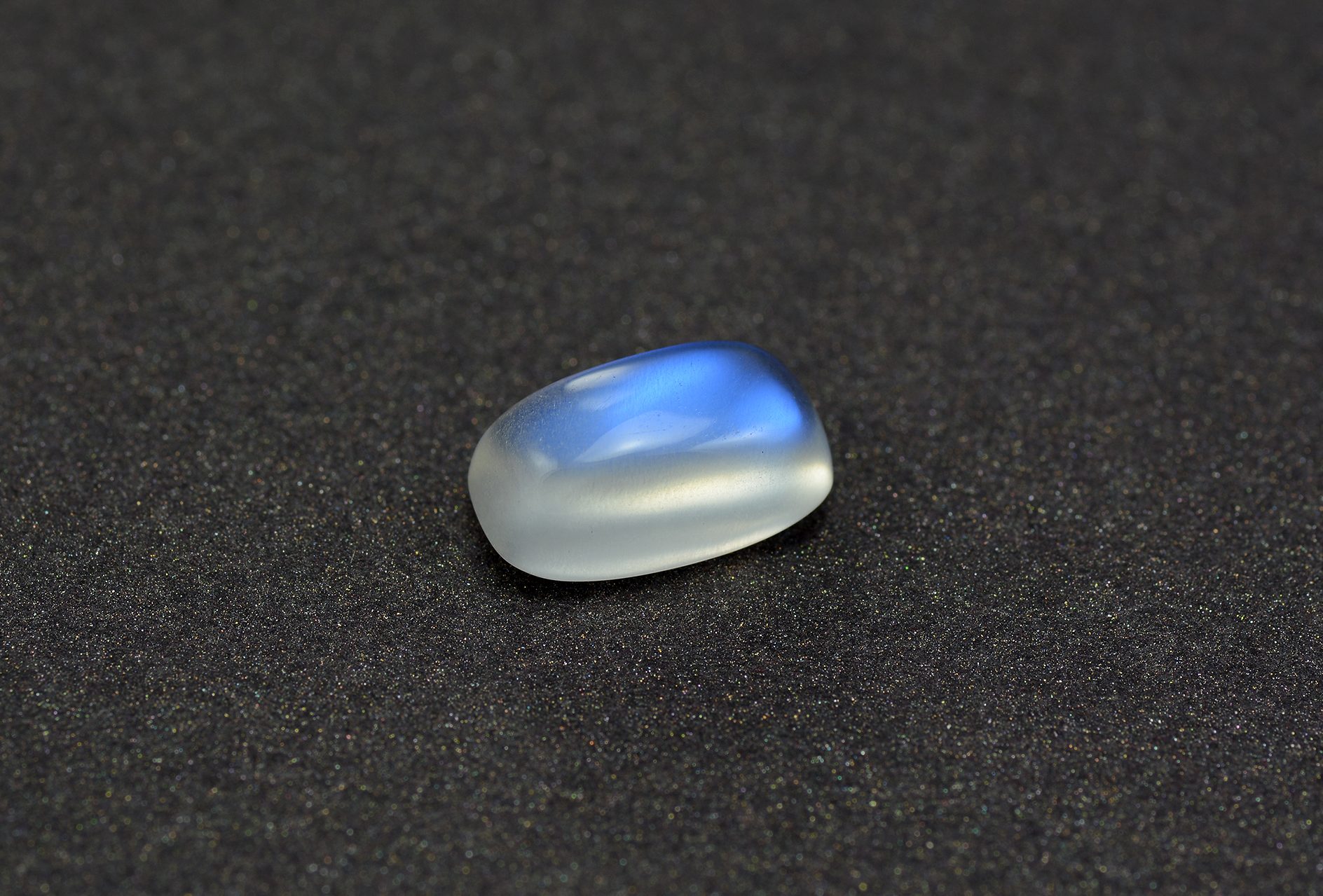
Blue Moonstone takes adularescence to its most vivid expression - a floating, electric blue light rolling across colorless feldspar like a.
- The blue in Blue Moonstone is created by the same optical physics that makes the sky blue - Rayleigh scattering of short-wavelength (blue) light by the stone's internal layered structure.
- The lamellae layers responsible for adularescence are measured in nanometers - hundreds of times thinner than a human hair.
- Sri Lanka's Blue Moonstone is sometimes described as having a 3-dimensional quality - the glow appears to hover inside the stone rather than at its surface.
- The thinner the alternating orthoclase-albite lamellae within the stone, the bluer and more intense the adularescence appears.
- Blue Moonstone value per carat can be 3-10x higher than white moonstone from the same deposit, driven entirely by the adularescence color intensity.
- Jewelry collectors who want the most vivid and sought-after moonstone variety
- June birthday gift givers wanting a visually dramatic birthstone
- Throat and Third Eye chakra practitioners seeking a water-element blue stone with intuitive frequency
- Those wanting electric blue with natural floating movement - unlike any painted or coated gem
- Intuition and psychic development practitioners for whom blue adularescence is the premium working tool
- Budget buyers - fine electric-blue moonstone from Sri Lanka is priced at a premium
- Daily ring wearers without protective settings - Mohs 6-6.5 requires care
- Those wanting solid blue color rather than a floating blue effect on white base
What Is Blue Moonstone?
Blue Moonstone is a specific grade of orthoclase feldspar moonstone distinguished by the strong, vivid blue color of its adularescence - the floating luminous glow that moves across the stone when light strikes it. It rates 6 - 6.5 on the Mohs hardness scale.
The mineral chemistry is identical to other orthoclase moonstones (KAlSi3O8), but the blue color intensity depends on the thickness and regularity of the alternating orthoclase-albite lamellae within the stone.
Thinner, more regularly spaced lamellae scatter predominantly short (blue) wavelengths of visible light, producing a vivid blue glow rather than the white or silver glow of thicker-layered material.
The finest Blue Moonstone comes from Sri Lanka, where the Meetiyagoda area of the Southern Province has yielded exceptional material with electric blue adularescence for over a century.
High-quality Sri Lankan Blue Moonstone is colorless to near-colorless in body color, allowing the blue glow to appear pure and intense against a transparent background. Indian sources produce Blue Moonstone as well, though typically with slightly less vivid adularescence than the best Sri Lankan material.
Blue Moonstone should not be confused with 'rainbow moonstone,' which is actually labradorite - a different feldspar species that shows a blue-white flash (labradorescence rather than adularescence). True Blue Moonstone's glow is softer and more internally dispersed than labradorite's flash, creating a distinctly different visual character.
Crystal system is monoclinic, Mohs hardness 6 to 6.5, with 2 cleavage planes at 90 degrees requiring careful setting and handling.
How Blue Moonstone Compares
| Property | Blue Moonstone | Rainbow Moonstone (Labradorite) | Blue Sapphire |
|---|---|---|---|
| Blue Source | Adularescence (internal scattering) | Labradorescence (flash) | Body color (chromophore) |
| Hardness | 6 - 6.5 | 6 - 6.5 | 9 |
| Price / carat | $$ Mid-range | $ Budget | $$ Mid-range |
| Best For | Premium jewelry, intuition work | Budget moonstone look | Fine jewelry, investment |
Meaning and Symbolism
Blue Moonstone carries all of moonstone's ancient associations with the moon, with feminine wisdom, and with the cycles of time - amplified by the specific frequency of blue light.
Blue is universally associated with depth, the sky, the sea, and in many spiritual traditions with the faculty of clear seeing: the ability to perceive truth beyond appearance. The floating blue glow of Blue Moonstone has made it one of the most visually compelling gems for spiritual practitioners throughout history.
Practitioners believe in Vedic tradition, moonstone's lunar association connects it to the Moon's rulership of the mind, emotions, and the subtle body. The vivid blue variety is associated with the indigo-blue third eye in some Indian healing traditions.
Blue light represents penetrating insight and the capacity to see across the veil between the seen and unseen worlds. Many crystal healers prize Blue Moonstone above other moonstone varieties specifically for this Third Eye amplification.
Contemporary crystal healing describes Blue Moonstone as a stone for those who are developing their intuitive capacities - particularly clairvoyance, prophetic dreaming, and the ability to read energy fields.
The blue adularescence is interpreted as the stone's visualization of what intuition looks and feels like: a light that emerges from within, moves with awareness, and illuminates without forcing.
Historical Timeline
Healing Tradition
Emotional
In crystal healing tradition, Blue Moonstone is said to support the development of emotional intuition - the felt-sense knowing of what is true in a situation before the mind has assembled its analysis.
Practitioners believe it helps those who have learned to distrust their intuitive impressions, often following experiences of emotional betrayal or self-doubt, to re-establish trust in their own perceptive faculties. The blue color adds a calming quality to this reconnection, making the process feel clarifying rather than overwhelming.
It is traditionally associated with emotional truth-telling and the courage to trust one's inner perceptions.
Spiritual
Blue Moonstone is described in crystal healing practice as the premier Third Eye activation stone among moonstone varieties.
Practitioners believe its blue adularescence directly stimulates clairvoyant perception, prophetic dreaming, and the kind of subtle-energy reading that experienced healers and intuitives develop over time.
Many psychic development practitioners use it as a meditation anchor, placing it at the Third Eye during practice or gazing into its blue glow under candlelight to stimulate the visual inner senses. It is traditionally associated with the activation of the higher-mind faculties.
Physical
From a crystal healing perspective, Blue Moonstone shares moonstone's traditional associations with hormonal cycles, fluid regulation, and the body's attunement to natural rhythms. The blue color adds traditional associations with the thyroid, throat, and vocal expression in some healing frameworks.
As with all crystal practices, these are energetic traditions rather than medical claims. Blue Moonstone should not replace qualified medical consultation for any health concern.
Zodiac, Birthstone and Gifts
Blue Moonstone serves Cancer most directly through the Moon rulership - Cancer is the lunar sign, and moonstone is the Moon's gem. The vivid blue adds Third Eye amplification that suits Cancer's remarkable emotional intelligence and intuitive sensitivity.
Pisces resonates equally strongly: the deepest water sign, ruled by Neptune (the planet of mysticism, intuition, and the unseen), Pisces practitioners often find Blue Moonstone to be the single most resonant stone in their collection.
Both signs benefit from the stone's combination of emotional wisdom and psychic sensitivity - qualities both Cancer and Pisces must learn to work with consciously and skillfully.
Care and Cleansing
Blue Moonstone's most aligned cleansing is moonlight - particularly full moon exposure overnight. Place on a windowsill or outdoors during clear full moon nights and retrieve in the morning. This practice is both energetically resonant and physically safe for the stone.
The blue glow often appears more intense after a full moon cleansing session to many practitioners, though this is a subjective observation.
Sound cleansing with a crystal singing bowl or Tibetan bells is effective and non-contact. Brief cool water rinsing is acceptable but avoid salt water and extended soaking. The 2 cleavage planes in orthoclase make it vulnerable to salt infiltration and impact damage.
Smudging with sage or palo santo is safe for loose stones and most settings.
- DO NOT use salt water - can infiltrate cleavage planes and damage internal structure.
- DO NOT use ultrasonic cleaners - vibration risks cleavage-plane fracturing.
- DO store in individual padded compartments - protect from impact and from harder gems that scratch it.
- DO choose bezel or halo settings for rings - protects the stone's vulnerable edges.
- DO NOT expose to rapid temperature changes - thermal shock can cause fractures along cleavage planes.
- NOTE: Blue Moonstone scratches at Mohs 6-6.5; keep away from quartz, topaz, and harder minerals in shared pouches.
Real vs Fake
The most important distinction is between genuine orthoclase Blue Moonstone and labradorite ('rainbow moonstone') or blue-coated glass. True Blue Moonstone's adularescence is internal - the blue glow comes from within the stone's lamellar structure, creating a three-dimensional effect.
Under magnification, genuine moonstone often shows distinctive 'centipede' inclusions - fine curved fractures following the lamellar boundaries.
Blue glass and dyed quartz lack the moving internal glow of genuine moonstone. Turn the stone slowly under a single light source: genuine adularescence moves smoothly and appears to float inside the body of the stone, while surface coatings or glass simply reflect light from the surface without internal depth.
Blue coating on stones can be scratched off; genuine adularescence is intrinsic and permanent.
Refractive index measurement (1.518-1.526 for orthoclase) clearly separates it from labradorite (1.554-1.572) and glass. For high-value Blue Moonstone purchases, a gemological laboratory report confirming orthoclase species and natural origin is recommended.
Blue Moonstone Jewelry & Gifts
Entry-level Blue Moonstone with modest adularescence begins around $20-$50 per carat for smaller calibrated pieces. Mid-grade with visible but not exceptional blue glow runs $50-$200/ct. Premium-grade Sri Lankan Blue Moonstone with vivid electric-blue adularescence in colorless body can reach $300-$600+ per carat from specialist dealers.
Adularescence intensity and color purity are the key quality factors. The ideal Blue Moonstone has an electric, saturated blue glow that is centered and moves dramatically across the entire face of the stone when tilted. Partial or patchy blue, gray-blue rather than pure blue, or pale white-blue are all lesser grades.
Body transparency is secondary - slightly milky is acceptable if the blue is strong. Always request video under single directional light when purchasing online.
Where to Buy Blue Moonstone
Affiliate disclosure: Some links below earn us a small commission at no extra cost to you. See our affiliate disclosure page.
Handmade, raw, and tumbled pieces from independent sellers worldwide.
Shop Blue Moonstone on Etsy →Accessories, tools, and specimen sets with fast Prime delivery.
Shop Blue Moonstone on Amazon →Certified loose gemstones graded and photographed for online buyers.
Shop Blue Moonstone on GemSelect →Pairs Well With



Where Blue Moonstone Is Found


