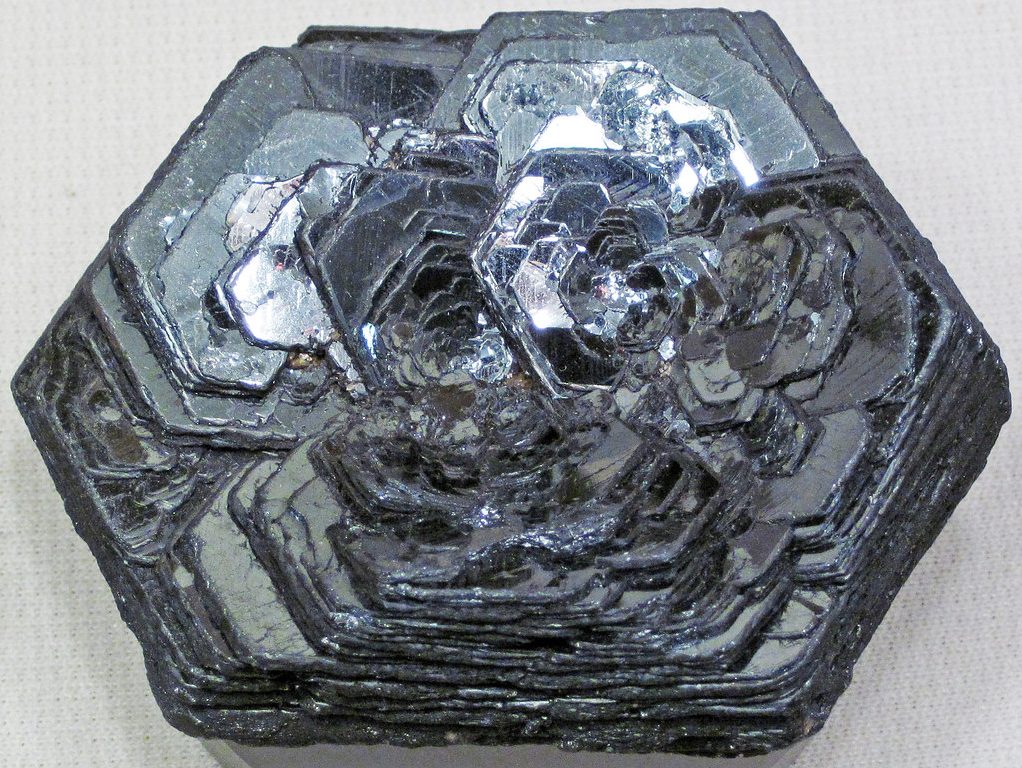
Hematite Rose
Hematite rose forms when tabular iron oxide crystals fan outward like steel-gray petals - one of mineralogy's most striking natural.
- The red streak of hematite was one of humanity's first pigments - archaeological evidence shows hematite ochre use over 300,000 years ago.
- Swiss iron roses from the Binntal Valley formed in Alpine pressure zones during the mountain-building event that created the Alps, roughly 15-30 million years ago.
- Despite looking silver-gray, hematite has a higher refractive index (2.94-3.22) than diamond (2.42) - it's extraordinarily optically dense.
- The planet Mars gets its red color from hematite and other iron oxides coating its surface rocks and dust.
- Hematite is weakly magnetic in its specular and massive forms, but well-formed tabular crystals like the iron rose show minimal magnetic response.
- Mineral collectors seeking dramatic natural sculptural formations
- Practitioners working with strong Mars energy and root chakra grounding
- Display enthusiasts wanting a metallic, architectural desk or shelf piece
- Those drawn to gray and silver tones in their crystal collection
- Buyers who appreciate geological rarity without gemstone pricing
- Those wanting a classic red hematite - iron roses are gray, not red; try red hematite cabochons instead
- Jewelry buyers needing impact-resistant stones - the delicate fan structure chips under pressure
- Beginners who prefer colorful or translucent crystals - hematite rose is monochromatic and opaque
What Is Hematite Rose?
Hematite rose, also called an "iron rose," is a naturally occurring rosette formed when tabular crystals of hematite (Fe₂O₃) grow in a radiating fan pattern resembling a steel-gray flower. It rates 5.5 - 6.5 on the Mohs hardness scale.
The effect is produced when individual hematite plates develop parallel to the basal plane of the trigonal crystal system, then stack and flare outward from a common center. The result is simultaneously geometric and organic - a sculpture that geology produces without tools.
True hematite roses are distinct from ordinary massive hematite. They require very specific hydrothermal conditions in which iron-rich fluids deposit hematite slowly enough for large, well-formed tabular crystals to develop.
The finest examples come from the Swiss Alps, particularly from the canton of Valais and the Binntal Valley, where Alpine fissures provided ideal slow-growth conditions. Brazilian and Canadian localities also produce collector-quality material.
The mineral's chemistry is pure iron oxide - the same compound that gives red soil its color - but the metallic-gray surface of crystallized hematite reflects no red at all in hand specimen.
The red streak test (scratching on unglazed porcelain) is the definitive confirmation: hematite always produces a red-brown streak regardless of how silver it appears externally. Mohs hardness of 5.5 to 6.5 makes it moderately durable but vulnerable to impact along crystal boundaries.
How Hematite Rose Compares
| Property | Hematite Rose | Pyrite Sun | Selenite Rose |
|---|---|---|---|
| Hardness | 5.5 - 6.5 | 6 - 6.5 | 2 |
| Formation | Iron oxide fan | Pyrite disc | Gypsum sand rose |
| Price Range | $ Budget | $ Budget | $ Budget |
| Best For | Collector display | Collector display | Meditation, selenite work |
Meaning and Symbolism
The hematite rose occupies a unique position in mineral symbolism - it combines the martial iron energy of hematite with the organic beauty of a rose form.
Ancient cultures across Mediterranean Europe associated hematite with warrior protection and blood vitality, drawing on its dense weight and the red streak that seemed to bleed when scratched.
The Alpine specimens from Switzerland carry an additional layer of meaning through their geological context: formed in pressure and heat, emerged through the slow opening of mountain fissures over millennia.
In modern crystal practice, the hematite rose is said to represent the capacity to maintain strength without hardness - to be grounded and resilient while remaining open to beauty.
Practitioners believe it bridges two energies that are often treated as opposites: the iron discipline of Mars and the receptive, petal-like form of something flowering. Many find it particularly meaningful as a symbol for those navigating difficult circumstances while choosing to remain emotionally available rather than closing off.
Historical Timeline
Healing Tradition
Emotional
Practitioners believe the hematite rose supports emotional strength without emotional numbing - the specific quality of remaining grounded and stable while still allowing feeling. Many find it useful during periods when circumstances demand resilience, providing a sense that one can hold difficulty without being broken by it.
In crystal healing tradition, it is said to help transform accumulated anger or frustration into directed will, borrowing from hematite's Mars connection.
The rose form adds a dimension of softness to the iron energy, and many practitioners find it more approachable than plain hematite for extended emotional support work.
Spiritual
In spiritual practice, the hematite rose is said to create a strong Earth Star chakra connection - rooting the energetic body deep into Earth's field before any upward work begins. Practitioners believe it protects the aura during intense energetic work by providing a stable anchor that prevents becoming ungrounded or scattered.
The combination of iron's Mars energy and the rose formation is traditionally associated with sacred warrior archetypes - the capacity to act from both strength and heart. Some practitioners use it as an altar centerpiece representing the union of discipline and beauty in spiritual life.
Physical
Crystal healing tradition associates hematite with blood, circulation, and physical vitality - connections drawn from the mineral's red streak and iron content. The rose form is said to carry these properties with added gentleness, making it appropriate for those who find plain hematite's energy too intense.
Practitioners believe the hematite rose supports energetic resilience in the physical body, particularly during recovery from stress or sustained physical effort. As with all crystal work, it is intended as a complementary practice alongside, not a replacement for, qualified medical care.
Zodiac, Birthstone and Gifts
Hematite rose connects most naturally to Aries through its Mars rulership and iron character. Aries practitioners may find the rose formation useful for tempering their direct energy with a quality of beauty and receptivity - holding the strength without losing the softness.
Aquarius has a less obvious but meaningful connection: Aquarians often benefit from strong grounding energy to balance their characteristic tendency toward abstraction and mental flight, and hematite rose's Earth Star connection provides exactly that anchor. Both signs gain from the stone's combination of disciplined structure and organic form.
Care and Cleansing
Hematite rose is best cleansed with sound or moonlight rather than water or salt. The delicate plate boundaries of the fan formation can be damaged by repeated wetting and drying, and salt is corrosive to iron-bearing minerals over time.
A singing bowl, tuning fork at 528Hz, or gentle bell ringing near the specimen for 30-60 seconds is ideal.
Full moon overnight on a windowsill resets the energetic field without any physical contact or moisture risk. Smudging is also effective - pass the specimen briefly through sage or palo santo smoke, allowing the air to carry away any stagnant energy.
Avoid burying hematite rose in soil or rice, as both can penetrate the crystal plate boundaries and are difficult to remove.
- DO NOT strike or drop hematite rose - the tabular crystal plates can separate along boundaries under impact.
- DO NOT soak in water - repeated wetting and drying weakens crystal-to-crystal bonds in the fan formation.
- DO NOT use salt - corrosive to iron-bearing mineral surfaces over time.
- DO store on a padded surface or small stand - flat-base storage prevents rolling and impact damage.
- DO NOT clean with stiff brushes - use a very soft brush or compressed air to remove dust from between crystal plates.
- NOTE: The red streak confirms genuine hematite - scratch lightly on unglazed porcelain tile if provenance is uncertain.
- DO keep away from strong magnets - while hematite rose is only weakly magnetic, strong magnets can attract iron dust from the surface.
Real vs Fake
Genuine hematite rose is identified first and foremost by the red-brown streak test. Despite appearing silver-gray, authentic hematite always produces a red-brown streak on unglazed porcelain. No other common silver mineral matches this combination of metallic gray appearance and red streak.
Pyrite (fool's gold) is yellow in streak; galena streaks lead-gray; magnetite streaks black.
Weight is a powerful second test. Hematite's specific gravity of 4.9 to 5.3 makes it noticeably heavy for its size - significantly denser than glass, resin, or most common stones. A hematite rose that feels light is suspect.
The fan of tabular crystals should show natural growth steps and slight surface irregularities; machine-cut or molded pieces tend toward unnatural uniformity.
Swiss and Brazilian iron roses command premium prices - $50 to several hundred dollars for museum-quality specimens. Exceptionally cheap "iron rose" material from unverified sources may be hematite-coated resin, pyrite pseudomorphs, or misidentified iron formations. Always request locality documentation from reputable mineral dealers.
Hematite Rose Jewelry & Gifts
Hematite rose prices vary significantly with quality and origin. Small specimens (3-5 cm) with well-defined fan plates typically range from $20 to $80. Swiss Valais specimens with complete, symmetrical fans of bright metallic crystals can reach $200-$500 or more at specialty mineral shows.
Brazilian material is generally more affordable and available in larger sizes, often with a slightly less brilliant luster than Swiss examples. Canadian and Moroccan specimens occupy the middle ground in both price and quality.
Look for specimens where the individual plates are cleanly separated and the fan is fully developed without excessive matrix crowding.
Hematite rose requires no treatments and is sold as-found. Color and luster are entirely natural. The only value-enhancing characteristic is specimen completeness - missing or broken plates reduce desirability significantly in collector markets.
Where to Buy Hematite Rose
Affiliate disclosure: Some links below earn us a small commission at no extra cost to you. See our affiliate disclosure page.
Handmade, raw, and tumbled pieces from independent sellers worldwide.
Shop Hematite Rose on Etsy →Accessories, tools, and specimen sets with fast Prime delivery.
Shop Hematite Rose on Amazon →Certified loose gemstones graded and photographed for online buyers.
Shop Hematite Rose on GemSelect →Pairs Well With


Where Hematite Rose Is Found


