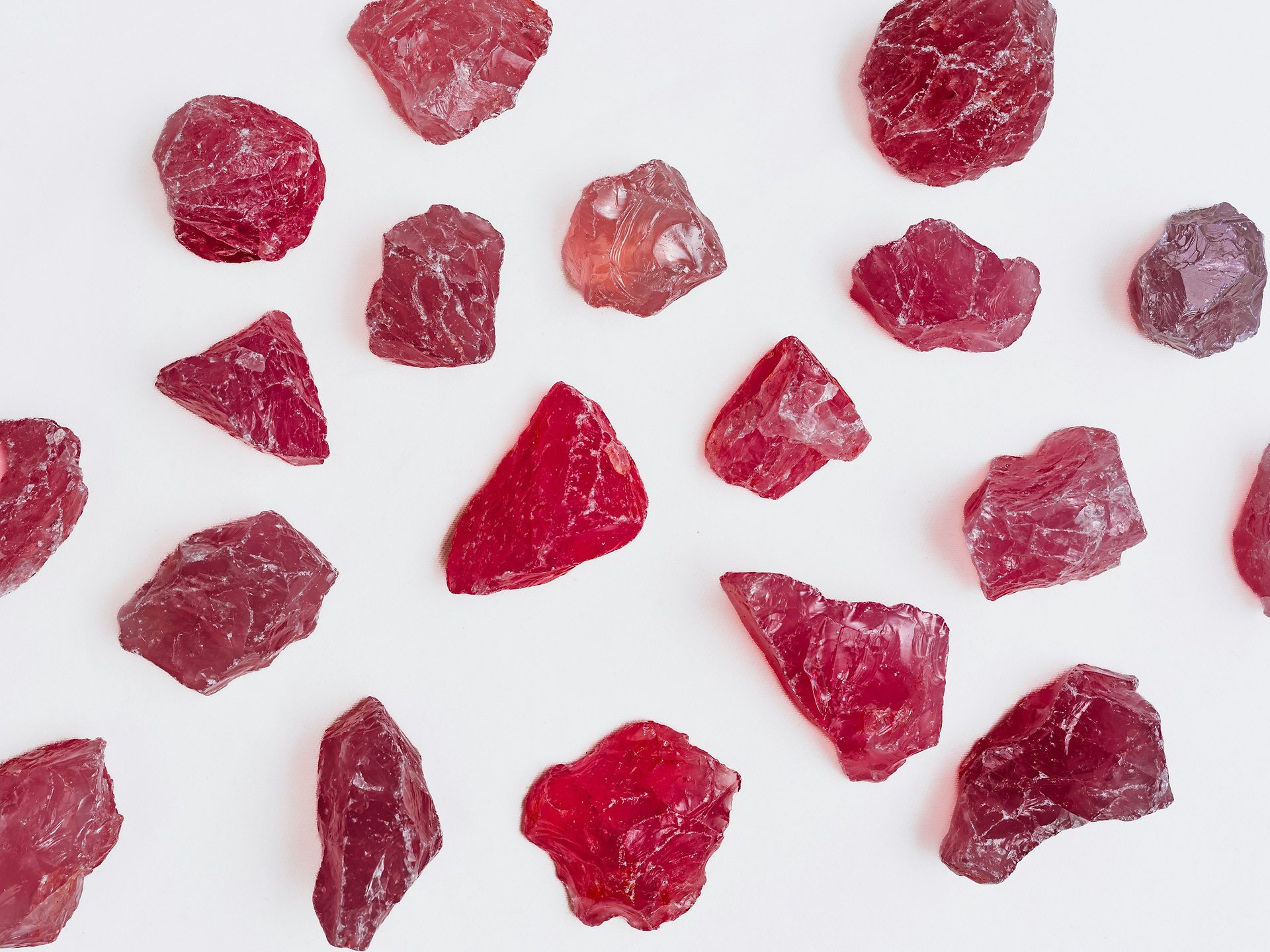
Mozambique Ruby
From the alluvial fields of Montepuez, Mozambique rubies deliver the vivid red chromium fire that only corundum can produce - now.
- The Montepuez deposit in Mozambique is estimated to contain the largest concentration of gem-quality ruby ever discovered - potentially transforming global ruby supply for decades.
- Ruby and sapphire are the same mineral (corundum, Al2O3). The only difference is color: chromium makes corundum red (ruby); iron and titanium make it blue (sapphire). All other corundum colors are sapphire.
- Fine ruby has historically sold for more per carat than diamond at auction. A 15.99-carat Burmese pigeon-blood ruby sold for $1.27 million per carat at major auction houses in 2015 - the world record per-carat price for any gemstone.
- Mozambique is also a significant source of other gems including tourmaline, paraiba tourmaline, and gemstone-quality garnets, making it one of the world's most important emerging gemstone-producing nations.
- Ruby's chromium content not only creates its red color but also causes intense fluorescence under UV light - this red glow in sunlight makes rubies appear to glow from within, the property most prized in fine specimens.
- Ruby buyers seeking fine quality at below-Burmese prices
- July birthstone shoppers wanting genuine corundum ruby
- Ethical buyers who prefer African provenance over Myanmar sources
- Collectors interested in a historically significant new ruby deposit
- Jewelry designers needing fine ruby with excellent hardness for all settings
- Investment buyers seeking maximum appreciation (Burmese pigeon-blood commands higher premiums)
- Budget ruby buyers (consider lab ruby or garnet for accessible red stones)
- Those specifically seeking the warm orangey-red of Burmese material (Mozambique leans more pinkish)
What Is Mozambique Ruby?
Mozambique ruby is corundum (Al2O3) colored by chromium, mined primarily in the Montepuez district of Cabo Delgado Province. Discovered in 2009, the Montepuez deposit is now the among the largest known known ruby deposit and has dramatically expanded global supply of gem-quality red corundum. It rates 9 on the Mohs hardness scale.
Mozambique rubies typically show a vivid red to pinkish-red color with strong fluorescence under UV light - the same fluorescent glow that makes fine Burmese rubies so prized.
Top Mozambique material is challenging to distinguish from Burmese without advanced laboratory testing, and some fine specimens are graded pigeon-blood red by leading gemological labs.
The stone's quality profile differs from Burmese: Mozambique rubies often show a slightly more pinkish-red hue and different inclusion characteristics (rutile silk patterns, growth zoning). They are also typically heavily heat-treated to improve color and clarity, with unheated Mozambique ruby commanding premium prices comparable to fine Burmese.
How Mozambique Ruby Compares
| Property | Mozambique Ruby | Burmese Ruby | Lab Ruby |
|---|---|---|---|
| Hardness | 9 | 9 | 9 |
| Price/ct | $$ Mid-range | $$$ Premium | $ Budget |
| Color | Vivid red-pinkish red | Warm vivid red | Consistent vivid red |
| Best For | Quality at value | Investment, prestige | Fashion jewelry |
Meaning and Symbolism
Ruby has been called the king of gems across Sanskrit, Burmese, and Arab traditions - a stone whose blood-red color was associated with the vital life force, courage under fire, and the protection of the warrior. Practitioners believe these properties are inherent to the chromium-fired crystal structure rather than origin-specific.
Mozambique ruby, like all fine ruby, is said to activate the root chakra - grounding the wearer in physical vitality and the courage to fully inhabit their life - while also opening the heart chakra to passionate, life-affirming love. Practitioners describe it as the most energizing of all red stones.
The ruby is traditionally associated with the sun in Vedic astrology (Jyotish), where it is worn to strengthen solar energy - vitality, authority, and the power of the individual will.
Practitioners believe this solar resonance is fully present in Mozambique specimens, as the chromium coloring agent is identical to that of any other ruby.
Historical Timeline
Healing Tradition
Emotional
Ruby is said to be the most powerfully energizing stone in the gemstone spectrum, with practitioners believing it activates dormant courage, passion, and the will to fully engage with life. It is traditionally associated with overcoming fear, lethargy, and the tendency to hold back from full self-expression.
Mozambique ruby, accessible at more moderate price points than Burmese material, brings this traditionally vibrant energy to a wider audience. Crystal healers often work with ruby when helping clients reconnect with their vitality, passion, and sense of purpose after periods of depression, exhaustion, or disconnection from their authentic desires.
These are experiential accounts, not medical claims.
Spiritual
In Vedic tradition, ruby is the sun stone - the stone of the atman or individual soul's radiance. Practitioners believe wearing ruby strengthens one's solar energy, the capacity to shine with authentic confidence and authority.
Root chakra activation through ruby is said to ground spiritual energy into the physical body, preventing the ungrounded, dissipated feeling some spiritual practitioners experience. Heart chakra resonance of ruby is said to open the wearer to passionate, life-affirming love rather than fearful, contracted love.
Many practitioners work with ruby during courage-building practices, believing the stone amplifies the qualities needed for brave, decisive action.
Physical
Crystal healing traditions associate ruby with the heart, circulatory system, and blood - associations rooted in the stone's red color and its traditional Vedic link to the sun and vitality. None of these associations have medical support and ruby should never replace professional medical care.
Practitioners sometimes work with ruby during practices focused on revitalizing and energizing, placing it near the root chakra or sternum while focusing on breath and the sensation of vitality. It is also said to support temperature regulation in some traditional wellness frameworks. As with all crystal healing, individual experiences vary significantly.
Zodiac, Birthstone and Gifts
Aries, ruled by Mars and fueled by the fire element, finds its quintessential gemstone companion in ruby. Practitioners believe ruby amplifies the Ram's natural courage, initiative, and passion while providing the grounding root chakra energy that channelizes Aries fire into decisive, purposeful action.
Cancer, whose deep emotional sensitivity benefits from heart-centered protection, is said by practitioners to find in ruby a protective, warming energy that shields vulnerable feelings while opening the heart.
Scorpio's transformative, passionate nature resonates with ruby's fire and depth; practitioners believe the pairing supports Scorpio's journey from raw intensity to refined, purposeful power.
Care and Cleansing
Ruby is one of the most durable gemstones and can be cleaned safely with warm soapy water and a soft brush. It is generally safe in ultrasonic cleaners unless heavily included or fracture-filled, in which case gentle hand cleaning is preferred.
Energetic cleansing options include sunlight (ruby is stable in sun and its solar association makes this particularly resonant), running water, and sound cleansing with singing bowls. Leave in morning sunlight for up to an hour for what practitioners describe as a solar recharge.
Salt and moonlight cleansing work well for ruby. Practitioners who use ruby for Vedic astrological purposes often cleanse it with raw cow's milk and honey in traditional preparation rituals before first wearing.
- DO clean ruby regularly with warm soapy water and a soft brush - ruby is one of the most durable gemstones and handles standard cleaning well.
- DO NOT expose heavily included or fracture-filled rubies to ultrasonic cleaners - fracture filling can be damaged by vibration.
- DO ask your jeweler specifically about treatment level before purchasing - heat treatment is nearly universal and acceptable; glass-filling is significantly value-reducing.
- NOTE glass-filled (lead glass) rubies look beautiful but are extremely fragile - they cannot tolerate heat, chemicals, or ultrasonic cleaning without damage.
- DO store ruby separately from other gems when traveling to prevent scratching of softer stones in contact.
Real vs Fake
The ruby market has significant fraud risk. Red garnet, red spinel, red tourmaline, and glass are all sold as ruby deceptively. True ruby is corundum (Al2O3); its refractive index of 1.762-1.770 and specific gravity of 3.99-4.00 definitively identify it with proper testing.
Red garnet is the most common ruby substitute - it looks similar but lacks ruby's chromium fluorescence. A UV lamp reveals this: genuine ruby glows red under longwave UV while most red garnets do not fluoresce or fluoresce much less strongly.
Glass-filled (lead glass) rubies are a major market issue. These are natural ruby corundum that has been heavily drilled, treated with glass to improve apparent clarity, and sold as fine rubies.
The lead glass filling makes them beautiful but extraordinarily fragile. Gemological laboratories and other labs have a code for heavily filled rubies.
Lab ruby is genuine corundum and cannot be distinguished by hardness or refractive index tests alone. Advanced inclusion examination (lab rubies lack the silk and growth zoning of natural) or trace element analysis is required. Lab ruby properly disclosed is legitimate.
For any Mozambique ruby over $500 per carat, obtain gemological laboratories, Gübelin, or SSEF certification confirming: natural origin, no glass filling, country of origin, and treatment disclosure (usually heat treated or unheated).
Mozambique Ruby Jewelry & Gifts
Mozambique ruby retails from $200 per carat for commercial heat-treated material to $8,000+ per carat for fine, unheated, certified vivid red specimens. This represents excellent value compared to equivalent Burmese ruby at 3-5 times higher prices for similar quality.
The most important buying factor is treatment disclosure. Heat-treated Mozambique ruby is the industry standard and entirely acceptable - but glass-filled rubies (heavily fissured stones stabilized with lead glass) are a different product entirely and worth a fraction of natural.
Color grades: vivid red (pigeon-blood red) commands the highest premiums. Pinkish-red is the most common Mozambique profile and excellent quality. Orangey-red and dark red tones represent lower-value material. Avoid brownish, purplish, or very dark stones.
Always buy certified for significant purchases. Request gemological laboratories or equivalent report specifically noting: species (corundum ruby), geographic origin (Mozambique), and treatment level (none, heat, or glass filling). The report number should be verifiable online.
For July birthstone gifts where budget matters, lab ruby at $15-100 per carat delivers genuine ruby with vivid color. For collectors and investors, certified unheated Mozambique ruby is the compelling value proposition in the current market.
Where to Buy Mozambique Ruby
Affiliate disclosure: Some links below earn us a small commission at no extra cost to you. See our affiliate disclosure page.
Handmade, raw, and tumbled pieces from independent sellers worldwide.
Shop Mozambique Ruby on Etsy →Accessories, tools, and specimen sets with fast Prime delivery.
Shop Mozambique Ruby on Amazon →Certified loose gemstones graded and photographed for online buyers.
Shop Mozambique Ruby on GemSelect →Pairs Well With


Where Mozambique Ruby Is Found

