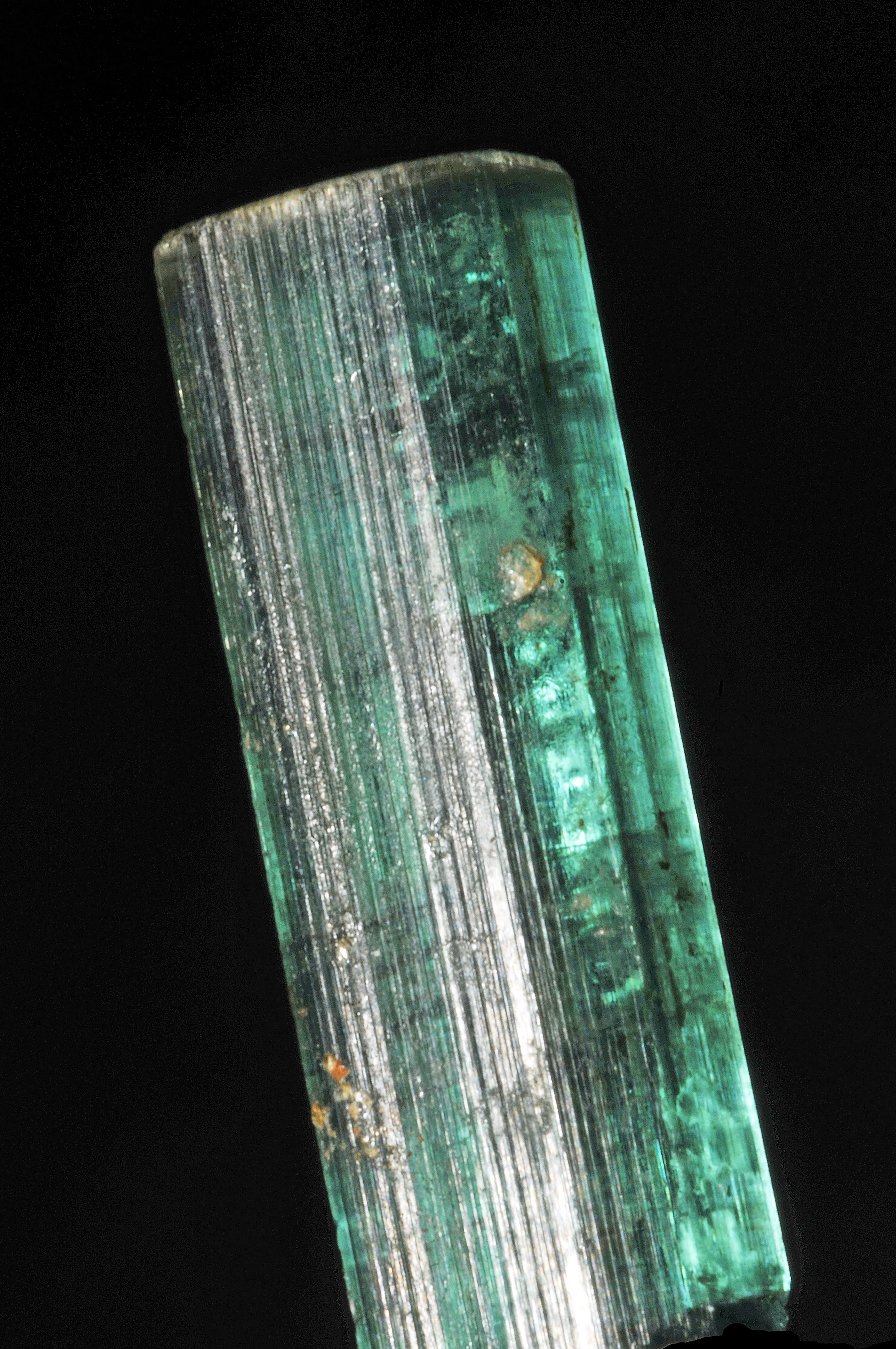
Paraiba Tourmaline
Lit from within by trace copper, Paraiba tourmaline is the rarest neon blue gem ever pulled from a Brazilian.
- Paraiba tourmaline was first mined from weathered pegmatite at only a few meters depth, unusual for a gem of its value.
- At auction, top Brazilian Paraiba has exceeded $60,000 per carat for exceptional electric blue specimens.
- The neon glow is caused by copper ions plus a trace of manganese; no synthetic copper-free tourmaline matches the look.
- Most faceted Paraiba tourmalines weigh less than one carat, which is why larger stones command steep premiums.
- Tourmaline is pyroelectric and piezoelectric; a clean Paraiba crystal will attract dust after gentle warming.
- Collectors who want a modern gem discovery with documented origin
- Fine jewelry buyers drawn to pure neon blue color not seen in sapphire
- Investors looking for one of the rarest colored gems on the market
- Practitioners working with throat chakra expression and heart-centered truth
- Shoppers willing to pay a premium for certified copper-bearing material
- Budget-conscious buyers under $1,000 per carat (try blue apatite or blue topaz)
- Those who want a durable daily-wear ring stone at scale (try aquamarine or sapphire)
- Shoppers unfamiliar with origin-based pricing (start with common tourmaline varieties)
What Is Paraiba Tourmaline?
Paraiba tourmaline is a copper-bearing variety of elbaite tourmaline whose color is produced primarily by trace amounts of copper and manganese. It was first discovered in 1989 in the Brazilian state of Paraiba by miner Heitor Dimas Barbosa. It rates 7 - 7.5 on the Mohs hardness scale.
After years of prospecting in decomposed pegmatite near the village of Sao Jose da Batalha.
Its signature color is a vivid neon blue to blue-green, often described as electric or glowing, that no other known gem displays in the same saturation.
Chemically, Paraiba tourmaline belongs to the elbaite species within the tourmaline supergroup. The IMA recognizes elbaite as the lithium-rich tourmaline end member, and Paraiba simply denotes the copper-bearing color variety.
Similar material has since been found in the Brazilian states of Rio Grande do Norte, as well as in Mozambique (Mavuco region) and Nigeria (Edoukou). A 2006 industry agreement allowed the trade name Paraiba tourmaline to extend to copper-bearing elbaite regardless of geographic origin, provided it contains measurable copper.
Hardness ranges from approximately 7 to 7.5 on the Mohs scale, making Paraiba suitable for most jewelry with reasonable care. Most faceted Paraiba tourmalines weigh under one carat, since larger rough is exceptionally rare.
Heat treatment is standard and typically lightens the slightly violet or reddish component of the rough to reveal the pure neon blue most buyers expect.
How Paraiba Tourmaline Compares
| Property | Paraiba Tourmaline | Aquamarine | Blue Zircon |
|---|---|---|---|
| Hardness | 7 - 7.5 | 7.5 - 8 | 6 - 7.5 |
| Price / carat | $$$$ Luxury | $$ Mid-range | $$ Mid-range |
| Rarity | Extremely rare | Common | Moderate |
| Best For | Collector, investment | Daily wear | Budget statement stones |
Meaning and Symbolism
Because Paraiba tourmaline was only identified as a distinct variety in 1989, its cultural meaning is modern rather than ancient. The stone entered crystal tradition largely through the work of contemporary metaphysical writers who adopted it soon after its discovery, and its reputation grew alongside its rarity.
Many practitioners now describe Paraiba as a stone of clear communication, heart-led truth, and what they frame as the courage to say what one actually feels.
Tourmaline itself has a long history across the Indian Ocean trade routes, where Sri Lankan merchants called colored tourmalines turmali, a Sinhalese word for mixed-colored gems.
Dutch traders introduced tourmaline to Europe in the early 1700s, and its property of pyroelectricity (generating a charge when heated) was documented by scientists in the same century. Paraiba inherits this lineage while standing apart as a specifically late 20th century discovery.
In contemporary crystal practice, Paraiba tourmaline is traditionally associated with the heart and throat chakras together. Practitioners believe its neon blue energy supports speaking from love rather than fear, which is why it appears in guidance for writers, teachers, and performers.
Many find Paraiba useful during transitional moments when old language stops fitting, since its reputation is for describing new territory rather than defending old ground.
Historical Timeline
Healing Tradition
Emotional
Practitioners believe Paraiba tourmaline is a stone of emotional truth and clear expression. In crystal healing tradition, it is said to help a wearer name feelings that have gone unspoken, especially in close relationships where old scripts block honest conversation.
Many find the stone useful during journaling, therapy preparation, or the quiet moments before a difficult conversation. Practitioners often describe Paraiba as pairing with rose quartz when the work involves softening toward oneself, or with smoky quartz when old pain needs to be released before new words can arrive.
Because the stone is associated with the throat and heart together, practitioners traditionally use it when kindness and candor need to move at the same time.
Paraiba is not considered a sedative stone; people drawn to sparkle and movement often find it energizing, so many save it for daytime wear rather than sleep.
Spiritual
In crystal healing tradition, Paraiba tourmaline is said to bridge the heart and throat chakras, aligning what one feels with what one says. Practitioners believe this quality makes Paraiba useful for teachers, writers, healers, and anyone whose work involves translating inner experience into language.
Many find the stone a gentle ally in meditations on authenticity, vocation, and the shape of one's voice. Because Paraiba is a modern discovery, it does not carry an ancient planetary assignment; contemporary practitioners often associate it with Neptune for its oceanic color or with Mercury for its connection to communication.
Carrying a small Paraiba during public speaking or creative work is a common ritual, and some practitioners place it on a written intention for an extended meditation before a significant conversation.
Physical
Practitioners believe Paraiba tourmaline supports what they describe as the throat and upper chest energetically, and it has long been used in modern traditions that associate copper-bearing stones with circulation and respiratory ease.
Folklore around tourmaline in general ties the species to immune vitality and nervous-system calm, though these associations are traditional rather than clinical. Many find wearing a Paraiba pendant near the collarbone or sternum comforting during seasonal shifts, long speaking days, or periods of vocal fatigue.
Paraiba tourmaline is not a substitute for medical care, and practitioners frame its role as supportive rather than curative. For readers managing thyroid concerns or chronic vocal strain, crystal healing tradition suggests gentle, intermittent use and continued attention to qualified medical guidance.
Zodiac, Birthstone and Gifts
Paraiba tourmaline is a modern accent birthstone for October, where it sits alongside opal and traditional pink tourmaline. Astrologers often suggest Paraiba for Libras who value balanced, diplomatic communication, since the stone is associated with the throat chakra and gentle honesty.
Scorpios drawn to transformative emotional work sometimes adopt Paraiba for its reputation as a stone of truth-telling that does not sacrifice warmth. Because the gem was only discovered at the end of the twentieth century.
It has no Vedic assignment and is used in contemporary Western astrology on the basis of its color. Element (water). Communicative symbolism rather than ancient texts.
Care and Cleansing
Paraiba tourmaline cleanses easily with gentle methods. Lukewarm soapy water and a soft brush handle skin oils and cosmetics well, and brief running water is safe for unset stones.
Avoid ultrasonic and steam cleaners, which can damage included Paraibas, weaken adhesives in older settings, or compromise any surface-reaching fissures that have been stabilized during cutting.
Moonlight is traditionally recommended for Paraiba, and short morning sun exposure is considered safe since the stone is color-stable. Smoke cleansing with palo santo or sage is common, as is sound cleansing with a singing bowl.
Dry salt placement is acceptable, but saltwater soaks should be avoided because of the stone's value and the risk of setting corrosion. Many practitioners recharge Paraiba by resting it on a clear quartz cluster or a selenite slab overnight between uses.
- DO rinse Paraiba in lukewarm soapy water and dry with a soft cloth after wear.
- DO NOT use ultrasonic or steam cleaners on Paraiba, especially on stones with visible inclusions.
- DO store Paraiba in a soft pouch separate from harder stones like sapphire and topaz.
- DO NOT expose Paraiba to sudden temperature changes, which can stress any internal tension.
- DO remove Paraiba rings before housework, gardening, or sports to protect delicate prongs.
- DO ask for disclosure of heat treatment and copper-bearing certification at the point of sale.
- Note: high-value Paraiba over one carat should carry a reputable lab report documenting copper content and origin.
Real vs Fake
Genuine Paraiba tourmaline displays a vivid neon blue to blue-green color that seems to glow independently of the light source. Imitations and substitutes commonly include blue apatite, blue topaz, swiss blue topaz, blue zircon, and copper-free tourmaline that has been heat-treated to a similar hue.
Apatite is softer (Mohs 5) and shows different refractive behavior under a gemological spectroscope, while topaz lacks the signature glow and tends toward a cooler, less saturated blue. The definitive test is laboratory analysis of copper and manganese content.
The Laboratory Manual Harmonisation Committee requires measurable copper for a stone to carry the Paraiba trade name, and reputable labs such as an independent gemological lab, a reputable lab, a reputable lab, and a reputable lab issue reports confirming both treatment and copper levels.
For any stone priced above approximately $2,000 per carat, a recent lab report is considered essential by most buyers and collectors.
Practical at-home clues include color under different light sources (Paraiba often shows a slightly brighter blue under fluorescent than under incandescent light) and the characteristic inclusions seen under 10x magnification, such as fine tubes, growth lines, or hollow channels typical of elbaite tourmaline.
Be cautious of stones marketed as Paraiba at prices similar to common tourmaline; without laboratory confirmation, such stones are likely copper-free blue elbaite or another species entirely. Synthetic copper-bearing tourmaline has been produced but is rare in the market and detectable by trained gemologists.
Paraiba Tourmaline Jewelry & Gifts
Paraiba tourmaline pricing is driven first by origin and then by color saturation, clarity, and size. Brazilian Paraiba from the original Sao Jose da Batalha mine commands the highest prices, with top neon blue stones above one carat trading from $10,000 to well over $30,000 per carat.
Mozambique copper-bearing tourmaline is generally available at lower prices, with clean neon stones running approximately $2,000 to $8,000 per carat depending on hue. Nigerian material tends to show more greenish or grayish tone and trades at a further discount.
Heat treatment is standard and disclosed; it typically removes a slightly violet or reddish component to reveal the prized neon blue. For any stone above about one carat, ask for a reputable laboratory report confirming copper content and, when possible, origin. Certified Brazilian origin carries a substantial premium in the collector market.
Trusted dealers will disclose treatment, copper readings, and any fracture filling or clarity enhancement at the point of sale.
Where to Buy Paraiba Tourmaline
Affiliate disclosure: Some links below earn us a small commission at no extra cost to you. See our affiliate disclosure page.
Handmade, raw, and tumbled pieces from independent sellers worldwide.
Shop Paraiba Tourmaline on Etsy →Accessories, tools, and specimen sets with fast Prime delivery.
Shop Paraiba Tourmaline on Amazon →Certified loose gemstones graded and photographed for online buyers.
Shop Paraiba Tourmaline on GemSelect →Pairs Well With




Where Paraiba Tourmaline Is Found


