
Pigeon Blood Ruby
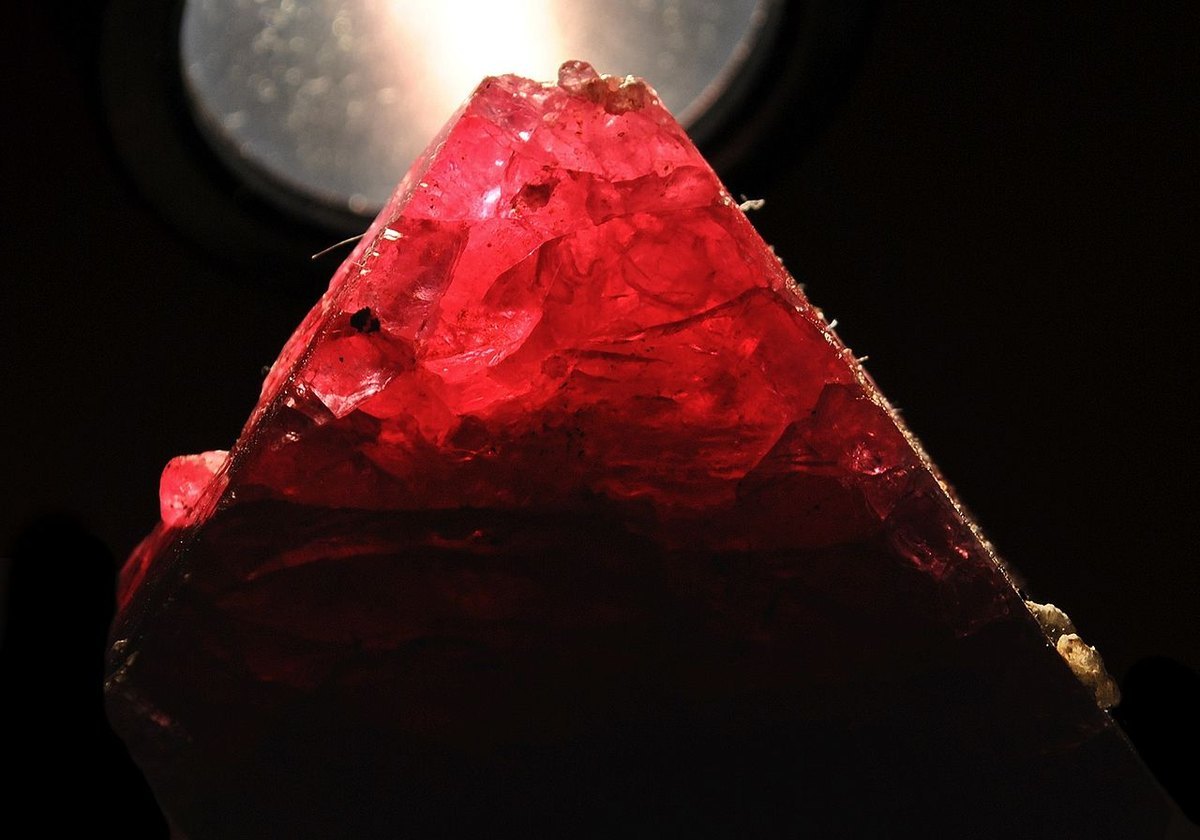
Pigeon blood ruby achieves a pure, slightly blue-tinged red that glows from within - a color so specific it has its own name and its own.
- The Sunrise Ruby, an 25.59-carat unheated Mogok pigeon blood ruby, sold at major auction houses in 2015 for $32.4 million - approximately $1.27 million per carat.
- Pigeon blood rubies fluoresce under UV light because chromium emits red light when excited by UV wavelengths - the same phenomenon that makes rubies appear to glow in outdoor daylight.
- True pigeon blood color is defined by gemological laboratories, AGL, and Gübelin using specific colorimetric standards - the designation requires meeting both hue and saturation thresholds, not just any vivid Burmese red.
- Mogok has been producing rubies continuously for at least 1,500 years and possibly much longer; local miners estimate many more centuries of known extraction.
- The term 'pigeon blood' is believed to derive from comparing the ruby's color to a specific anatomical observation about pigeons, though the exact traditional Burmese reference has multiple documented interpretations.
- Investment-grade gem collectors seeking the world's most coveted red stone
- Fine jewelry clients wanting an heirloom piece with maximum prestige and historical significance
- July birthday recipients for whom only the finest expression of the birthstone will do
- Those drawn to the deepest fire energy in metaphysical practice and willing to acquire the most powerful red
- High-net-worth buyers seeking documented Burmese-origin stones as a store of value
- Budget or mid-range buyers - fine pigeon blood ruby is among the most expensive materials per carat on Earth
- Anyone unwilling to navigate complex geopolitical provenance ethics around Myanmar-sourced gems
- Those wanting casual wear jewelry - the investment value creates security considerations incompatible with daily exposure
What Is Pigeon Blood Ruby?
Pigeon blood ruby is the trade designation for the finest quality rubies - corundum (Al2O3) colored by chromium - from the Mogok Valley in Myanmar (formerly Burma), displaying a pure, intense red with a slight blue undertone and exceptional fluorescence. It rates 9 on the Mohs hardness scale.
The color name comes from a traditional Burmese comparison: the specific red of a freshly killed pigeon's eye, which carries a particular purity and liveliness that distinguishes it from rubies that are too dark, too pink, too orange, or too brown.
The color phenomenon that makes pigeon blood ruby distinctive is the interaction of chromium coloration with natural UV fluorescence. Chromium absorbs yellow-green light and emits both transmitted red and fluorescent red simultaneously, creating a glow that appears to come from within the stone rather than merely reflecting red light from outside.
This internal fire is most pronounced under natural daylight, particularly in outdoor conditions with some UV content, and is the quality most prized by collectors and connoisseurs.
**Mogok's geological conditions** - marble-hosted corundum in metamorphic rocks with high chromium and low iron content - produce rubies with exceptionally high chromium concentrations relative to iron, which would shift color toward darker, purpler tones.
The low iron means the fluorescence is not quenched, and the chromium concentration is high enough for vivid color without opacity. These conditions are rare globally, making true pigeon blood quality from Mogok irreplaceable despite active searching for comparable material worldwide.
How Pigeon Blood Ruby Compares
| Property | Pigeon Blood Ruby | Thai/African Ruby | Red Spinel |
|---|---|---|---|
| Price / carat | $$$$ Luxury | $$$ Premium | $$ Mid-range |
| Color | Pure red, fluorescent glow | Darker, less fluorescent | Pure red, lower price |
| Hardness | 9 | 9 | 8 |
| Best For | Investment, ultimate heirloom | Fine jewelry | Elegant alternative |
Meaning and Symbolism
Ruby has been the 'king of gems' across virtually every culture that encountered it. Ancient Sanskrit texts called it *ratnaraj* - king of precious stones. Burmese warriors inserted rubies under their skin before battle believing they conferred invulnerability. Medieval European royalty associated ruby with blood, vitality, and the divine right of authority.
The Romans called it *carbunculus* (little coal of fire) for its incandescent quality. In all of these traditions, the deepest, purest red was the most prized.
Pigeon blood ruby represents the apex of this 4,000-year tradition of associating the finest red stone with supreme power, protection, and vitality. Mogok has been mining rubies since at least the 6th century CE.
The Mogok 'Stone Tract' has been documented as a source of exceptional rubies in Buddhist chronicles, Burmese royal records, and European merchant accounts across centuries.
**In crystal healing tradition**, ruby is associated with the root and heart chakras - grounding vitality and courageous love simultaneously. Pigeon blood quality, with its internal fire and maximum chromium concentration, carries these associations at the highest intensity practitioners work with.
It is traditionally a stone of life force, courage, passion, and the will to fully inhabit one's existence.
Historical Timeline
Healing Tradition
Emotional
Practitioners associate ruby with the deepest form of life-force vitality - the courage to be fully present, to love without reservation, and to fight for what genuinely matters. Pigeon blood quality, with its exceptional chromium-driven fire, is said to carry these qualities at maximum intensity.
Many find it supportive during periods of profound loss or transition where the fundamental will to live and engage needs to be renewed at the cellular level. Crystal healing tradition describes its energy as the most powerful expression of heart and root chakra combined - passionate, grounded, and completely alive.
Spiritual
In spiritual practice, ruby is associated with the divine masculine principle in certain traditions - not gendered in the social sense but referring to the principle of active engagement, directed will, and courageous presence.
Pigeon blood ruby's extraordinary fire is said to activate the spiritual warrior archetype - the capacity to act from deep values even when the stakes are high and the outcome uncertain.
Some traditions link it to the solar and martial energies of the Sun and Mars simultaneously, creating a concentrated vitality that practitioners use to overcome inertia and restore purposeful direction.
Physical
Crystal healing texts associate ruby with the circulatory system, the blood, and the heart's physical functioning through the root and heart chakra connection. Some traditions link it to adrenal energy, physical courage, and the body's fight-or-flight vitality systems.
Ruby is sometimes used in body layouts directly over the heart or at the root chakra for practices focused on restoring physical vitality after serious illness or prolonged depletion. These associations are traditional and metaphysical - ruby is not a medical treatment and should not substitute for qualified healthcare.
Zodiac, Birthstone and Gifts
Ruby is the official July birthstone, connecting it primarily to Cancer. The sign's ruling Moon and its deep emotional nature finds a complementary energy in ruby's passionate fire - the combination of deep feeling with the courage to act from the heart.
Pigeon blood ruby's extraordinary internal glow resonates with Cancer's quality of intense inner life that is not always visible on the surface.
Leo's solar radiance and natural vitality align with ruby's Sun-Mars associations, making this pairing intensely energizing for the sign's creative and leadership qualities. Sagittarius connects through the philosophical warrior tradition - the archer's combination of vision and bold, purposeful action.
All three signs benefit from ruby's traditional association with courageous engagement with life at its fullest intensity.
Care and Cleansing
Pigeon blood ruby's corundum hardness of 9 makes it tolerant of all standard cleansing approaches. Brief cleaning with mild soap and a soft brush under warm water is safe for the stone. Check metal settings with your jeweler before any wet cleaning. Dry completely after water contact.
For spiritual cleansing, **sunlight** is the most symbolically appropriate choice for ruby's solar and Mars associations - placing a pigeon blood ruby in bright morning sunlight for a few hours cleanses and energizes. Sound cleansing with crystal singing bowls resonates well with corundum's mineral hardness.
Selenite plates provide maintenance energy cleansing for displayed or stored specimens.
- DO NOT use ultrasonic cleaners without gemological confirmation that the stone is fracture-free - fractures present in many rubies can propagate under vibration.
- DO clean with mild soap, warm water, and a soft brush; rinse and dry completely.
- DO NOT expose to steam cleaning without confirming the stone has not been fracture-filled with resin - heat dissolves common fracture fillers.
- DO store individually in a padded compartment in a secure location appropriate to the stone's value.
- NOTE: Any pigeon blood ruby sold without gemological laboratories, AGL, or Gübelin origin and treatment documentation is impossible to authenticate - never purchase significant stones without certified reports.
- DO insure at current replacement value and reappraise every 3 to 5 years as fine ruby values change.
- NOTE: Fracture filling with glass or resin is common in commercial ruby - fine pigeon blood quality should be confirmed unheated and untreated.
Real vs Fake
Authenticating pigeon blood ruby requires laboratory analysis - no visual or tactile test reliably identifies Kashmir-caliber Mogok origin or distinguishes the finest pigeon blood color from very good Burmese ruby.
gemological laboratories, AGL, and Gübelin laboratories assess chromium concentration, inclusion characteristics specific to Mogok marble-hosted deposits, UV fluorescence behavior, and colorimetric measurements to confirm both origin and the pigeon blood color designation.
The most common misrepresentation is selling treated or non-Burmese ruby at pigeon blood prices. Heat treatment is extremely common in the ruby trade - over 95% of commercial rubies are heated. Fracture filling with glass or resin is also widespread.
An unheated Mogok ruby with pigeon blood color grade and no filling treatment is the correct definition of investment-grade pigeon blood quality; any deviation from all three criteria requires substantial price adjustment.
**Glass-filled rubies** are a specific fraud category: stones with significant fractures filled with lead glass to improve apparent clarity, sometimes misrepresented as fine quality. These are detectable under magnification by the 'flash effect' - a blue-to-green flash from the glass-filled fractures under oblique light, distinctly different from the stone's body color.
Any laboratory report will identify filling treatment. Purchase only certified stones from established dealers.
Pigeon Blood Ruby Jewelry & Gifts
Pigeon blood ruby purchasing is entirely a documentation and laboratory exercise. The minimum requirements for any significant purchase are: gemological laboratories, AGL, or Gübelin report confirming Burmese (Mogok) origin.
Confirmation of 'no indication of heating' for investment quality; absence of fracture filling or other clarity treatments; and the pigeon blood color designation where applicable. Without all four confirmations, pricing should be adjusted downward significantly.
Value factors: origin (Mogok commands premium over all other sources), treatment status (unheated multiply premium above heated), color grade (pigeon blood designation from a major lab adds 50% to 200% over non-designated equivalents), size (exponential per-carat value increase above 3 carats).
Clarity (minor inclusions are acceptable at this rarity level, but significant fractures or treatment reduce value substantially).
**Purchase venues**: major auction houses, major auction houses, Bonhams, and Phillips auction houses for documented fine stones. Established certified dealers with verifiable track records for rare colored stones. Never purchase from unofficial market sources, online marketplaces without full certification, or dealers who cannot provide complete provenance.
Fine ruby prices range from $30,000 per carat for fine quality to over $1 million per carat for exceptional unheated Mogok pigeon blood material.
Where to Buy Pigeon Blood Ruby
Affiliate disclosure: Some links below earn us a small commission at no extra cost to you. See our affiliate disclosure page.
Handmade, raw, and tumbled pieces from independent sellers worldwide.
Shop Pigeon Blood Ruby on Etsy →Accessories, tools, and specimen sets with fast Prime delivery.
Shop Pigeon Blood Ruby on Amazon →Certified loose gemstones graded and photographed for online buyers.
Shop Pigeon Blood Ruby on GemSelect →Pairs Well With



Where Pigeon Blood Ruby Is Found
