Precious Topaz
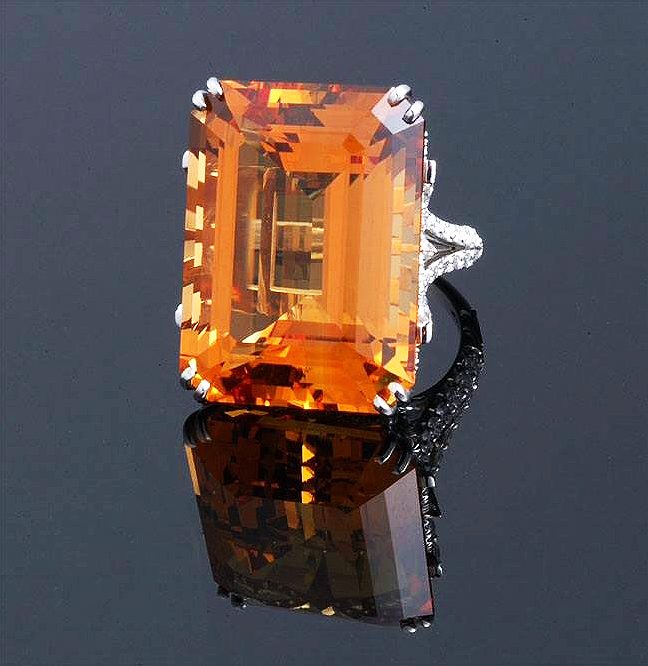
The warm amber-to-orange imperial topaz from Minas Gerais - the true precious topaz of Brazilian tradition, rarer and more valuable than any blue or white variety
- The Portuguese name for precious topaz from Ouro Preto was ‘topaz of Brazil,’ and it was more valuable than diamonds in some 18th-century European markets.
- Imperial topaz can display a pleochroism visible to the eye: turning the stone shows different color intensities from different angles.
- Fine precious topaz can fluoresce orange under longwave UV light, a useful identification tool.
What Is Precious Topaz?
Precious topaz is a nesosilicate mineral with the formula Al₂SiO₄(F,OH)₂, belonging to the topaz family. It crystallizes in the orthorhombic system and rates 8 on the Mohs hardness scale, making it ideal for fine jewelry and heirloom pieces.
Golden yellow, orange-yellow, and sherry brown hues characterize precious topaz, colors created by trace chromium or natural lattice defects. Its vitreous luster and transparent clarity showcase brilliant light performance. The refractive index ranges from 1.609 to 1.643 with specific gravity of 3.49 to 3.57.
Precious topaz forms in granite pegmatites and hydrothermal veins under specific geological conditions. Brazil's Ouro Preto region in Minas Gerais remains the premier source, though the Ural Mountains, Pakistan, and Mexico also yield fine specimens for collectors and jewelers worldwide.
Practitioners believe precious topaz radiates warmth and confidence, making it cherished by those seeking emotional renewal. It is said to inspire optimism and generosity, transforming self-doubt into inner strength. Many turn to this golden stone during challenging transitions or periods of low energy.
Meaning and Symbolism
The term 'precious topaz' or 'imperial topaz' refers to topaz in warm golden-orange to sherry tones, historically the most prized colors in the European gem trade, with topaz mineralogy documented at Britannica’s mineral encyclopedia. The finest imperial topaz comes from Brazil's Ouro Preto region, where it was discovered in the eighteenth century and quickly entered royal collections.
The name 'imperial topaz' honors the Russian Imperial family, who controlled much of the trade from the Ural Mountains in the eighteenth and nineteenth centuries. Uralian topaz in pink-orange and sherry tones supplied St. Petersburg court jewelers, though Brazilian material eventually surpassed Uralian production in both volume and international renown.
Topaz has a long presence in lapidary lore, associated with the sun and clarity of mind in Western and Indian gem traditions. In Hindu gem astrology, yellow topaz is associated with Jupiter and traditionally worn to attract wisdom and good fortune, an association influencing modern metaphysical writings on precious topaz.
Historical Timeline
Healing Tradition
Emotional
Practitioners believe precious topaz brings warmth, optimism, and confidence to those who feel emotionally depleted or lacking in self-worth. It is said to radiate the abundant, generous energy of its golden color, encouraging practitioners to recognize their own value and approach life with the sunny, expansive generosity that comes from genuine inner security.
Spiritual
Traditionally associated with the solar plexus and crown chakras in crystal healing practice, precious topaz is said to align personal will with divine intention. Crystal healing tradition holds that it supports the manifestation of abundance and the confident pursuit of authentic purpose, connecting the warmth of individual aspiration to a broader spiritual vision of creative fulfillment.
Physical
Some practitioners believe precious topaz supports the digestive system and metabolic vitality, associations drawn from its golden color and solar plexus chakra attribution in crystal lore. These claims are not medically verified and should not replace professional care. It is used in wellness settings as a motivating companion during nutritional and lifestyle practices aimed at restoring physical energy and vitality.
Care and Cleansing
Cleanse under lukewarm running water and dry immediately. Avoid prolonged sunlight exposure to protect color stability in treated or pale specimens. Sound bowls and selenite charging are popular gentle alternatives.
- Avoid ultrasonic and steam cleaners; cleavage planes can be exploited by vibration and heat.
- Do not expose to sudden temperature extremes.
- Store wrapped or in a separate compartment to prevent scratching softer gems and being scratched by diamonds or corundum.
- Remove before contact sports or activities with risk of direct impact.
Where to Buy Precious Topaz
Affiliate disclosure: Some links below earn us a small commission at no extra cost to you. See our affiliate disclosure page.
Handmade, raw, and tumbled pieces from independent sellers worldwide.
Shop Precious Topaz on Etsy →Accessories, tools, and specimen sets with fast Prime delivery.
Shop Precious Topaz on Amazon →Certified loose gemstones graded and photographed for online buyers.
Shop Precious Topaz on GemSelect →Pairs Well With