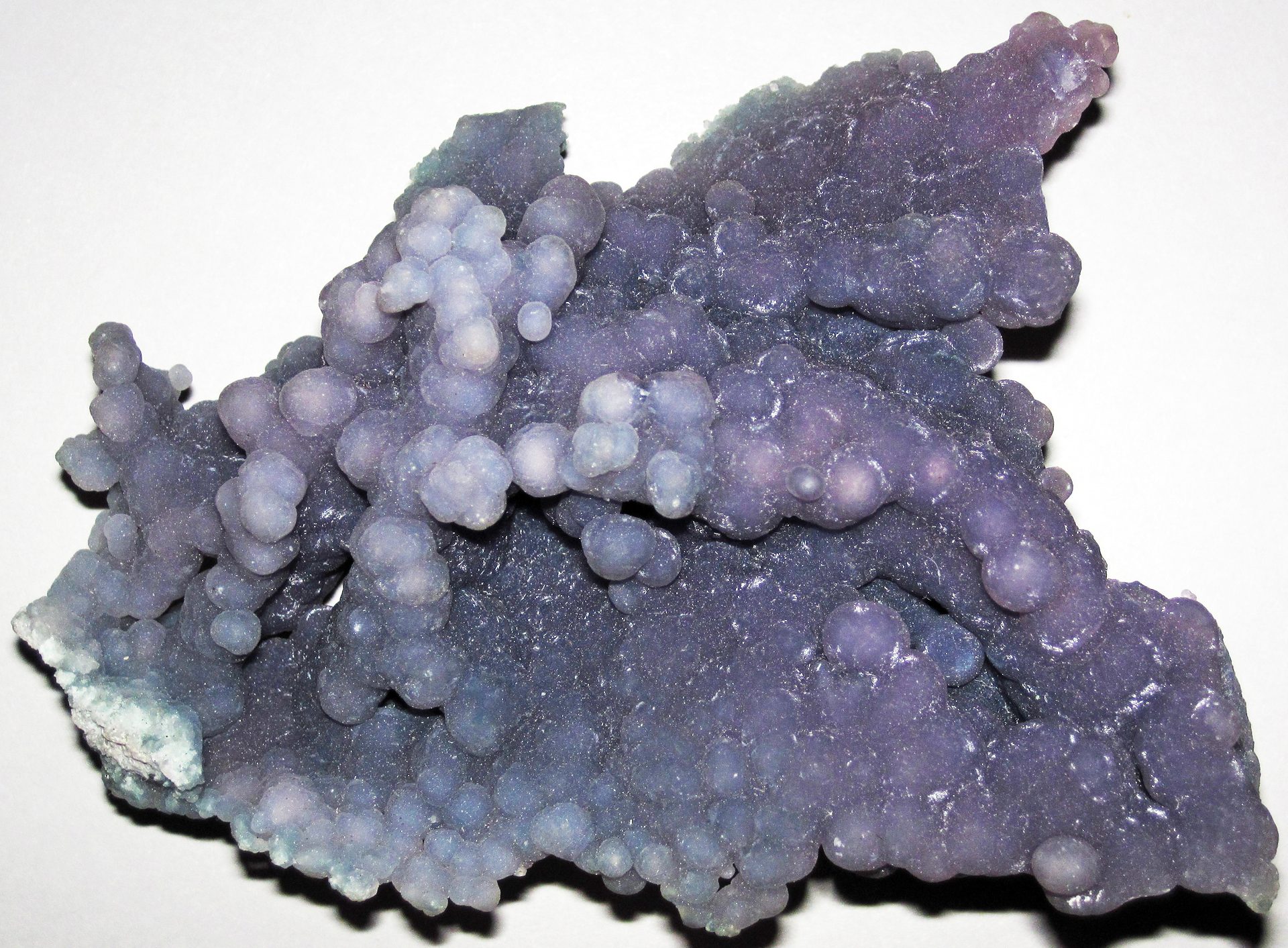
Purple Chalcedony
Violet mystery in waxy silk - purple chalcedony for spiritual intuition, calm, and dreaming deeply
- Indonesian purple chalcedony forms in botryoidal clusters resembling bunches of grapes - the result of silica precipitating in rounded nodular formations on volcanic rock surfaces.
- Some purple chalcedony from Turkey is so translucent that it is cut into cabochons for fine jewelry, where the waxy luster and internal glow create a beautiful alternative to more expensive purple stones.
- The distinction between purple chalcedony and purple agate is purely about banding: if the material has visible color bands or layers, it is agate; if solid-colored throughout, it is chalcedony.
- Purple chalcedony from Oregon's Prineville area is found in geodes with white agate lining - the inner purple chalcedony layer creates a stunning contrast against the white outer ring.
- Manganese is responsible for some purple chalcedony's color - the same element that gives rhodochrosite its pink tones and contributes to turquoise's blue-green hues.
- those drawn to spiritual development and intuition
- practitioners of dreamwork and meditation
- those seeking calm amid spiritual seeking
- collectors of purple and violet crystals
- anyone working with crown and third eye energies
- buyers seeking saturated bright violet
- collectors focused on gem-quality clarity
- those wanting rare high-value stones
What Is Purple Chalcedony?
Purple Chalcedony is a microcrystalline form of quartz with lavender to deep grape-purple coloration, caused by trace amounts of iron and manganese impurities within its tightly interlocked microscopic crystal structure. Its color ranges from pale lilac through rich violet, with Indonesian "grape chalcedony" being one of the most sought-after variants.
The stone shares chalcedony's characteristic waxy luster and translucency - qualities that give it a glowing, almost luminous quality when held to light. Unlike amethyst (which is large-crystal quartz), purple chalcedony's microcrystalline nature creates a softer, more diffuse visual effect and a slightly different metaphysical profile in crystal traditions.
Notable sources include Indonesia's Sulawesi island (producing the distinctive botryoidal "grape" form), Turkey, and Brazil. Some purple chalcedony from the American Southwest shows banding patterns that classify it as purple agate at the transition point - the two are the same mineral with and without banding.
Purple Chalcedony vs. Similar Purple Stones
| Property | Purple Chalcedony | Amethyst | Sugilite |
|---|---|---|---|
| Hardness | 6.5-7 | 7 | 5.5-6.5 |
| Price/lb | $ Budget | $ Budget | $ Budget |
| Rarity | Uncommon | Common | Uncommon-rare |
| Best For | Dreams, intuition | Spiritual clarity | Spiritual love |
Meaning and Symbolism
Purple chalcedony carries the spiritual depth associated with all violet stones - wisdom, intuition, and connection to realms beyond ordinary waking consciousness. Practitioners particularly value it for its gentle quality within this category: less intense than amethyst, less demanding than sugilite, it is said to open spiritual channels quietly and sustainably.
The stone is traditionally associated with dreamwork, psychic development, and the quiet inner wisdom that speaks more in images and feelings than in words.
Many practitioners use it specifically for sleep-adjacent practices - placing it near the bed to encourage prophetic dreams, lucid dreaming, and restful sleep while the spirit does its nightly processing.
On an emotional level, purple chalcedony is said to bring calm to spiritual seeking - soothing the anxiety that can arise when one's intuition or spiritual experiences outpace one's ability to integrate them.
It is a grounding stone for those on a spiritual path, in the sense of helping spiritual energy settle into the body rather than create nervous activation.
Historical Timeline
Healing Tradition
Emotional
Practitioners describe Purple Chalcedony as calming to the emotional turbulence that often accompanies deep spiritual development or psychic opening. The stone is said to provide a quiet, stabilizing presence for those whose inner life is rich and often overwhelming - helping sensitive, intuitive people maintain functional daily life while honoring their depth.
Many crystal healers use it for clients who feel "too much" - those who absorb others' energies easily and need support maintaining their own calm center. It is traditionally associated with developing healthy emotional boundaries without closing off sensitivity.
Spiritual
In spiritual practice, purple chalcedony is associated with the crown and third eye chakras, said to open channels for spiritual guidance in a gentle, sustainable way. Unlike the more activating amethyst, it is described as a "soft landing" for spiritual energy - supporting gradual psychic development without overwhelm.
Many practitioners use it in dreamwork, setting it under the pillow or on the nightstand to encourage prophetic dreaming, clear dream recall, and the processing of spiritual material during sleep. It is said to enhance the vividness and clarity of meditative inner visions.
Physical
Some crystal wellness practitioners associate Purple Chalcedony with the nervous system, sleep quality, and support for conditions related to the endocrine system and immune function. It is traditionally used in placement on the crown or forehead during energy healing sessions. No scientific evidence supports these associations.
Always consult a qualified healthcare provider for health concerns.
Zodiac, Birthstone and Gifts
Sagittarius's philosophical, spiritually curious nature aligns with purple chalcedony's wisdom-seeking energy, supporting their quest for higher meaning without overstimulating their restless fire nature. Pisces's deeply intuitive, dreaming nature resonates profoundly with this stone's dreamwork and psychic receptivity associations - it is said to be among the most naturally aligned stones for Piscean energy.
Care and Cleansing
Moonlight is the ideal cleansing method for purple chalcedony - set outdoors or on a windowsill under a full moon overnight. This deeply aligns with the stone's lunar, dreamwork, and intuitive associations and poses no risk to color stability.
Brief rinsing under cool running water while holding a clearing intention is safe and practical. Dry immediately. Avoid hot water or prolonged soaking. This is an excellent daily or weekly cleanse for a regularly used meditation or dreamwork stone.
Selenite charging plates are a popular method for purple chalcedony among practitioners - place the stone on or beside a selenite slab for several hours to several days for what many describe as a deep energetic reset without any physical intervention.
- DO store away from direct sunlight as UV exposure may gradually fade the violet color.
- DO NOT use abrasive cleaning materials - at 6.5-7 hardness it can be scratched by harder minerals.
- DO NOT soak in water for extended periods as the porous microcrystalline structure may absorb mineral deposits.
- NOTE that dyed white chalcedony is frequently sold as purple chalcedony - natural color specimens require verification.
- DO NOT store with quartz varieties, topaz, or corundum which are harder and could scratch the surface.
Real vs Fake
Natural purple chalcedony has characteristic gentle color variation throughout - slightly lighter and darker zones, natural transitions, and no color concentration at surfaces or crevices. The color feels "in" the stone rather than "on" it.
Dyed white chalcedony shows color pooling in natural crevices and surface texture under magnification. Soak in water briefly - dyed material may show faint color bleed. The color also often looks too uniform or too saturated for natural purple chalcedony.
Indonesian grape chalcedony (botryoidal form) is distinctive and harder to fake convincingly - the rounded bubble-cluster texture is a natural formation pattern not easily replicated. Glass or resin fakes of this form are rare but exist.
Temperature test: real chalcedony stays cool longer in the hand than glass or plastic, which warm quickly. This is not definitive but helps filter obvious synthetic substitutes.
Purchase from dealers who specify natural, undyed material and provide locality. "Sulawesi, Indonesia" for grape form, "Turkey" or "Oregon, USA" for translucent flat purple chalcedony are the most reliable source indicators.
Purple Chalcedony Jewelry & Gifts
Purple chalcedony tumbles run $5-$20; carved pieces $15-$60; Indonesian botryoidal grape chalcedony clusters $20-$150 depending on size and quality. Price ranges are accessible across all budgets.
The most distinctive and collectible form is Indonesian botryoidal purple chalcedony - look for uniformly rounded bubble surfaces, good color saturation, and no surface damage. These range from small palm-sized pieces at $15-$40 to large display clusters at $80-$200.
For flat, polished purple chalcedony (towers, hearts, tumbles), Turkish material is considered premium for its exceptional translucency and internal glow. Hold pieces to a light source - translucent pieces that show an internal lavender light are highest quality.
Beaded purple chalcedony jewelry is widely available from Indian and Chinese suppliers. Check drill holes for lighter interior color (indicates dyed material) - natural beads show consistent color through the entire bead.
For metaphysical use, color consistency and personal resonance matter most - choose pieces that feel visually and tactilely appealing to you. For collectors, Indonesian botryoidal material from verified Sulawesi sources with intact nodular structure is the most investment-worthy form.
Where to Buy Purple Chalcedony
Affiliate disclosure: Some links below earn us a small commission at no extra cost to you. See our affiliate disclosure page.
Handmade, raw, and tumbled pieces from independent sellers worldwide.
Shop Purple Chalcedony on Etsy →Accessories, tools, and specimen sets with fast Prime delivery.
Shop Purple Chalcedony on Amazon →Certified loose gemstones graded and photographed for online buyers.
Shop Purple Chalcedony on GemSelect →Pairs Well With


Where Purple Chalcedony Is Found


