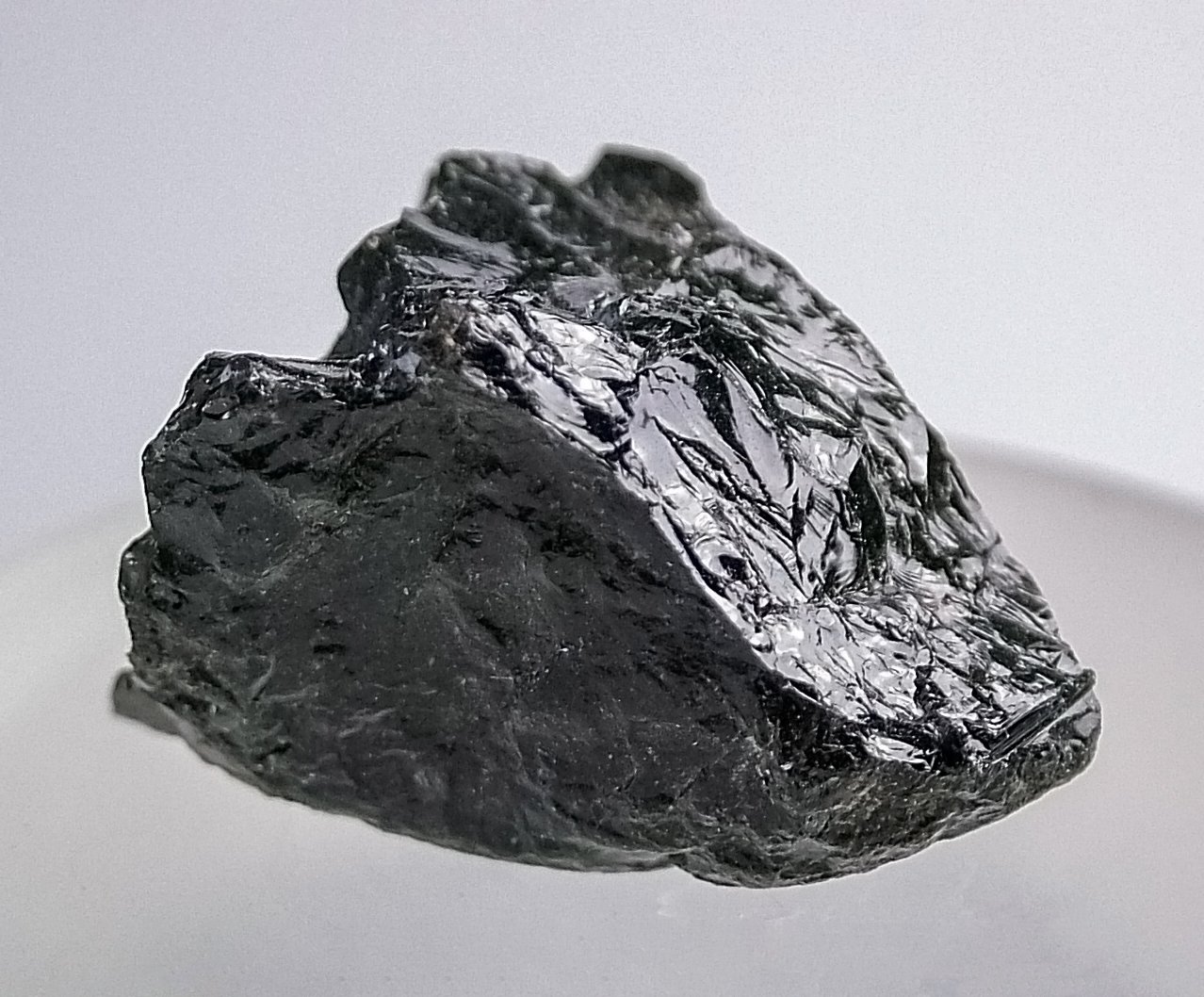
Schorl
The iron-dominant black tourmaline species - lustrous, striated prismatic crystals found in granites worldwide and universally recognized.
- Schorl is estimated to make up roughly 95% of all tourmaline on Earth - it is by far the most common member of this diverse mineral group.
- Tourmaline (including schorl) is piezoelectric and pyroelectric - it generates a small electrical charge when compressed or heated. This property was used in early 20th century scientific instruments and gauges.
- The town of Zschorlau in Germany's Erzgebirge is thought to be the source of the name 'schorl' - the mineral was found in abundance near the tin mines there.
- Schorl is the only common opaque black mineral in granite that shows distinctive vertical striations along its crystal faces - this is one of the easiest field identification features in all of mineralogy.
- Fine schorl crystals from Brazil's Minas Gerais and from Pakistan's Skardu region regularly reach lengths of 30-60 cm - some of the largest single tourmaline crystals in the world.
- Anyone building a foundational protection and grounding crystal practice
- Those living in energetically dense environments (cities, hospitals, crowded spaces)
- Practitioners working with shadow integration and psychic protection
- Anyone starting with black crystals for the first time
- Those who work with electronics or EMF-dense environments regularly
- Those wanting colorful or visually complex crystals
- Collectors seeking rarity - schorl is one of the world's most common tourmalines
- Buyers who want faceted jewelry gems - schorl is rarely transparent enough
What Is Schorl?
Schorl is the iron-dominant species of tourmaline - the same mineral group as verdelite, rubellite, and Paraiba tourmaline, but colored an opaque black by high iron content. It is the most common tourmaline species and among the most abundant minerals in granite pegmatites worldwide. It rates 7-7.5 on the Mohs hardness scale.
The name dates to at least the 15th century in German mining literature, predating formal mineralogical classification; it referred to a common black mineral in tin mines of the Erzgebirge region.
Schorl forms characteristic elongated prismatic crystals with strongly striated surfaces running parallel to the long axis - these vertical striations are one of the most recognizable field identification features in mineralogy. Crystals range from tiny needles embedded in quartz to massive columnar specimens several feet long.
The most visually dramatic specimens show glassy black crystals on white quartz or pink feldspar matrix, creating a striking color contrast.
In the crystal-healing community, schorl is marketed almost universally as 'Black Tourmaline' without the species name. The terms are effectively interchangeable for practical purposes - what crystal shops sell as Black Tourmaline is almost always schorl.
Distinguishing schorl from other black tourmaline species (like povondraite) requires detailed chemical analysis and is irrelevant for most uses.
How Schorl Compares
| Property | Schorl | Black Obsidian | Hematite |
|---|---|---|---|
| Hardness | 7-7.5 | 5-5.5 | 5.5-6.5 |
| Price | $ Budget | $ Budget | $ Budget |
| Rarity | Very common | Common | Common |
| Best For | Protection, grounding | Shadow work, truth | Grounding, strength |
Meaning and Symbolism
Schorl is arguably the most universally recommended protection stone in the crystal-healing world - its black iron composition, Root chakra resonance, and piezoelectric properties are said to create an energetic barrier that deflects, absorbs, and transmutes negative or harmful energy in the environment.
Practitioners describe it as the crystal equivalent of a ground wire in an electrical system: it doesn't stop electricity from flowing, it channels it safely away.
In crystal-working traditions, schorl is associated with creating energetically clean and protected space. Practitioners place it at the four corners of rooms, beside front doors, near computers and electronics, and at the Root chakra during meditation.
It is said to be particularly valuable in environments where many people pass through - workplaces, hospitals, public venues - where accumulated emotional and psychic residue can affect sensitive individuals.
The stone is also associated with grounding - the fundamental act of bringing scattered attention back into the physical body and the present moment. Practitioners believe schorl's iron-earth energy directly calms the nervous system's stress response, described as re-rooting awareness in the body when it has drifted into anxious future-projection or rumination.
It is traditionally the first stone recommended to those beginning crystal practice, and it remains essential at all levels of experience.
Historical Timeline
Healing Tradition
Emotional
Practitioners universally describe schorl as the most reliable stone for emotional grounding - the act of returning scattered, anxious, or overwhelmed feelings to a manageable baseline.
It is said to work like an emotional circuit breaker: when the system overloads with anxiety, reactivity, or the emotional debris absorbed from environments and other people, schorl provides the ground connection that allows the charge to dissipate safely.
Crystal workers often recommend it for those with high sensitivity to others' emotional states - empaths, healers, therapists, and people pleasers who routinely absorb what the people around them are feeling.
It is traditionally described as creating a field of emotional clarity that distinguishes what belongs to you from what you have absorbed.
Spiritual
In spiritual practice, schorl is the foundational protection stone - used before, during, and after any form of energy work, meditation, or ritual that opens the practitioner to non-ordinary states.
Practitioners believe it prevents what they call 'psychic sponging' - the unintentional absorption of energies that don't belong to the practitioner during open, expanded states. It is said to maintain the integrity of the energetic field even when awareness is ranging into less ordinary territory.
Some practitioners place schorl at the four cardinal points of any ritual space as the first act of preparation, treating it as the container that makes everything else safe to do.
It is associated with the grounding half of the cycle: whatever goes up must come down, and schorl ensures the landing is clean and complete.
Physical
Crystal-working traditions widely associate schorl with the adrenal system, the immune response, and the nervous system's stress-regulation axis. No scientific evidence supports these claims.
Practitioners sometimes place it at the base of the spine or soles of the feet during energy work, believing it draws excess activation out of the nervous system and into the earth.
Many practitioners also use it around electronic devices, associating its piezoelectric properties with a metaphorical capacity to interact with electromagnetic fields - though this has no scientific basis.
Zodiac, Birthstone and Gifts
Capricorn, the sign of practical mastery, long-term commitment, and earth-based achievement, resonates with schorl's no-nonsense protective grounding - it is a stone that simply does what it does without drama or ceremony.
Practitioners believe it amplifies Capricorn's natural capacity for sustained focus and completion, keeping the energy field clear and stable during the demanding long-arc projects this sign favors.
Libra, the sign of balance and relational harmony, benefits from schorl's protective field when navigating the emotional complexity that deep relationship engagement brings, helping Libra maintain their own center while remaining genuinely open to others.
Care and Cleansing
Schorl is hard (Mohs 7-7.5) and durable enough for water, salt, sunlight, and virtually any cleansing method. Running water is the most common and practical choice - practitioners often rinse schorl weekly or after particularly intense use, visualizing the absorbed energy flowing away down the drain.
Salt water, dry salt burial, moonlight, sunlight, smoke, sound, and selenite plate are all effective options. Because schorl is used heavily for protection and grounding, practitioners tend to cleanse it more frequently than other stones - weekly is common for pieces in active use.
Earth burial is particularly appropriate for schorl - burying a piece in garden soil overnight is said to return absorbed energies to the earth for complete transformation. This method is preferred by practitioners with earth-based spiritual traditions.
- DO cleanse regularly - schorl is used for absorption and grounding and benefits from frequent refreshing.
- DO NOT worry about most standard cleansing methods - schorl is one of the most physically durable crystals for regular handling.
- DO NOT use ultrasonic cleaners for matrix specimens with fragile rock formations.
- NOTE: Tumbled and raw schorl can leave slight black marks on some surfaces; place on appropriate display materials.
- DO store away from lighter-colored stones it might stain in prolonged contact in a humid environment.
Real vs Fake
Schorl is extremely common and inexpensive - there is almost no economic incentive to fake it. What is sold as Black Tourmaline in the vast majority of cases genuinely is schorl.
The primary identification feature is the strong vertical striations visible on crystal faces. No other common black mineral shows this striation pattern as clearly as tourmaline. If a 'black tourmaline' crystal has completely smooth faces without any visible parallel lines, look more carefully.
A magnet test helps: schorl is typically non-magnetic or very weakly magnetic. Magnetite (a common lookalike) is strongly magnetic. If a black crystal sticks firmly to a magnet, it is more likely magnetite than schorl.
Schorl is harder than glass (7-7.5 vs 5.5) and will scratch a glass surface; obsidian and other common lookalikes do not scratch glass as readily.
Price: genuine schorl is among the most affordable crystals available. If you are paying dollars per pound for raw schorl, you almost certainly have genuine material. Be somewhat more cautious with unusual or very large crystal specimens claiming to be schorl at unexpected prices.
Schorl Jewelry & Gifts
Schorl is among the most affordable crystals available. Small tumbled pieces run $3-$8; medium raw chunks $5-$15; nice crystals on matrix $10-$60 depending on crystal size and quality of the matrix presentation.
For protection grids, buy in sets of 4 or 8 - matched rough pieces of similar size are sold as protection grid sets and offer good value. For personal carry, a medium tumbled piece in a pocket is the most practical form.
Matrix specimens showing black crystals on white quartz or pink feldspar are the most display-worthy and make excellent shelf pieces. Brazilian material from Minas Gerais and Pakistani material from Skardu provide the most dramatic crystal-on-matrix presentations.
For jewelry, look for schorl beads or cabs in existing pieces rather than loose stone - raw schorl is not typically faceted due to opacity and common fractures. Beaded bracelets are the most widely available schorl jewelry form.
Available everywhere - garden centers, hardware stores (grounding rods!), gem shows, crystal shops, and online retailers. Genuine schorl is so ubiquitous that any source offering it at sensible prices will almost certainly have genuine material.
Where to Buy Schorl
Affiliate disclosure: Some links below earn us a small commission at no extra cost to you. See our affiliate disclosure page.
Handmade, raw, and tumbled pieces from independent sellers worldwide.
Shop Schorl on Etsy →Accessories, tools, and specimen sets with fast Prime delivery.
Shop Schorl on Amazon →Certified loose gemstones graded and photographed for online buyers.
Shop Schorl on GemSelect →Pairs Well With



Where Schorl Is Found


