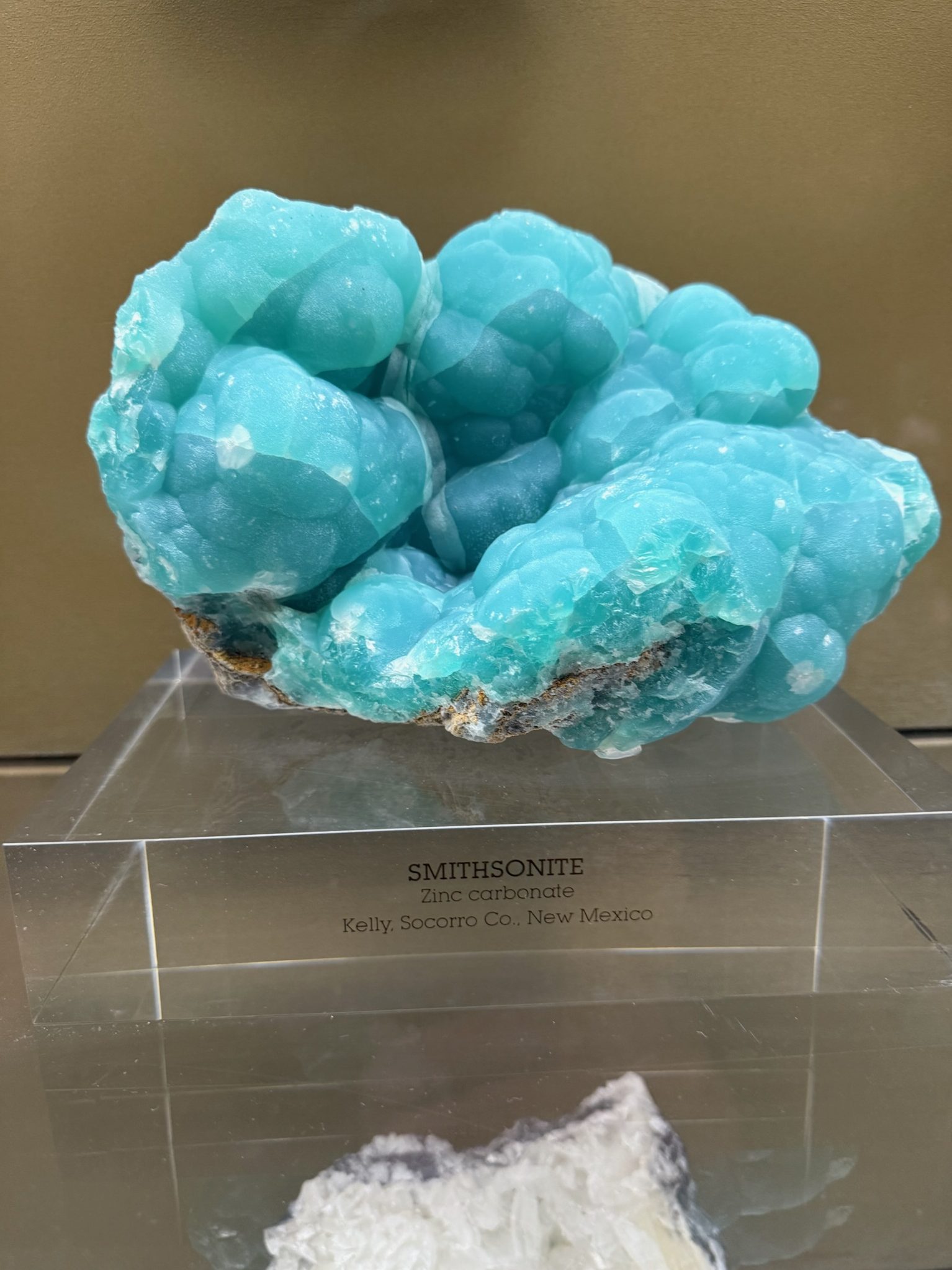
Smithsonite Blue
A soft zinc carbonate gem with an extraordinarily delicate robin's-egg blue that no other mineral quite replicates - one of mineralogy's.
- Smithsonite is named after James Smithson, who never visited the United States but whose $500,000 bequest founded major natural history museums Institution.
- The specific gravity of smithsonite (4.0-4.5) is so high that a fist-sized specimen feels noticeably heavy compared to any common rock.
- Blue smithsonite and blue hemimorphite are visually nearly identical - distinguishing them reliably requires hardness testing or spectroscopy.
- The Kelly Mine in New Mexico produced blue-green smithsonite specimens still considered among the finest ever found, though the mine is now closed.
- Pink cobaltian smithsonite from Tsumeb, Namibia, is so vividly colored that it resembles candy - an entirely natural effect of trace cobalt.
- Collectors seeking rare zinc minerals with exceptional color
- Crystal practitioners drawn to throat and heart chakra work
- Display collectors who want the unique robin's-egg blue that no other mineral replicates
- Gift for a mineral enthusiast who appreciates subtle rarity
- Botryoidal form collectors - smithsonite's grape-cluster habit is visually striking
- Jewelry use - Mohs 4-4.5 is too soft for most jewelry applications; choose aquamarine instead
- Budget collectors - quality blue smithsonite is expensive for its size
- Water cleansing routines - carbonate minerals dissolve slowly in water
What Is Smithsonite Blue?
Smithsonite is zinc carbonate (ZnCO3), a secondary mineral that forms in the oxidized zone of zinc ore deposits where hydrothermal fluids interact with surface processes. It was named in 1832 to honor James Smithson, the British mineralogist whose bequest funded the founding of major natural history museums Institution.
The blue color variety is caused by copper impurities substituting for zinc in the crystal lattice - the same copper that produces blue in turquoise and chrysocolla.
The trigonal crystal system produces characteristic *botryoidal* (grape-cluster) and *stalactitic* habits more often than discrete crystals, giving many specimens a smooth, bubbled surface with a translucent inner glow. Hardness is 4 to 4.5, and **specific gravity of 4.0-4.5** is exceptionally high for a carbonate mineral, reflecting the density of zinc.
This weight is a useful field identification characteristic.
Color ranges widely depending on trace impurities: copper produces blue and green, cobalt produces pink and lavender, manganese produces yellow, and iron produces brown to yellow. Pure zinc smithsonite is colorless to white. Blue smithsonite from Kelly Mine, New Mexico, and Tsumeb, Namibia, represents the benchmark for the color category worldwide.
How Blue Smithsonite Compares
| Property | Blue Smithsonite | Turquoise | Aquamarine |
|---|---|---|---|
| Hardness | 4 - 4.5 | 5 - 6 | 7.5 - 8 |
| Price / piece | $ Budget | $ Budget | $$ Mid-range |
| Color cause | Copper in ZnCO3 | Copper in Al-PO4 | Fe in beryl |
| Best use | Display/collection | Jewelry/collection | Jewelry |
Meaning and Symbolism
Blue smithsonite carries the energy of calm communication and emotional transparency. The delicate robin's-egg blue has long been associated with the throat chakra, and practitioners believe smithsonite helps dissolve the fear of honest expression.
The stone is said to encourage gentle truth-telling rather than harsh confrontation, making it popular among practitioners working on communication patterns in relationships.
In crystal healing tradition, smithsonite is also associated with inner child healing. The soft, rounded botryoidal forms are said to evoke a quality of tenderness and safety, encouraging the holder to approach their own emotional history with compassion rather than judgment.
The heart-throat connection is particularly emphasized in crystal healing work with blue smithsonite.
James Smithson's legacy - a private scholar who never visited America but chose to fund a public institution for the diffusion of knowledge - resonates with smithsonite's association with generous communication and the sharing of inner wisdom. Some practitioners use this historical connection in working with themes of unexpected legacy and giving.
Historical Timeline
Healing Tradition
Emotional
Practitioners believe blue smithsonite is one of the most supportive stones for emotional communication and self-expression. The stone is said to soften the fear of vulnerability and create the inner safety needed to speak honestly about feelings.
Many crystal practitioners use it specifically for inner child work, believing its gentle botryoidal energy creates a quality of nurturing that helps address early wounds around being heard or seen. In crystal healing tradition, it is associated with dissolving emotional guardedness without forcing exposure.
Spiritual
In crystal healing tradition, blue smithsonite bridges the heart and throat chakras, facilitating the expression of what is genuinely felt rather than what is socially acceptable. Practitioners use it in meditation on authentic communication and the alignment between inner truth and outer speech.
The stone is said to support channeling and intuitive communication, making it popular among those who work with spiritual guidance or teaching. It has long been associated with the honest transmission of wisdom.
Physical
Blue smithsonite is traditionally associated with throat and respiratory health in crystal healing, linked to its throat chakra resonance. Practitioners sometimes place it on the neck or upper chest during relaxation practices aimed at reducing tension in the throat and jaw.
The high zinc content of the mineral itself is noted as symbolic of immune and cellular vitality, though crystal practice does not involve ingesting or dissolving the stone. Crystal work is complementary to professional medical care.
Zodiac, Birthstone and Gifts
Blue smithsonite is associated with Virgo and Pisces in crystal astrology. Virgo benefits from the stone's support of honest, precise communication - helping the sometimes self-critical Virgo speak from the heart rather than the inner judge.
Pisces's deep emotional sensitivity and spiritual receptivity align with smithsonite's inner child themes and its association with the gentle expression of intuitive truth. Practitioners working with either sign often use blue smithsonite in communication rituals or emotional healing sessions.
Care and Cleansing
Smithsonite is a carbonate mineral that dissolves slowly in acidic solutions and weakens with extended water exposure. Use dry cleansing methods: moonlight, sunlight (brief), selenite plates, or sound are all ideal.
Smudging with sage or palo santo is the recommended primary method for smithsonite. Pass slowly through the smoke for 30-60 seconds. The botryoidal surface holds smoke fragrance briefly, which many practitioners find pleasant.
If a light surface wipe is needed for dust, use a barely damp soft cloth and dry immediately. Never soak, never salt. The soft surface (Mohs 4-4.5) also means avoid wiping with anything abrasive.
- DO NOT soak in water - smithsonite (ZnCO3) dissolves slowly in acidic or sustained water contact.
- DO NOT use salt cleansing - salt can etch the soft carbonate surface.
- DO NOT store loose with harder stones - Mohs 4-4.5 will be scratched by quartz, feldspar, or most other gems.
- DO wrap in soft cloth or keep in a padded display box.
- NOTE: The botryoidal surface bumps are fragile at thin edges - avoid dropping or stacking.
- DO NOT use ultrasonic cleaners - vibration can fracture the delicate botryoidal form.
Real vs Fake
Blue smithsonite has a very distinctive delicate blue that is difficult to fake convincingly. Test specific gravity - genuine smithsonite feels noticeably heavy (SG 4.0-4.5) for its size compared to glass or dyed calcite.
The botryoidal surface texture is also characteristic: each rounded bubble should show a consistent translucent-to-opaque blue with a waxy luster.
Blue hemimorphite (zinc silicate) is the most common confusion mineral - it looks nearly identical and forms in the same geological environments. Distinguish by hardness: hemimorphite tests at Mohs 4.5-5 vs smithsonite's 4-4.5. By acid test - a drop of dilute hydrochloric acid causes smithsonite to effervesce (CO2) while hemimorphite does not.
Dyed howlite or magnesite occasionally appears in the blue mineral market. These are significantly lighter (lower SG), softer in the wrong places, and show even, uniform color rather than the subtle variations characteristic of genuine copper-colored smithsonite.
Smithsonite Blue Jewelry & Gifts
Blue smithsonite is a collector rarity and priced accordingly. Small specimens start around $30-60. Quality display pieces with vivid robin's-egg blue botryoidal surfaces range from $100 to $400. Museum-grade specimens from Kelly Mine, NM, or Tsumeb, Namibia, can reach $500+ for substantial display pieces.
Look for consistent, saturated blue-to-blue-green color, translucency (pieces that glow slightly when backlit are particularly prized), and an undamaged botryoidal surface without chips. The best specimens show a depth of color that seems to come from within rather than sitting on the surface.
No standard treatments are applied to blue smithsonite - the color is naturally derived from copper impurities. Light stabilizing impregnation with resin is occasionally used on very fragile specimens from some dealers, but this should be disclosed.
Where to Buy Smithsonite Blue
Affiliate disclosure: Some links below earn us a small commission at no extra cost to you. See our affiliate disclosure page.
Handmade, raw, and tumbled pieces from independent sellers worldwide.
Shop Smithsonite Blue on Etsy →Accessories, tools, and specimen sets with fast Prime delivery.
Shop Smithsonite Blue on Amazon →Certified loose gemstones graded and photographed for online buyers.
Shop Smithsonite Blue on GemSelect →Pairs Well With


Where Smithsonite Blue Is Found


