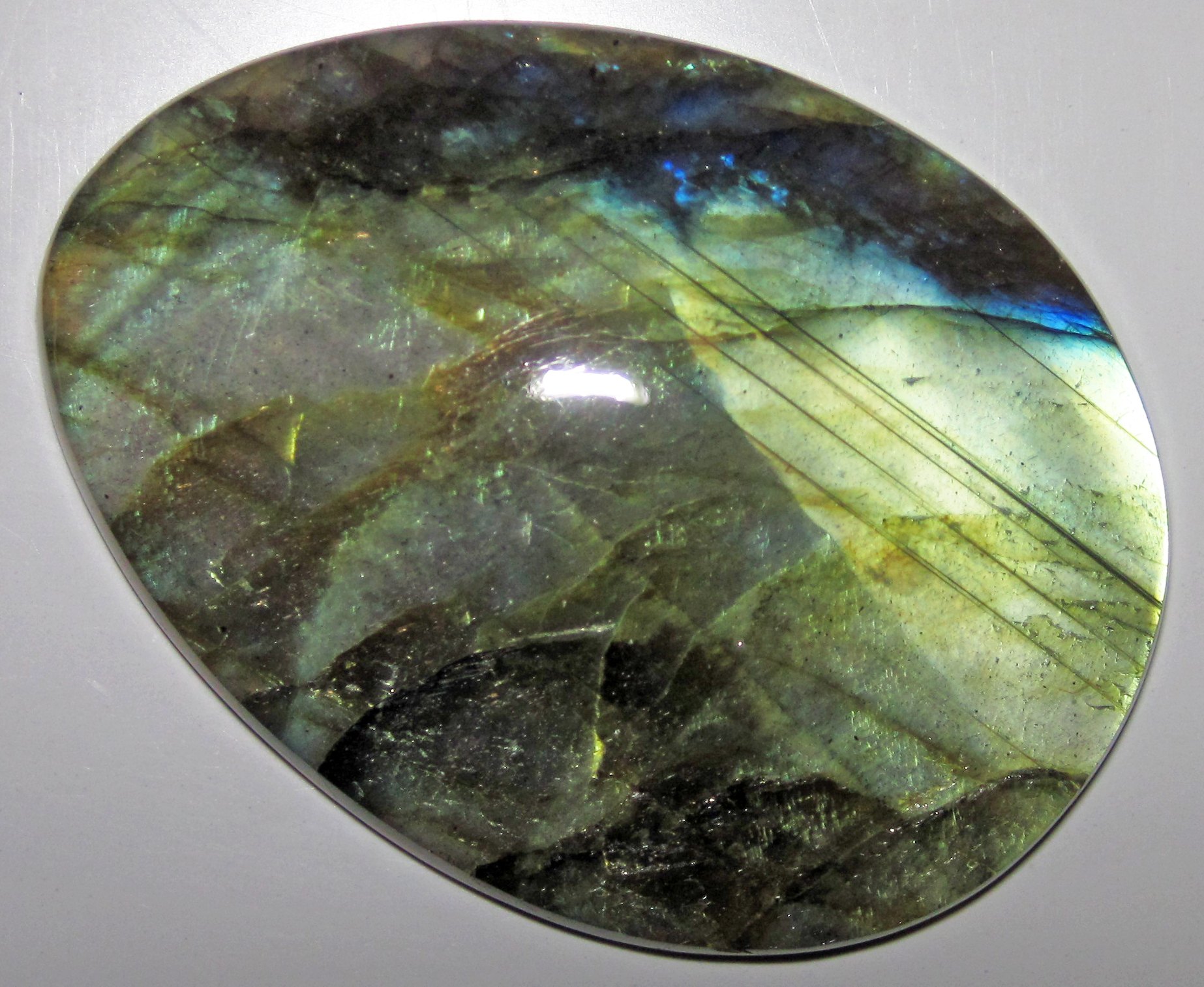
Spectrolite
Mined only in Finland, spectrolite is the full-spectrum labradorite, flashing every color the rainbow holds.
- Spectrolite is mined from only one deposit worldwide, near Ylamaa in southeastern Finland.
- The trade name was coined in 1940 by geologist Aarne Laitakari during Finnish road construction work.
- Spectrolite is Finland's unofficial national gemstone and features prominently in Finnish design tradition.
- The full-spectrum flash includes red and orange hues that ordinary labradorite rarely displays.
- Spectrolite's labradorescence arises from thin-film interference between microscopic twin layers in the feldspar structure.
- Labradorite lovers seeking the full-spectrum Finnish variety
- Collectors fascinated by feldspar mineralogy and origin-specific premium varieties
- Chakra practitioners wanting a single stone that addresses all energy centers
- Readers drawn to stones with dramatic optical phenomena (schiller effect)
- Gift givers looking for a rare conversation-piece cabochon or pendant
- Buyers seeking transparent faceted gems (try rainbow moonstone or quartz varieties)
- Rough-wear jewelry shoppers (try labradorite in protected settings or sapphire)
- Budget buyers wanting mainstream chakra stones (try standard labradorite or amethyst)
What Is Spectrolite?
Spectrolite is a premium variety of labradorite displaying the full spectrum of rainbow colors in its characteristic optical phenomenon called labradorescence. The stone is mined exclusively from one deposit in southeastern Finland near the town of Ylamaa, making it strictly origin-defined rather than a distinct mineral species.
Standard labradorite typically shows blue, gold, and occasional green flash on a dark gray base. Spectrolite displays the same phenomenon but across a far broader color range, including red, orange, purple, and yellow flashes alongside the blues and greens.
The color arises from thin-film interference as light reflects between microscopic twin-layer boundaries in the feldspar's internal structure.
The trade name Spectrolite was coined in 1940 by Finnish geologist Aarne Laitakari, who rediscovered the material during road-construction work near the Russian border. The deposit has been worked continuously since the 1940s on a careful, limited scale.
Finnish sovereign designation and trade protections require genuine Spectrolite to originate only from the Ylamaa deposit; labradorite from other origins that shows similar rainbow flash cannot legally be marketed as Spectrolite in Finland.
Spectrolite sits at Mohs 6 to 6.5 and is typically cut as cabochons, freeform polished pieces, and carvings rather than faceted gems. The dark base brings out the full spectrum of internal colors in reflected light.
How Spectrolite Compares
| Property | Spectrolite | Standard Labradorite | Rainbow Moonstone |
|---|---|---|---|
| Hardness | 6 - 6.5 | 6 - 6.5 | 6 - 6.5 |
| Flash colors | Full spectrum | Blue and gold | Blue primary |
| Price / carat | $ Budget | $ Budget | $ Budget |
| Best For | All-chakra, collector work | Protection, intuition | New beginnings |
Meaning and Symbolism
Finnish mythology speaks of the northern lights captured in stone, and spectrolite has become a poetic answer to that folklore. The Ylamaa deposit was rediscovered in 1940 during road construction at Finland's eastern border, and the material quickly became a point of national pride.
Finnish jewelry design schools embraced spectrolite as a signature local stone.
In crystal healing tradition, spectrolite is associated with labradorite's long folklore as a stone of transformation and intuition, amplified by the presence of every spectral color. Practitioners describe it as a master stone for chakra alignment, said to address each energy center through its respective rainbow flash.
The stone has long been used in meditation practices focused on integration.
Many readers choose spectrolite over standard labradorite when they want a single piece that addresses multiple energetic needs. Crystal workers often place spectrolite at the third-eye during meditation, with the full-spectrum flash considered a symbol of integrated awareness.
The stone is traditionally paired with amethyst for crown work or with clear quartz for amplification in chakra-balancing grids.
Historical Timeline
Healing Tradition
Emotional
Practitioners believe spectrolite supports emotional integration, with the full-spectrum flash framed as a visual reminder that every mood has its place and color. Crystal healing tradition associates the stone with transformation, and it is often used during life-transition periods when emotional clarity feels fragmented.
Many readers keep spectrolite nearby during journaling sessions focused on reconciling contradictory feelings. The stone is considered especially supportive during grief-joy overlap, anniversary emotions, and other moments when multiple states coexist.
Crystal workers sometimes pair spectrolite with rose quartz for tender emotional work or with black tourmaline for grounding during intense processing. The stone's broad color range is traditionally associated with emotional adaptability and resilient softness.
Spiritual
In crystal healing tradition, spectrolite is considered a master chakra stone because the rainbow flash corresponds visually with the traditional chakra color spectrum. Practitioners describe it as a bridge stone, said to support coordinated work across multiple energy centers rather than focusing on one.
Many readers use spectrolite during meditation focused on integration and overall energetic alignment. The stone has long been associated with intuition through its labradorite lineage, and crystal workers often place it at the third eye for enhanced perceptive work.
Crystal workers often place spectrolite at the center of a seven-chakra grid with colored corresponding stones at each point, or pair it with clear quartz for amplification during full-spectrum energy practices. Spectrolite is traditionally considered a twilight stone, most effective during transitional times of day.
Physical
Practitioners believe spectrolite supports what they describe as whole-body energetic balance rather than single-issue healing. Crystal healing tradition associates the rainbow flash with coordinated systemic support, and many readers wear the stone as a pendant for general daily wellbeing work.
The stone is not a substitute for medical care, and practitioners frame its role as companioning rather than therapeutic. Crystal workers sometimes recommend spectrolite for people recovering from illness that affected multiple systems, treating it as a stone of integrated rather than localized support.
Many readers carry a small spectrolite piece during periods of change and demanding travel, with the stone considered supportive for the body's adjustment through new rhythms. The Finnish origin and association with the aurora borealis add a dimension of circadian and seasonal symbolism for readers drawn to northern light imagery.
Zodiac, Birthstone and Gifts
Spectrolite is not a traditional birthstone, but astrologers often recommend it for Scorpio (for transformation work), Sagittarius (for expansive vision), and Leo (for the full-spectrum self-expression associated with the sign).
The stone is sometimes paired with Uranus-ruled sign work because Uranus is associated with sudden insight and unusual optical phenomena. Many readers choose spectrolite during Uranus return, birthday phases, and other transitional astrological moments when integration feels especially important.
Care and Cleansing
Spectrolite requires gentle cleaning because feldspars have perfect cleavage planes sensitive to impact and thermal shock. Brief rinses in cool or lukewarm water with a soft cloth are safe. Avoid ultrasonic cleaners, steam cleaning, and prolonged soaking, all of which can stress the twin layers responsible for the labradorescence.
Moonlight charging is widely recommended, especially during the full moon. Morning sunlight is safe in moderation. Smoke cleansing with palo santo or sage is an excellent option for spectrolite because it avoids water contact entirely. Dry salt cleansing is safe briefly; saltwater soaks should be avoided because salt can penetrate cleavage microfractures.
Many practitioners cleanse spectrolite by placing it on a bed of clear quartz chips overnight, a method especially suited to the stone's sensitivity. Finnish tradition associates spectrolite with northern-light energy, and some readers cleanse it under winter night skies as a symbolic charging practice.
- DO clean spectrolite with a soft dry cloth or brief lukewarm rinse only.
- DO NOT use ultrasonic or steam cleaners; they can damage feldspar cleavage planes.
- DO use protective bezel settings for rings and bracelets to reduce impact exposure.
- DO NOT expose spectrolite to thermal shock (hot to cold) or prolonged high heat.
- DO store spectrolite separately from harder gems to protect the polished surface.
- DO ask your seller to confirm Finnish Ylamaa origin for genuine Spectrolite material.
- Note: some labradorite from other origins is mismarketed as Spectrolite; verify provenance for premium pieces.
Real vs Fake
Genuine spectrolite shows a full spectrum of colors (red, orange, yellow, green, blue, purple) in its labradorescence when rotated in light, against a characteristic dark gray to near-black base. Standard labradorite typically shows only blue and gold flash on a lighter gray base, making the distinction visually clear in direct comparison.
True Finnish Spectrolite carries origin certification from the Ylamaa mining operation when purchased through reputable dealers.
Common imitations and mislabels include standard labradorite marketed as Spectrolite without Finnish provenance, assembled doublets (labradorite tops over darker backings), and synthetic opal rainbows. Under 10x magnification, genuine spectrolite shows the characteristic feldspar twin-layer structure visible as fine parallel lines when light catches the internal planes at certain angles.
Assembled doublets reveal their glue line at the stone's edge or base, often visible to the naked eye.
Practical at-home checks include rotating the stone under direct light to observe the full color range of the flash, examining the base color for characteristic dark gray rather than black or brown, and checking for the feldspar-typical cleavage behavior on any unpolished edges.
For premium-priced pieces, request documentation from Finnish mining authorities or GIA, Mindat, and USGSoratory confirming Ylamaa origin.
Spectrolite Jewelry & Gifts
Spectrolite commands a significant premium over standard labradorite because of its rare Finnish origin. Small polished pieces and tumbles run $20 to $60, medium cabochons typically price at $40 to $150 per stone, and large fine-flash cabochons or freeform pieces above 30 carats can reach $150 to $400.
Top museum-grade specimens with exceptional full-spectrum flash in large sizes command the highest prices, particularly when sold with Finnish provenance certification.
When buying, request confirmation of Ylamaa origin and look for dark gray base color with clear rainbow flash visible at multiple angles. Protected bezel settings are strongly recommended for rings and bracelets because labradorite at Mohs 6 to 6.5 is softer than many gems.
Many authentic spectrolite pieces come from Finnish design houses with documented provenance chains.
Where to Buy Spectrolite
Affiliate disclosure: Some links below earn us a small commission at no extra cost to you. See our affiliate disclosure page.
Handmade, raw, and tumbled pieces from independent sellers worldwide.
Shop Spectrolite on Etsy →Accessories, tools, and specimen sets with fast Prime delivery.
Shop Spectrolite on Amazon →Certified loose gemstones graded and photographed for online buyers.
Shop Spectrolite on GemSelect →Pairs Well With



Where Spectrolite Is Found


