Star Sapphire
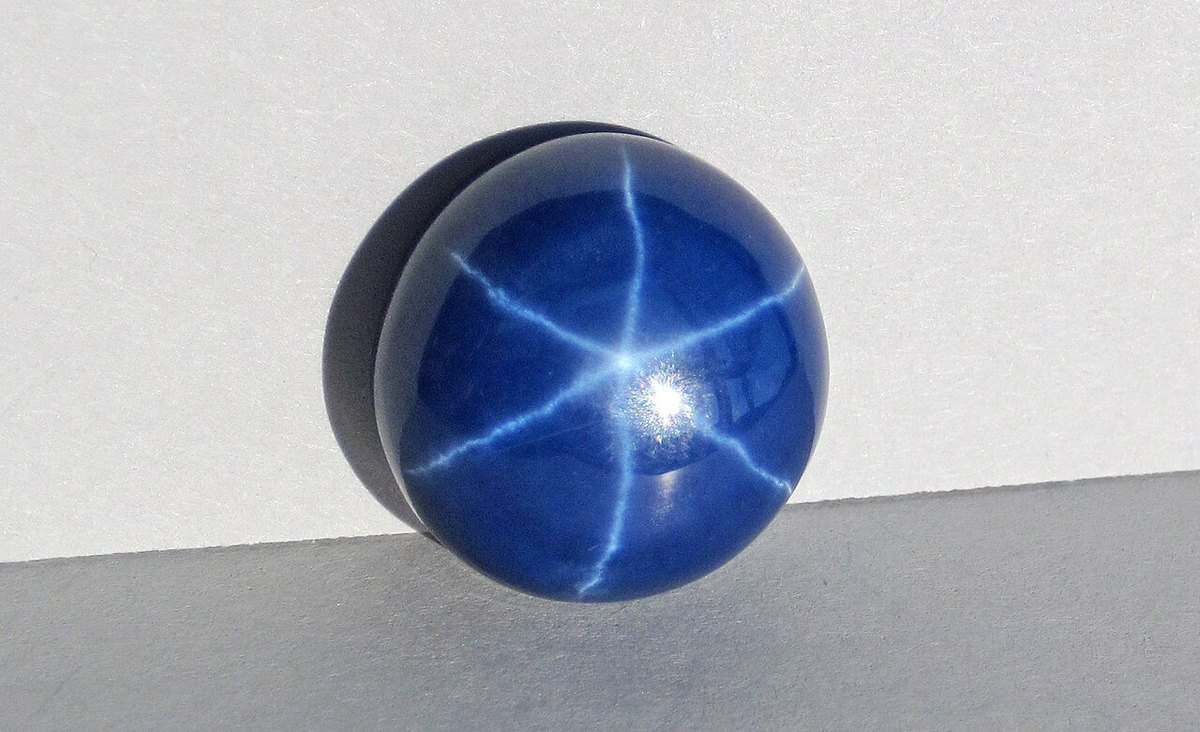
A cabochon of iron-blue corundum with a floating six-rayed star, star sapphire carries sapphire wisdom into a living beam.
- The Star of India at the American Museum of Natural History weighs 563 carats and is one of the largest star sapphires on public display.
- Star sapphires show asterism because of tiny rutile silk needles aligned along three crystal axes.
- Black star sapphire, found mainly in Thailand, shows a silver or gold star on a black body and is a popular men's ring stone.
- Helen Keller carried the Star of Asia sapphire with her as a personal talisman for many years.
- Twelve-rayed stars occasionally appear in certain star sapphires with two overlapping rutile orientations, doubling the normal six-ray pattern.
- Collectors drawn to asterism phenomena and cabochon heirloom stones
- September birthstone seekers wanting a unique alternative to faceted sapphire
- Engagement ring shoppers seeking a meaningful, softly glowing blue center stone
- Practitioners working with throat and third eye chakras for honest, guided speech
- Readers who want a phenomenal stone that moves the ray as the wearer moves
- Shoppers wanting transparent faceted brilliance (consider standard blue sapphire)
- Budget buyers under $100 per carat for natural material (try star moonstone)
- Those who dislike translucent or milky body color (consider transparent sapphire)
What Is Star Sapphire?
Star sapphire is the asterism-bearing variety of sapphire, an iron and titanium colored member of the corundum family that shows a six-rayed star when cut as a cabochon. The star is produced by reflection from thousands of oriented rutile silk inclusions aligned along three crystallographic directions.
The International Mineralogical Association symbol for corundum is Crn, and asterism requires a narrow range of silk density and alignment to form a sharp star.
With a Mohs hardness of 9, star sapphire matches its faceted sibling in durability, making it ideal for everyday rings, pendants, and heirloom pieces. Specific gravity of 3.95 to 4.03 gives the stone a dense, reassuring weight in the hand.
Star sapphires form primarily in metamorphic deposits associated with gneiss and skarn, with secondary placer occurrences in alluvial gravels. Sri Lanka's Ratnapura district supplies much of the world's fine star material, alongside Burmese Mogok and Kashmir-adjacent Indian production.
Color ranges from deep royal blue through cornflower and violetish blue to gray, black, pink, and yellow star varieties. Black star sapphires from Thailand, often called black star of Queensland, offer a dramatic silver star on an opaque body at accessible prices.
Most fine star sapphires are untreated beyond cabochon polishing, because heat treatment dissolves the silk that creates the star. Lower grades sometimes undergo surface diffusion to induce a shallow asterism, a separate category that must be disclosed.
How Star Sapphire Compares
| Property | Star Sapphire | Star Ruby | Star Moonstone |
|---|---|---|---|
| Hardness | 9 | 9 | 6 - 6.5 |
| Star Rays | 6 | 6 | 4 |
| Price / carat | $$ Mid-range | $$ Mid-range | $ Budget |
| Rarity | Uncommon | Rare | Uncommon |
Meaning and Symbolism
Star sapphire has been called the stone of destiny in European lore for more than eight hundred years. Helen Keller described her Star of Asia sapphire as her constant companion, and the six crossing rays have been interpreted across cultures as faith, hope, and destiny, or as past, present, and future.
Medieval travelers carried star sapphires as amulets, believing the rays would continue to guide the wearer even after the stone was passed to an heir.
In Christian tradition, star sapphires were called stones of the cross, and the three intersecting lines were linked to symbols of protection in pilgrimage and prayer.
The Star of India, a 563 carat Ceylon cabochon at the American Museum of Natural History, remains one of the most famous gems in the world, drawing visitors for more than a century.
Sri Lankan folklore celebrated star sapphires as drops of heaven fallen to earth, and royal families collected them as heritage pieces for generations.
In modern crystal practice, star sapphire is traditionally associated with guided wisdom and protected truth. Practitioners believe the stone refines the throat and third eye chakras, adding a contemplative softness to sapphire's sharper clarity.
Many find star sapphire a useful stone for long-term studies, spiritual seeking, or moments when a decision must be made after careful inner listening.
Historical Timeline
Healing Tradition
Emotional
Practitioners believe star sapphire is a stone of guided perception. In crystal healing tradition, it is said to refine sapphire's cool focus into something more contemplative, helping the wearer sit with difficult emotions long enough to understand them before acting.
Many find star sapphire supportive during long decisions, spiritual retreats, and times of grief that call for patience rather than resolution, with the stone traditionally associated with quiet discernment rather than sharp judgment.
Practitioners often pair it with rose quartz when the work requires softening, or with moonstone when the listening is meant to deepen intuitive reception.
Star sapphire is also said to support people who feel pulled between competing obligations, giving them a sense of guiding light rather than forced choice.
It is not considered a stimulating stone; readers looking for motivation usually turn to carnelian or citrine, keeping star sapphire for the slow, careful moments of a life's work.
Spiritual
In crystal healing tradition, star sapphire is said to open the throat and third eye chakras together, with the three crossing rays interpreted as the meeting of speech, vision, and silent knowing. Practitioners believe this configuration is what gives star sapphire its reputation as the stone of destiny.
Many find star sapphire useful in meditations on life direction, vocation, or the long arc of spiritual practice, where the asterism serves as a visual anchor for breath and intention.
The stone has a long ritual history in South Asia and medieval Europe, where it was worn by clergy, teachers, and travelers as a guiding amulet.
Star sapphire is traditionally associated with Saturn in both Western and Vedic astrology, which practitioners interpret as patience, structure, and the fruits of sustained effort. Holding a star sapphire during a threshold decision, vow, or new-moon intention has become a classic practice among readers who favor phenomenal stones for deep inner work.
Physical
Practitioners believe star sapphire supports what they describe as clear seeing and steady nerves, and it has long been used in traditions that link gems to the eyes, mental fatigue, and long-distance travel.
Folklore associates star sapphire with restful sleep, a settled mind, and protection during journeys, and many find wearing a star sapphire pendant near the heart comforting during demanding periods. In Ayurvedic gem therapy, star sapphire is said to balance Saturn's influence on the body through a gentler channel than faceted neelam.
Star sapphire is not a substitute for medical care, and practitioners frame its role as supportive rather than curative.
For readers drawn to Vedic tradition, a brief trial wearing period is recommended before committing to daily use, since the stone is said to amplify whatever is already present in the wearer's chart and life.
Zodiac, Birthstone and Gifts
Star sapphire shares the September birthstone role with standard sapphire and is traditionally associated with Virgo in the primary solar month. Modern astrologers also connect the asterism variety to Taurus for its slow, grounded wisdom.
For Virgo, star sapphire is said to temper the sign's analytical precision with intuitive patience, softening critical judgment without blunting discernment. For Taurus, the stone is believed to deepen the sign's natural sensuality into a more reflective appreciation of the long view.
Practitioners suggest wearing star sapphire in silver, platinum, or white gold, typically in a bezel setting that protects the cabochon and lets light reach the dome. Beginners often start with a pendant or small ring before moving to larger heirloom pieces.
Care and Cleansing
Star sapphire is among the easiest stones to cleanse because it tolerates nearly every common method. Running tap water for under a minute is safe for a loose cabochon, as is a brief rinse in lukewarm soapy water with a soft cloth to remove skin oils from jewelry.
Ultrasonic and steam cleaners are generally safe for untreated star sapphires but should be avoided for diffusion-treated or heavily included stones.
Sunlight cleansing is traditionally fine for star sapphire, since the stone does not fade under ordinary UV exposure and the silk inclusions remain stable. A short morning sun bath is considered effective. Moonlight, smoke cleansing with palo santo or sage, and sound cleansing with a singing bowl are all considered safe.
Salt cleansing should be dry only, never a saltwater soak, since saltwater can corrode metal settings over time. Many practitioners rest star sapphire on a clear quartz cluster between working sessions to recharge the star's glow.
- DO rinse star sapphire jewelry in lukewarm soapy water and dry with a soft cloth after long wear.
- DO NOT use ultrasonic or steam cleaners on diffusion-treated or fracture-filled star sapphires.
- DO store star sapphire separately from softer gems like pearls or opals to avoid scratching them.
- DO NOT expose diffusion-treated stones to thermal shock, since the surface layer can be damaged.
- DO remove star sapphire rings before rock climbing or heavy hand tools to protect the cabochon dome.
- DO ask for disclosure of any diffusion, heat, or fracture-filling treatment at the point of purchase.
- Note: inspect the ray under a single point light before buying; weak or off-center stars reduce value.
Real vs Fake
A genuine star sapphire shows a six-rayed asterism that remains sharp and centered across most of the dome when the cabochon is rotated under a single point light.
Natural silk inclusions are visible under a 10x loupe, and the body color is typically a saturated blue, black, gray, or occasionally pink or yellow. A stone marketed as star sapphire with a blurry, off-center, or stubbornly fixed star deserves closer inspection.
Common imitations include synthetic star sapphires made by the Linde process, star glass doublets, and diffusion-treated natural corundum with a shallow induced star. Linde synthetics typically show a star that is too perfect and a pavilion marked by tiny spherical gas bubbles when examined under magnification.
Dyed or coated star quartz is occasionally sold as star sapphire at very low prices, a clear warning sign.
Practical at-home checks include a hardness test (genuine star sapphire scratches quartz), a weight test (noticeably denser than glass), and a ray-movement test (natural asterism moves with both the cabochon and the light source, not just one).
Dichroism is faint in blue star sapphires but can sometimes be seen when the stone is rotated under polarized light.
For any significant purchase, a report from an independent gemological lab should confirm natural origin, species, and whether any diffusion or fracture treatment has been applied. Reputable dealers price diffused, composite, and synthetic star sapphires as separate categories from naturally grown material.
Star Sapphire Jewelry & Gifts
Star sapphire pricing depends on body color, star sharpness, size, and origin. Commercial gray or black star sapphires from Thailand start around $50 to $150 per carat, while translucent gray-blue Indian stones run $100 to $400 per carat through reputable online retailers.
Mid-grade Sri Lankan blue star sapphires with sharp centered rays trade at $400 to $1,500 per carat, and top Ceylon royal blue material can exceed $3,000 per carat for well-formed stones above three carats.
Diffusion-treated star sapphires, which have induced asterism in a shallow surface layer, must be disclosed and are priced as a separate category at lower levels. Black star sapphires are usually natural and represent strong value for men's rings and pendants, while fine blue star material remains a classic heirloom investment.
For serious purchases, request a report from an independent gemological lab confirming natural asterism, country of origin where determinable, and absence of diffusion or fracture treatment. Bezel settings are recommended to protect the polished dome, and insurance is wise for stones above one thousand dollars.
Where to Buy Star Sapphire
Affiliate disclosure: Some links below earn us a small commission at no extra cost to you. See our affiliate disclosure page.
Handmade, raw, and tumbled pieces from independent sellers worldwide.
Shop Star Sapphire on Etsy →Accessories, tools, and specimen sets with fast Prime delivery.
Shop Star Sapphire on Amazon →Certified loose gemstones graded and photographed for online buyers.
Shop Star Sapphire on GemSelect →Pairs Well With




Where Star Sapphire Is Found


