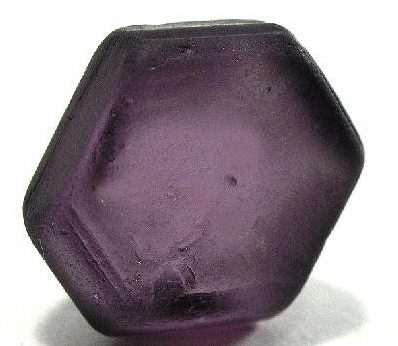
Taaffeite
Rarer than diamond - taaffeite's lavender fire is one of Earth's most extraordinary natural creations
- Taaffeite is the only gemstone ever first identified in its cut, polished state rather than as a rough mineral - Count Taaffe spotted the unusual stone in a box of already-faceted gems.
- Taaffeite is estimated to be approximately one million times rarer than diamond by geological occurrence - making it arguably the rarest transparent gemstone on Earth.
- The mineral was initially confirmed by gemologists at major natural history museums in London who tested Taaffe's suspicion - making London's museum a significant player in discovering one of the world's rarest minerals.
- Musgravite, a close chemical relative of taaffeite, was for a time considered the same mineral - they were eventually distinguished and musgravite recognized as an even rarer separate species.
- Most taaffeite in existence is smaller than 1 carat after faceting - even 0.5 carat stones of gem quality represent a remarkable rarity. A 2-carat fine taaffeite would be considered an extraordinary specimen.
- serious gemstone collectors and investors
- those drawn to the energy of extreme rarity
- practitioners working with the highest crown energies
- gemologists and natural history enthusiasts
- those manifesting highest-level consciousness and clarity
- first-time gemstone buyers
- those with limited budgets
- practitioners who do not feel called to work with extreme rarity energy
What Is Taaffeite?
Taaffeite (pronounced TAH-fite) holds the remarkable distinction of being the only gemstone first identified in a cut and polished state rather than in rough mineral form. In 1945, Irish gemologist Count Richard Taaffe purchased a small box of mixed stones in Dublin, noticing that several pale mauve stones looked unusual.
When tested, they proved to be an entirely unknown mineral - now named in his honor.
Chemically, taaffeite is beryllium magnesium aluminum oxide (BeMgAl₄O₈) - an extremely rare combination requiring specific geochemical conditions during metamorphic or metasomatic rock formation. It occurs primarily in Sri Lanka's alluvial gem gravels, where it was previously mistaken for mauve spinel (which it closely resembles). Myanmar (Burma), China, and Tanzania produce small quantities.
The total global supply of gem-quality taaffeite is estimated at only a few hundred faceted stones - making it many times rarer than diamond. Faceted taaffeite stones are primarily lavender to pale purple, sometimes mauve-pink or colorless, with excellent brilliance due to high refractive index.
A significant faceted taaffeite typically sells for $2,000-$10,000 per carat.
Taaffeite vs. Similar Rare Gemstones
| Property | Taaffeite | Painite | Musgravite |
|---|---|---|---|
| Hardness | 8-8.5 | 8 | 8-8.5 |
| Price/ct | $$$$ Luxury | $$$$ Luxury | $$$$ Luxury |
| Rarity | Extreme | Ultra extreme | Extreme |
| Est. faceted stones | ~hundreds | <50 | ~dozens |
Meaning and Symbolism
Taaffeite's extreme rarity gives it a spiritual quality that practitioners describe as uniquely concentrated - as if the rarest things in nature carry correspondingly rare qualities of consciousness.
The stone is said to embody the principle of genuine uniqueness: not the performed individuality of ego but the authentic singularity of a being that is genuinely irreplaceable.
In crystal traditions, taaffeite is associated with the highest expressions of crown chakra energy - not just connection to spiritual guidance but the full realization of one's nature as a unique manifestation of the universal source.
Practitioners who work with it describe it as a stone for those at the farthest edges of their spiritual development, where familiar frameworks no longer fully apply.
The stone is also associated with discernment at the finest level - the ability to distinguish the genuinely valuable from the superficially similar, just as Count Taaffe distinguished an unknown mineral from the common spinel it resembled.
This quality of precise perception beneath appearances gives taaffeite a specific role in spiritual practices involving truth-seeing and refined discrimination.
Historical Timeline
Healing Tradition
Emotional
Practitioners who work with taaffeite (a small but serious community given the stone's accessibility) describe it as uniquely supportive for those confronting their own genuine uniqueness - the emotional territory of being genuinely different, genuinely rare in their gifts or path.
Needing to trust that what is genuinely valuable about them will be recognized by those with the perception to see it. The stone is said to dissolve the tendency to make oneself more ordinary to be more accepted, supporting the courage to be exactly as rare and distinctive as one actually is.
Spiritual
In spiritual practice, taaffeite is associated with the pinnacle experiences of spiritual development - moments of genuine recognition of one's nature as unique, irreplaceable, and of extraordinary value.
Practitioners believe the stone creates a field of ultra-refined perception, helping distinguish the genuinely true from the merely familiar, the genuinely spiritual from the spiritually-labeled, and the genuine self from the constructed self.
It is described as a stone for the edges of the spiritual map - where the well-traveled paths end and genuine exploration begins.
Physical
Some crystal wellness practitioners associate Taaffeite with the pineal gland, higher nervous system function, and the refined perception required for advanced spiritual practice. Its beryllium content is a physical fact; its metaphysical implications are traditional belief. No scientific evidence supports health associations.
Beryllium compounds can be toxic in dust form - do not sand or grind taaffeite. Normal handling of faceted or polished specimens is safe.
Zodiac, Birthstone and Gifts
Virgo's precision, discernment, and appreciation for genuine quality over superficial appearance resonates with taaffeite's discovery story and the refined perception it is said to embody. Sagittarius's philosophical quest for ultimate truth and willingness to explore the edges of the map aligns with the stone's association with the frontiers of spiritual development.
Care and Cleansing
Taaffeite is extremely durable (8-8.5 hardness) and water-safe - brief rinsing is fully safe and effective. Dry thoroughly. Treat the stone with the reverence appropriate to its extraordinary rarity and value.
Moonlight cleansing on a secure, protected surface overnight is the preferred method for practitioners who favor energetic alignment over physical cleaning methods. The lunar cycle is particularly resonant for a stone associated with the finest levels of spiritual perception.
Sound cleansing with the highest-quality instruments available is appropriate for taaffeite's refined energy profile. Crystal bowls tuned to the crown frequency (B note) are commonly used by practitioners working with this stone.
- DO store safely - taaffeite's value makes secure storage essential.
- DO NOT expose to beryllium dust (do not grind or sand) - beryllium compounds are toxic in particulate form. Handling faceted or polished specimens is safe.
- DO keep certification documents securely stored alongside the stone.
- DO NOT purchase significant taaffeite without independent gemological certification.
- NOTE the market has misrepresentation - spinel and synthetic corundum are sometimes sold as taaffeite. Laboratory confirmation is non-negotiable.
Real vs Fake
Taaffeite is frequently confused with or misrepresented as spinel (which it closely resembles visually). The only reliable authentication is spectroscopic and refractive index testing by a qualified gemological laboratory.
The refractive index of taaffeite (1.719-1.723) is higher than spinel (1.712-1.717) - this small but measurable difference is detectable with a refractometer and is used in gemological authentication.
Synthetic taaffeite does not exist commercially as of the author's knowledge - the stone is not synthesized for the gem market. Any stone sold as 'synthetic taaffeite' should be viewed with extreme skepticism.
Laboratory reports from gemological laboratories, GRS, or SSEF specifically identifying the stone as taaffeite (BeMgAl₄O₈) are the only acceptable authentication for a significant purchase. The lab fee is trivial compared to the stone's value.
Even experienced gemologists have mistaken spinel for taaffeite - the similarity is the reason the stone remained undiscovered until 1945 despite being present in mixed gem parcels. This underscores the essential nature of laboratory testing for any taaffeite purchase.
Taaffeite Jewelry & Gifts
Natural gem-quality taaffeite is priced at $2,000-$10,000 per carat for fine material. Even very small stones (under 0.25 carat) command significant prices due to extreme rarity. This is not an accessible purchase for most buyers.
The most reliable sources are established gemstone auction houses (major auction houses, major auction houses, Bonhams), specialist rare gemstone dealers with documented track records, and laboratory-certified material from reputable Sri Lankan or Myanmar dealers.
Gemological certification from gemological laboratories, GRS, SSEF, or Gübelin is absolutely non-negotiable for any taaffeite purchase. The certificate should identify the species as taaffeite, provide measurements and weight, and note any treatment (typically none).
Sri Lankan material from Ratnapura's alluvial deposits is considered the benchmark for taaffeite quality. Myanmar material is also highly regarded. Chinese and Tanzanian material is generally available at slightly lower prices.
For those attracted to taaffeite's energy profile without budget for the genuine stone, practitioners sometimes work with high-quality lavender spinel or fine amethyst as accessible resonant alternatives while saving for authentic taaffeite.
Where to Buy Taaffeite
Affiliate disclosure: Some links below earn us a small commission at no extra cost to you. See our affiliate disclosure page.
Handmade, raw, and tumbled pieces from independent sellers worldwide.
Shop Taaffeite on Etsy →Accessories, tools, and specimen sets with fast Prime delivery.
Shop Taaffeite on Amazon →Certified loose gemstones graded and photographed for online buyers.
Shop Taaffeite on GemSelect →Pairs Well With



Where Taaffeite Is Found


