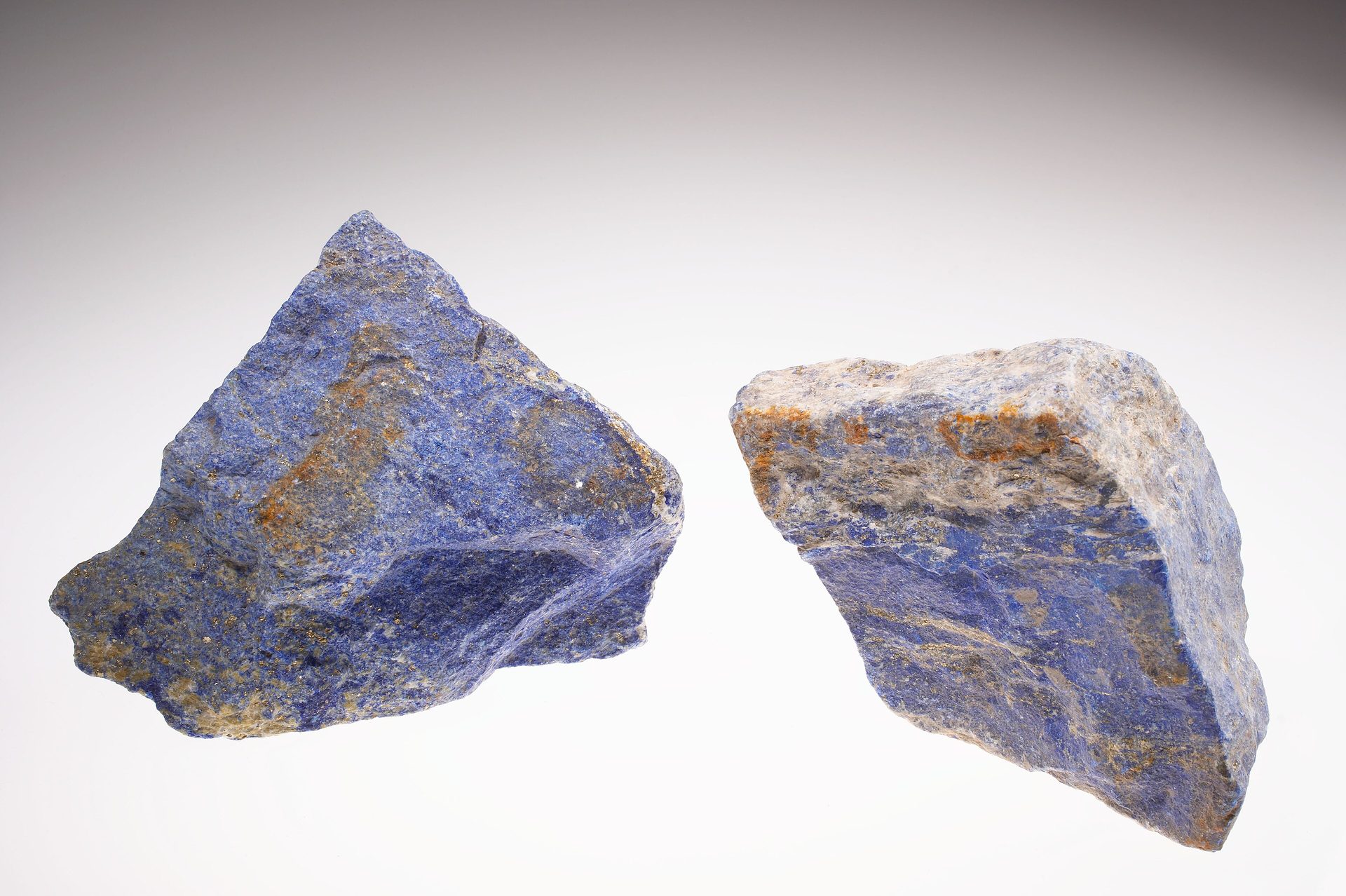
Afghan Lapis Lazuli
The mines of Badakhshan supplied ancient Egypt, Renaissance masters, and Mughal emperors - six thousand years of the most coveted blue on.
- The Sar-i-Sang mines in Badakhshan have been producing lapis lazuli for at least 6,000 years - the longest continuously operated gem mining operation in human history.
- Lapis lazuli was literally worth more than gold in the Renaissance art market. The cost of painting the Virgin Mary's blue robe was considered a major financial commitment by patrons.
- Egypt had no lapis deposits yet possessed more lapis than almost any ancient civilization. The stone traveled over 3,000 miles from Badakhshan via ancient trade routes to reach the Nile.
- The phrase Persian lapis refers to the finest Afghan material, which historically reached Europe through Persian trade routes - even though the stone was mined in Afghanistan, not Persia.
- Lapis lazuli is not a mineral but a rock - a mixture of minerals including lazurite, calcite, and pyrite. Technically it is a metamorphic rock rather than a single crystal species.
- Collectors of historically significant gemstones
- Buyers who want the original source of lapis with 6000 years of continuous mining history
- Spiritual practitioners drawn to deep throat and third eye chakra energy
- Jewelry designers working with opaque stones in gold settings
- Those studying the history of pigment, art, and civilization
- Daily-wear ring buyers (5-6 Mohs - soft and porous, scratches easily)
- Buyers expecting faceted gemstone brilliance (lapis is opaque and cabochon-cut)
- Those who want a low-maintenance stone (lapis is porous and requires careful care)
What Is Afghan Lapis Lazuli?
Afghan lapis lazuli is a metamorphic rock composed primarily of lazurite (the deep blue sodium-calcium aluminum silicosulfate mineral) combined with calcite (white), pyrite (gold flecks), and other minerals. The finest material comes from the Sar-i-Sang mines in Badakhshan Province, Afghanistan - the oldest continuously operating gem mines in the world.
The deep royal blue color comes from the trisulfide anion (S3-) within the lazurite mineral. The finest grade (called Persian lapis historically) shows a deep, even midnight blue with little white calcite and fine gold pyrite flecks distributed like stars in a night sky.
Lower grades show excessive white calcite veining or dull, grayish blue tones.
Lapis was ground into ultramarine pigment for centuries - the most precious blue paint in the world, used for the robes of the Virgin Mary in Renaissance paintings and the blue faience of ancient Egypt. Michelangelo's Sistine Chapel ceiling used Afghan lapis ultramarine.
How Afghan Lapis Lazuli Compares
| Property | Afghan Lapis (Grade AAA) | Chilean Lapis | Sodalite (look-alike) |
|---|---|---|---|
| Color | Deep midnight blue, gold pyrite | Medium blue, gray veins | Blue-gray, white veins |
| Price/lb | $$ Mid-range | $ Budget | $ Budget |
| True lapis? | Yes | Yes (lower grade) | No (different mineral) |
| Best For | Fine jewelry, collectors | Carving, décor | Budget lapis look |
Meaning and Symbolism
Lapis lazuli is one of the oldest recorded spiritual stones in human history - ancient Sumerians, Egyptians, and Persians all considered it a stone of divine power and royal authority.
The Egyptians associated it with the night sky, the realm of the gods, and the Eye of Horus; Cleopatra reportedly used powdered lapis as eyeshadow in ritual contexts.
Practitioners today associate Afghan lapis with the throat and third eye chakras, believing it supports clear, truthful communication, deep intuitive wisdom, and the ability to access and express one's inner knowing. It is said to stimulate the desire for knowledge, the love of truth, and the recognition of authentic spiritual authority.
The gold pyrite inclusions in fine Afghan lapis are said by practitioners to represent the light of stars and divine sparks within the night sky of the stone - a metaphor for the soul's light within the material world. This imagery resonates deeply in multiple spiritual traditions.
Historical Timeline
Healing Tradition
Emotional
Lapis lazuli is said to be the stone of authentic self-knowledge and honest self-expression - one of the most powerful truth-telling stones in crystal healing traditions. It is traditionally associated with the dissolution of repression and the courage to speak what has been held back.
Crystal healers often work with lapis for clients who struggle with self-expression, have difficulty accessing their feelings, or find it challenging to communicate from their authentic center. Ancient associations with royal authority resonate with modern practitioners who see lapis as a stone that helps people step into their own sovereign self.
These are personal wellness accounts, not medical claims.
Spiritual
Practitioners believe Afghan lapis lazuli carries an unbroken thread of spiritual wisdom stretching back six thousand years of human use - a quality they describe as making it among the most deeply encoded stones in the metaphysical tradition.
It is said to activate the third eye, stimulate the acquisition of wisdom, and support the seeker's journey toward authentic spiritual understanding. In Vedic tradition, lapis is associated with Jupiter and Saturn, planets of wisdom and discipline.
Many practitioners use lapis in practices focused on the development of spiritual authority and the courage to live from one's highest understanding.
Physical
Crystal healing traditions associate lapis lazuli with the throat, thyroid, nervous system, and immune system - none of which have scientific support and the stone should never replace professional medical care.
Practitioners sometimes work with lapis in throat chakra healing layouts for what they describe as support for those with communication or thyroid-related issues. Ancient Egyptians used powdered lapis medicinally in ways that modern science would not support. As with all crystal healing, these are wellness rituals rather than medical treatments.
Zodiac, Birthstone and Gifts
Sagittarius, the philosopher and truth-seeker, finds in lapis lazuli a stone whose six-thousand-year tradition of associating with wisdom and truth mirrors the Archer's deepest purpose. Practitioners believe lapis amplifies Sagittarius's natural gift for big-picture thinking and accelerates their journey toward authentic philosophical understanding.
Capricorn, whose patient pursuit of authority and mastery resonates with lapis's associations with earned wisdom and spiritual gravitas, is said to find in the stone an ally for their long-term cultivation of genuine excellence.
Pisces, whose mystical nature benefits from a stone that bridges earthly and spiritual realms, is traditionally associated with lapis in practices focused on developing spiritual discernment.
Care and Cleansing
Afghan lapis lazuli is porous and sensitive - handle physical cleaning very carefully. A barely damp soft cloth is safest. Avoid any prolonged water contact, salt water, or chemical cleaners that can penetrate the stone's porous structure.
Energetic cleansing with moonlight, sound (singing bowl), or smoke (sage or frankincense) is ideal for lapis. Frankincense is particularly recommended by practitioners given its ancient connection to the same Middle Eastern sacred traditions that valued lapis.
Do not use salt cleansing methods for lapis - salt can be absorbed into the porous stone and cause damage. Stick to dry or smoke-based energetic cleansing and very minimal physical moisture.
- DO NOT use ultrasonic or steam cleaners - lapis is porous, soft (5-6 Mohs), and sensitive to vibration and heat.
- DO NOT expose to salt water, acids, or strong chemicals - lapis absorbs liquids and can be permanently stained or damaged.
- DO NOT use abrasive cleaners - at 5-6 Mohs, lapis scratches easily.
- NOTE lapis can fade with prolonged UV exposure - store away from sustained direct sunlight.
- DO handle lapis jewelry gently and remove before swimming, bathing, or physical activity.
Real vs Fake
Sodalite is the most common lapis substitute - same blue color family, often with white veining that resembles calcite in lapis. The key difference: genuine lapis contains pyrite flecks (gold metallic); sodalite does not. Under magnification, look for metallic golden inclusions.
Dyed howlite and dyed jasper are sold as lapis in low-end markets. Both lack pyrite, and the dye tends to concentrate in veins and fractures rather than the uniform depth of natural lapis blue.
Synthetic lapis (Pierre Gilson) exists with artificial pyrite distribution. It tends to show a very regular, perfect pattern unlike the organic distribution of natural pyrite. The deep color in synthetic lapis often appears too even.
Afghan lapis grades: grade AAA shows deep midnight blue with minimal white calcite and fine distributed pyrite. Grade AA shows medium blue with some calcite. Grade A shows significant white veining and duller blue. Grade commercial has grayish blue tones.
Sar-i-Sang origin lapis from Afghanistan commands the highest prices. Chilean lapis is a legitimate origin but generally considered lower quality with more gray and less intense blue. Ask sellers to specify origin and grade.
Afghan Lapis Lazuli Jewelry & Gifts
Afghan lapis lazuli is priced by grade: AAA grade (deep midnight blue, minimal calcite, fine pyrite distribution) retails from $50-500+ per pound for cabochon material. Carving-grade lapis starts around $5-20 per pound. Fine carved pieces and jewelry pieces vary enormously.
The finest quality lapis has a deep, uniform midnight blue color with fine gold pyrite flecks distributed throughout. Excessive white calcite veining, gray tones, and large concentrated pyrite patches all reduce quality.
Sar-i-Sang Afghan lapis is considered the world standard. Reputable dealers specify Badakhshan or Afghan origin for premium material. Chilean lapis, while genuine, typically shows a lighter, more gray-blue color and sells at lower price points.
For jewelry, look for well-polished cabochons with even blue color coverage face-up. The stone's natural beauty requires good polish - dull or uneven surfaces reduce the characteristic velvety luster.
Carving-quality Afghan lapis offers exceptional value for sculptors and decorative arts. Finely carved lapis beads, scarabs, vessels, and figurines in the style of ancient Egyptian artisans are made today in Afghanistan and represent both heritage craft and beautiful objects.
Where to Buy Afghan Lapis Lazuli
Affiliate disclosure: Some links below earn us a small commission at no extra cost to you. See our affiliate disclosure page.
Handmade, raw, and tumbled pieces from independent sellers worldwide.
Shop Afghan Lapis Lazuli on Etsy →Accessories, tools, and specimen sets with fast Prime delivery.
Shop Afghan Lapis Lazuli on Amazon →Certified loose gemstones graded and photographed for online buyers.
Shop Afghan Lapis Lazuli on GemSelect →Pairs Well With


Where Afghan Lapis Lazuli Is Found


