Black Spinel
Harder and shinier than onyx, richer than obsidian, black spinel is the sleek natural alternative that diamond cutters now favor for its exceptional brilliance in dark tones
- Black spinel is harder than onyx, making it a more durable choice for daily-wear jewelry.
- Spinel was named the August birthstone alongside peridot in 2016.
- Famous historical “rubies” including the Black Prince's Ruby are actually red spinels.
- Black spinel is not typically treated, unlike many other gem varieties.
- The iron content that makes black spinel black is the same element that makes some spinels blue or gray.
- Buyers who want a durable, glossy black gem for daily wear
- Men's jewelry shoppers looking beyond onyx and hematite
- Minimalist fashion buyers who want understated black accents
- Readers working with root chakra grounding and protective themes
- Shoppers seeking a natural gemstone alternative to black diamond
- Collectors seeking transparent faceted stones (try black diamond or dark garnet)
- Buyers expecting ancient metaphysical tradition (black spinel's tradition is modern)
- Budget shoppers under $10 per carat (try onyx or hematite)
What Is Black Spinel?
Black spinel is an iron-rich variety of the mineral spinel, magnesium aluminum oxide (MgAl₂O₄), colored black by substantial iron substitution in the crystal lattice. It rates 8 on the Mohs hardness scale.
While common spinel can be nearly any color, including the pigeon-blood red historically confused with ruby, black spinel is a distinct iron-dominant variety that is nearly opaque and often shows a glossy, almost adamantine finish when polished. Spinel crystallizes in the cubic system.
Black spinel is no exception, forming octahedral crystals in basaltic and metamorphic environments.
Hardness of 8 on the Mohs scale makes black spinel significantly more durable than onyx (Mohs 6.5 to 7) and jet (Mohs 2.5 to 4), and close to aquamarine or topaz in scratch resistance.
The refractive index of approximately 1.718 to 1.735 and specific gravity of 3.58 to 3.90 are both reliable indicators under gemological testing. The IMA symbol for spinel is Spl.
Most gem-quality black spinel on the market comes from Thailand (especially the Chanthaburi region), Sri Lanka, Myanmar, and Cambodia, where it forms in basaltic host rocks alongside other spinel colors and sapphires.
Unlike its red and blue counterparts, black spinel is typically not heat-treated; the color is stable and the stone is sold as natural. This makes black spinel one of the few black gemstones commonly available in large sizes without surface treatment or dyeing.
How Black Spinel Compares
| Property | Black Spinel | Onyx | Black Diamond |
|---|---|---|---|
| Hardness | 8 | 6.5 - 7 | 10 |
| Price / carat | $ Budget | $ Budget | $$$ Premium |
| Rarity | Moderate | Common | Moderate |
| Best For | Daily wear, modern style | Budget black accents | Fine jewelry |
Meaning and Symbolism
Spinel has a much older reputation than black spinel specifically. The red variety has been confused with ruby for centuries, and famous “rubies” such as the Black Prince's Ruby in the British Imperial State Crown and the Timur Ruby are in fact red spinels.
Black spinel itself has no ancient metaphysical tradition and has emerged in modern crystal practice as a distinct variety over the last few decades, shaped by contemporary designers and crystal writers who needed a durable, glossy black stone for the fashion and healing markets.
In contemporary crystal tradition, black spinel is traditionally associated with the root chakra and grounding. Practitioners believe its dense iron content supports steady personal energy and quiet protection, framing the stone as a modern counterpart to black tourmaline or obsidian for readers who prefer a glossier, more jewelry-ready look.
Many find black spinel a useful stone for high-stress work environments, difficult commutes, or periods of crowd-heavy travel, where a clean, durable stone can be worn without drawing attention.
The rise of minimalist and gender-neutral jewelry has given black spinel a growing role in contemporary design. Faceted black spinel reads as sleek rather than mystical, and many designers use it alongside diamond, silver, or matte black metals for modern rings, bracelets, and earrings.
Practitioners who want a protective stone that fits contemporary wardrobes often choose black spinel for its ability to move between aesthetic and energetic contexts without feeling out of place in either.
Historical Timeline
Healing Tradition
Emotional
Practitioners believe black spinel is a stone of quiet emotional protection and steady grounding. In crystal healing tradition, it is said to support a wearer during high-stress periods, crowded travel, or emotionally demanding work environments, acting less as a shield and more as a calm anchor.
Many find black spinel a useful daily carry during difficult job transitions, conflict seasons, or long caregiving weeks where staying centered is the main task.
Black spinel is often paired with rose quartz when the work involves keeping the heart open despite external pressure, with smoky quartz when old anxiety needs to settle before new calm can arrive, and with black tourmaline when active energetic protection is the aim.
Practitioners tend to describe black spinel as reserved rather than powerful, which is part of why it suits minimalist daily wear.
Spiritual
In crystal healing tradition, black spinel is said to anchor the root chakra with a steady, understated energy. Practitioners believe the stone supports readers whose spiritual path emphasizes embodied presence and steady practice rather than dramatic opening, which has made it a favorite in modern minimalist crystal kits.
Because black spinel has no ancient metaphysical tradition, contemporary practitioners often treat it as a blank-slate protective stone, suitable for programming with specific intentions at purchase. Many associate black spinel with Saturn for its reserved, disciplined quality, and the stone is sometimes used during new-moon intention-setting or quiet winter-season practice.
Carrying black spinel during long-distance travel or during periods of major transition is a common ritual in contemporary crystal communities.
Physical
Practitioners believe black spinel supports what they describe as steady physical endurance and nervous-system settling, with folklore tying the stone's iron content to circulation and body warmth in gentle, metaphorical ways. Crystal healing tradition associates spinel (all colors) with energy regulation rather than with acute or targeted physical effects.
Many find wearing a black spinel bracelet or pendant comforting during long workdays, demanding travel, or convalescent periods. Black spinel is not a substitute for medical care, and practitioners frame its role as supportive rather than curative.
Readers managing chronic anxiety, migraines, or fatigue are encouraged to rely on qualified medical guidance and treat crystal work as one element of a broader self-care routine.
Zodiac, Birthstone and Gifts
Spinel (all colors) became an official August birthstone alongside peridot in 2016, so Leos and Virgos born in August occasionally choose black spinel as a modern alternative. In Western astrology, Capricorns drawn to understated, serious, protective stones often adopt black spinel for its reserved quality and its traditional association with Saturn.
Scorpios comfortable with dark, quiet, transformative aesthetics also frequently choose the stone. Vedic astrology (Jyotish) treats spinel as a substitute stone for ruby (red spinel) or blue sapphire, and black spinel is typically used on an intention basis rather than as a classical Vedic prescription.
Contemporary practitioners often suggest morning sunlight or a clear quartz cluster as the first charge for a new black spinel.
Care and Cleansing
Black spinel is easy to cleanse. Lukewarm soapy water and a soft brush remove skin oils and cosmetics from both set and loose stones, and brief rinses under running water are safe.
Ultrasonic and steam cleaners are generally safe for natural black spinel, though these methods should be avoided if the stone has been fracture-filled or if it is set in delicate jewelry with adhesive components.
Sunlight, moonlight, smoke cleansing with palo santo or sage, and sound cleansing with a singing bowl are all considered safe methods. Dry salt placement is acceptable, and saltwater is unusually tolerable for black spinel because the stone is chemically robust, though prolonged saltwater soaks are still discouraged for metal settings.
Many practitioners recharge black spinel by resting it on a clear quartz cluster, a selenite slab, or in fresh garden soil overnight.
- DO rinse black spinel in lukewarm soapy water and dry with a soft cloth after wear.
- DO NOT use ultrasonic cleaners on fracture-filled or treated black spinel if disclosed.
- DO store black spinel separately so it does not scratch softer stones like pearls or opal.
- DO NOT expose black spinel settings to prolonged chlorinated pool water.
- DO remove black spinel rings before heavy housework to protect the setting rather than the stone.
- DO ask whether the stone has been fracture-filled or surface-treated before purchase.
- Note: untreated black spinel is standard; any enhancement should be disclosed by the seller.
Real vs Fake
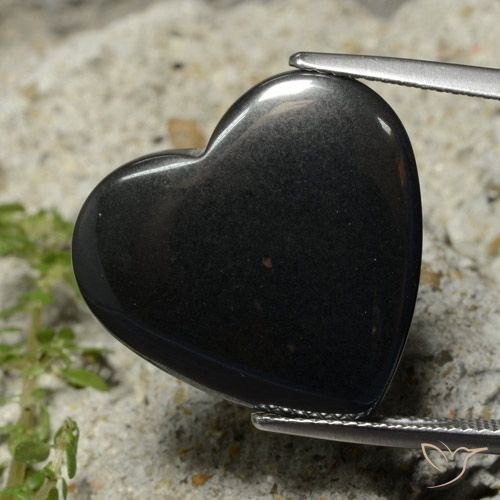
Genuine black spinel is opaque with a high polish and a slightly cool touch. Most confusion happens with other black stones rather than with outright fakes.
Common substitutes include black onyx (softer, Mohs 6.5 to 7), black tourmaline (different crystal habit), jet (much softer and warmer), obsidian (glass-like, showing conchoidal fracture), and black glass (often with visible mold seams or bubbles).
The most reliable check is a gemological test for refractive index (approximately 1.718 to 1.735) and specific gravity (3.58 to 3.90). Black spinel's cubic crystal habit means that rough crystals, when present, show octahedral form, distinguishing it from tourmaline's trigonal prisms.
Under magnification, natural black spinel shows angular inclusions and occasional mineral growth features, while glass imitations show curved bubbles, swirl marks, and mold seams.
Practical at-home clues include the scratch test (black spinel scratches onyx and glass easily, while onyx does not scratch black spinel), weight in hand (black spinel is denser than glass and jet, similar to onyx), and visual inspection for surface quality (black spinel takes a cleaner, glossier polish than matte-finished black stones).
Because the stone is relatively inexpensive and untreated, laboratory confirmation is usually only worth the cost for larger or designer-grade pieces.
Black Spinel Jewelry & Gifts
Black spinel pricing is reasonable for the quality. Small faceted stones under one carat run $10 to $30, one to two carat stones $30 to $70 per carat, and larger clean stones above five carats $50 to $100 per carat.
Cabochons, beads, and bracelet strands typically sell for $15 to $80 depending on length and bead size. Pendants and rings in silver settings run $40 to $200, while designer pieces in gold or platinum command premium pricing based on workmanship rather than gem rarity.
Most commercial black spinel comes from Thailand (Chanthaburi remains the dominant cutting center), Sri Lanka, Myanmar, and Cambodia. Thai stones supply the bulk of the mass market, while Sri Lankan material sometimes trades at a modest premium for historical provenance.
Treatments are uncommon for black spinel; the stone is typically sold untreated, which is a selling point compared with many other colored gems. For buyers, look for clean polish, no visible surface pits, and consistent glossy finish; black spinel's appeal rests entirely on surface quality since color is uniform across the variety.
Where to Buy Black Spinel
Affiliate disclosure: Some links below earn us a small commission at no extra cost to you. See our affiliate disclosure page.
Handmade, raw, and tumbled pieces from independent sellers worldwide.
Shop Black Spinel on Etsy →Accessories, tools, and specimen sets with fast Prime delivery.
Shop Black Spinel on Amazon →Certified loose gemstones graded and photographed for online buyers.
Shop Black Spinel on GemSelect →Pairs Well With




Where Black Spinel Is Found


