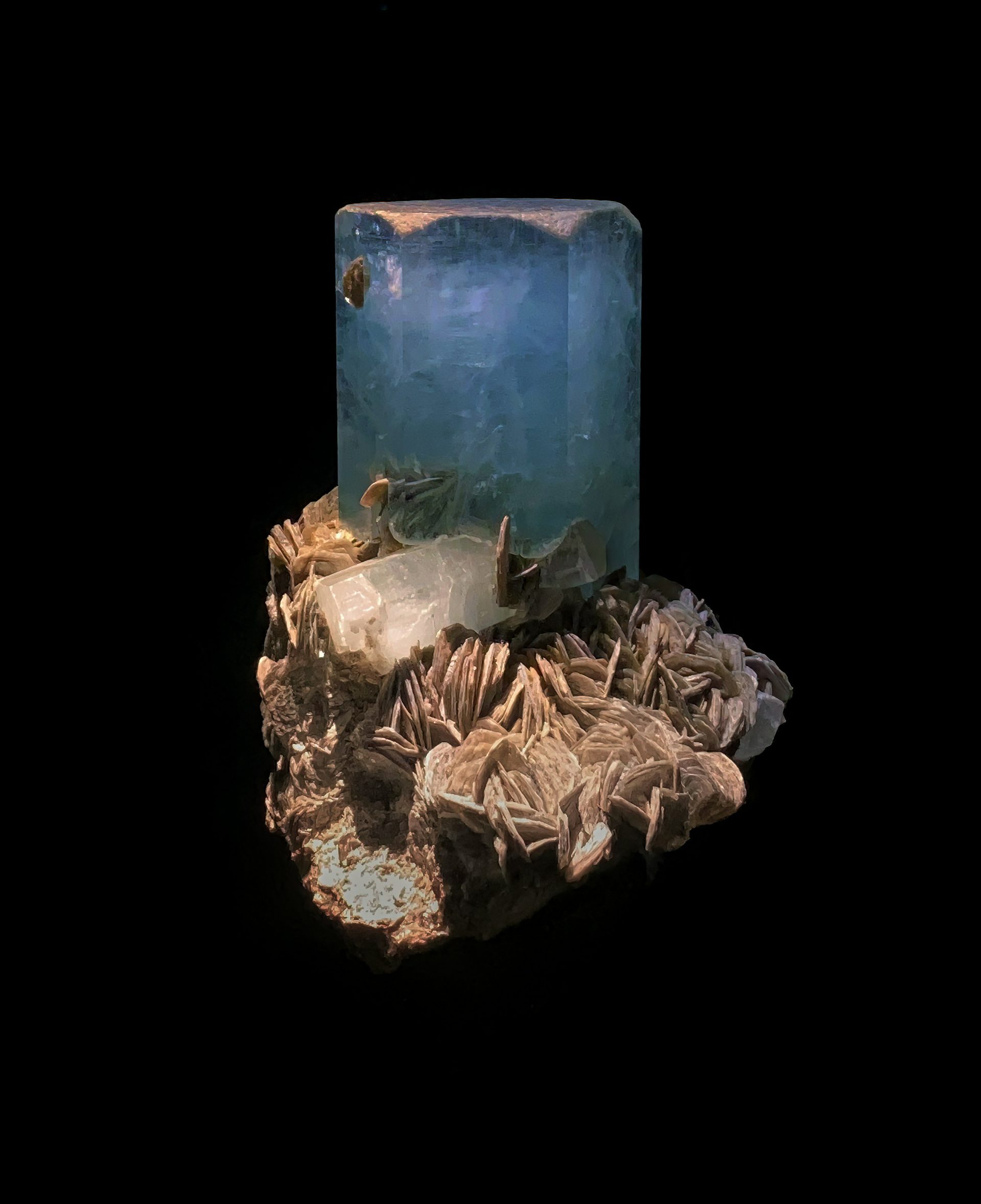
Blue Quartz
The gentle communicator's stone - soft blue clarity for calm minds and open expression, formed when blue mineral inclusions suffuse common quartz with a peaceful midday-sky hue.
- Most blue quartz owes its color to microscopic inclusions of dumortierite, a mineral named after a French paleontologist - not to any color-causing element in the quartz itself.
- Dumortierite quartz from Arizona was historically used in the porcelain industry because its extreme hardness made it ideal for grinding wheels and abrasive applications.
- Some "blue quartz" sold in markets is actually blue-dyed quartzite - similar mineral but much lower quality with color that fades over time when exposed to water.
- True single-crystal blue quartz points are extremely rare; most blue quartz specimens are cut from massive (non-crystalline) deposits and have no natural termination.
- Blue quartz can exhibit a silky chatoyancy (cat's eye effect) when the fiber inclusions are densely and uniformly aligned - a rare and valuable variant called blue quartz cat's eye.
- those working on clear communication
- meditation and mindfulness practitioners
- anxiety-prone individuals drawn to calming stones
- speakers, teachers, and counselors
- those drawn to sky and water color energies
- collectors seeking rare or high-value specimens
- buyers wanting brilliant faceted gemstones
- those preferring vivid saturated colors
What Is Blue Quartz?
Blue Quartz is a collective term for quartz specimens with blue coloration, most commonly caused by microscopic inclusions of dumortierite, tourmaline, or riebeckite mineral fibers within the silica matrix. The host crystal is ordinary quartz; the color entirely comes from these inclusions rather than from the quartz itself.
The most commercially common type - dumortierite quartz - contains inclusions of the mineral dumortierite (an aluminum borosilicate), producing a consistent denim-blue to slate-blue color. This is the blue quartz most often seen in tumbles and carved pieces at crystal markets.
Rarer forms include tourmalinated blue quartz and naturally blue aventurescent quartz from India.
True single-crystal blue quartz is extremely rare; virtually all commercial blue quartz is massive material cut from large deposits in Brazil, Spain, or the American Southwest. Some "blue quartz" on the market is actually blue-dyed quartzite or glass - always verify with a reputable dealer.
Blue Quartz vs. Similar Blue Stones
| Property | Blue Quartz | Blue Lace Agate | Angelite |
|---|---|---|---|
| Hardness | 7 | 6.5-7 | 3.5 |
| Price/ct | $ Budget | $ Budget | $ Budget |
| Rarity | Common | Common | Common |
| Best For | Communication, calm | Gentle expression | Angelic connection |
Meaning and Symbolism
Blue quartz has long been associated with communication, mental clarity, and emotional calm across various cultural traditions. Its sky-colored hue naturally evokes openness, breath, and spaciousness - qualities valued in mindfulness and contemplative practices.
Practitioners traditionally link blue quartz to the throat chakra, believing it supports honest self-expression and helps release unexpressed thoughts or emotions that create internal tension. Many crystal healers use it specifically with clients working through social anxiety or communication blocks.
On a spiritual level, blue quartz is said to bridge the emotional body and the intellect - a quality that makes it valued for writers, counselors, and anyone who works to translate inner experience into words.
It is also traditionally associated with third eye clarity and intuitive insight, though its throat connection is considered primary.
Historical Timeline
Healing Tradition
Emotional
Practitioners describe Blue Quartz as one of the most calming stones for anxiety and scattered thinking. It is said to gently slow racing thoughts and bring a sense of mental spaciousness, similar to the felt sense of a clear blue sky above stress and noise.
Many crystal healers use it for clients who struggle with overthinking, social anxiety, or difficulty expressing emotions clearly. The stone is traditionally associated with patience and perspective, helping users see past immediate emotional reactivity to a broader view.
Spiritual
Blue quartz is believed to activate both the throat and third eye chakras, supporting not only clear speech but also the inner clarity that makes genuine communication possible. Practitioners use it in meditation to access what they describe as a quiet, spacious state of awareness - a temporary rest from mental chatter.
Some traditions associate blue quartz with angelic communication and spiritual guidance through dreams. It is said to support discernment, helping one distinguish inner wisdom from fear-based thinking.
Physical
Some crystal wellness practitioners associate Blue Quartz with respiratory system support, throat and thyroid health, and relief from tension headaches related to stress. It is traditionally used in placement on the throat during energy healing sessions. No scientific evidence supports these associations. Always consult a qualified healthcare provider for medical concerns.
Zodiac, Birthstone and Gifts
Gemini's mercurial communication energy resonates with blue quartz's throat chakra support - the stone is said to help Geminis channel their quick mental energy into clear, grounded expression. Libra's diplomatic nature and appreciation for harmonious communication makes blue quartz a natural ally for balance-seeking Libran energy.
Care and Cleansing
Blue quartz is water-safe and can be briefly rinsed under cool running water while holding the intention of clearing accumulated energy. Dry immediately and thoroughly. Avoid soaking, which can dull polished surfaces and potentially affect any synthetic treatments if present.
Sound cleansing is particularly well-suited to blue quartz - the stone is associated with the throat (sound) chakra, and many practitioners consider sound the most aligned method. A singing bowl, tuning fork, or even humming directly over the stone for 2-3 minutes is considered effective.
Moonlight bathing under a full moon is the preferred energetic cleanse for blue quartz in most crystal traditions. The lunar association complements blue quartz's intuitive and calming qualities, and unlike sunlight, moonlight poses no risk to color stability.
- DO rinse briefly in cool water for physical cleaning; dry immediately after.
- DO NOT expose to prolonged direct sunlight as some blue quartz types may fade over time.
- DO NOT use ultrasonic cleaners as inclusion-heavy varieties may have internal fractures.
- NOTE that dyed blue quartzite is often sold as blue quartz - check for color running into crevices or uneven coating under magnification.
- DO NOT store with corundum, topaz, or other minerals harder than 7 that could scratch the surface.
Real vs Fake
Genuine blue quartz (dumortierite variety) has color distributed evenly throughout the stone from microscopic inclusions - the blue is internal, not a surface coating. Holding it to strong light shows the color continues through the material without concentration at edges.
Dyed quartzite fakes often show color concentrated in cracks and surface crevices under magnification. When soaked in water and dried, dyed material sometimes shows slight color bleeding. The color is also often unnaturally vivid compared to the muted slate-blue of real dumortierite quartz.
Glass fakes are uniformly translucent with no internal texture and no visible inclusions. They also warm in the hand much faster than genuine quartz. Real blue quartz has a slight graininess or silky texture visible under a loupe.
Ask sellers specifically whether the material is dumortierite quartz, tourmalinated quartz, or another identified variety. Vague "blue quartz" labeling without mineral identification warrants extra scrutiny.
The most trustworthy sources are mineral dealers with locality data (Brazil, Arizona, Spain) and photos showing the raw material alongside the finished piece. Mass-market crystal retailers rarely provide this level of documentation.
Blue Quartz Jewelry & Gifts
Blue quartz is one of the most affordable crystals available - tumbled pieces run $3-$15, small towers $10-$35, and larger display pieces $40-$120. This accessibility makes it an excellent entry point for those drawn to blue stones.
Dumortierite quartz is the most common and authentic variety - look for a consistent denim to slate blue with a slightly silky or granular texture when examined closely. This material comes primarily from Brazil and Arizona.
Color depth and evenness are the primary quality factors - avoid pieces with obvious gray patches, dull streaks, or unnaturally bright color that suggests treatment. Medium, consistent blue throughout the specimen is the quality standard.
"Blue aventurine" from India is often sold alongside blue quartz - it is a genuine quartz-family stone with sparkle from fuchsite mica rather than blue color from dumortierite. Both are real and legitimate; the distinction matters for those seeking specific properties.
For carved pieces like spheres, towers, and hearts, ensure the carver has preserved some color depth and the piece has a smooth, consistent finish without edge chips that indicate low-quality rough material was used.
Where to Buy Blue Quartz
Affiliate disclosure: Some links below earn us a small commission at no extra cost to you. See our affiliate disclosure page.
Handmade, raw, and tumbled pieces from independent sellers worldwide.
Shop Blue Quartz on Etsy →Accessories, tools, and specimen sets with fast Prime delivery.
Shop Blue Quartz on Amazon →Certified loose gemstones graded and photographed for online buyers.
Shop Blue Quartz on GemSelect →Pairs Well With



Where Blue Quartz Is Found


