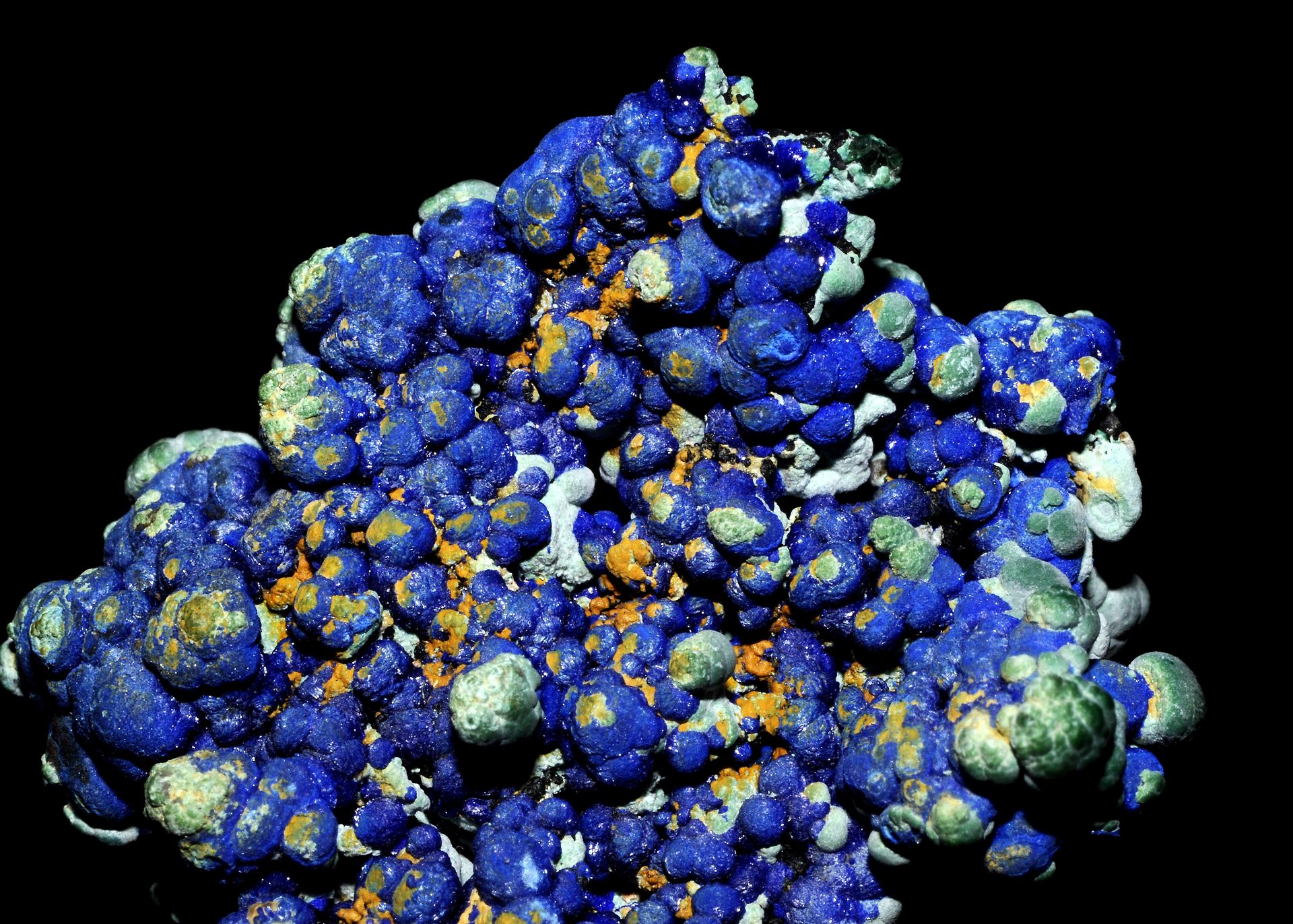
Bluebird Azurite
One of nature's most vivid blues, this rich copper carbonate forms in oxidized copper deposits and has captivated artists, healers
- Azurite slowly converts to malachite over geological time - many ancient paintings that once showed blue skies have greened as their azurite pigment transformed.
- The Bluebird Mine in Miami, Arizona is one of the most cited localities for American azurite specimens in major museum collections.
- Azurite's extreme color saturation - among the deepest natural blues in the mineral kingdom - made it irreplaceable as an artist's pigment for over 3,000 years.
- The mineral is closely related to malachite: both are copper carbonates, differing only in their OH-to-CO₃ ratio and crystal structure.
- High-quality transparent azurite crystals have been faceted into collector gemstones, with the intense blue color rivaling fine sapphire in visual impact.
- mineral collectors
- metaphysical practitioners
- throat and third eye workers
- artists and art historians
- copper mineral enthusiasts
- everyday jewelry wearers
- water elixir users
- high-durability seekers
What Is Bluebird Azurite?
Bluebird Azurite is a marketing and collector trade name for richly colored azurite material, originally associated with the Bluebird Mine in Miami, Arizona, one of America's most celebrated copper deposit localities. It rates 3.5–4 on the Mohs hardness scale.
Azurite itself is a copper carbonate hydroxide mineral formed through the weathering of copper ore deposits, where it produces some of the most intense natural blues found in any mineral on Earth.
The mineral forms as prismatic or tabular monoclinic crystals, nodules, or massive material, frequently occurring alongside its green cousin malachite, which forms as azurite continues to weather. This azurite-malachite combination produces striking blue-green specimens treasured by collectors worldwide.
At 3.5 to 4 on the Mohs scale, azurite is too soft for most jewelry without protective settings.
Azurite has been prized since antiquity as a blue pigment in Egyptian tomb paintings, medieval illuminated manuscripts, and Renaissance oil paintings. The name derives from the Persian word for blue, 'lazhward.' The Bluebird Mine name elevates the standard azurite brand with associations of exceptional color saturation from a storied American copper mining region.
Bluebird Azurite vs. Similar Blue Collector Minerals
| Feature | Bluebird Azurite | Lapis Lazuli | Blue Chrysocolla |
|---|---|---|---|
| Mohs hardness | 3.5–4 | 5–6 | 2–4 |
| Color source | Copper carbonate | Lazurite + calcite | Copper silicate |
| Blue intensity | Extreme | Medium-high | Medium |
| Jewelry suitability | Limited (soft) | Good | Limited (soft) |
Meaning and Symbolism
Azurite has been called the 'Stone of Heaven' in various metaphysical traditions, associated with clarity of mind, expanded perception, and access to higher guidance. Practitioners believe it activates the third eye, making it a classic tool for meditation, intuitive development, and mental focus.
Its deep celestial blue is considered a visual expression of inner sky and boundless awareness.
The mineral is said to dissolve mental blockages and old thought patterns that limit growth, replacing confusion with insight and uncertainty with trust in one's own perception. Practitioners use it in journaling rituals, creative work, and visioning practices where clear thinking and inspired ideas are the desired outcomes.
It is traditionally associated with the writer, the philosopher, and the student of life.
Bluebird Azurite is also linked to honest communication in metaphysical traditions, bridging the throat and third eye so that what one perceives internally can be expressed clearly and with integrity. Practitioners believe it supports courageous truth-telling and the willingness to speak one's genuine understanding even when difficult.
Historical Timeline
Healing Tradition
Emotional
Practitioners believe bluebird azurite cuts through confusion and emotional fog, bringing mental clarity to situations where conflicting feelings have made it hard to see clearly. It is associated with releasing fear-based thinking and replacing it with grounded, perceptive awareness.
Spiritual
Azurite is regarded as one of the premier third eye activators in crystal healing traditions, said to expand psychic perception, enhance dream recall, and deepen meditation. Practitioners use it to access higher states of awareness and connect with inner wisdom beyond surface-level thought.
Physical
In crystal healing traditions, azurite is associated with cognitive function, mental acuity, and the nervous system. These associations are not medically verified and should not replace professional medical care or treatment.
Zodiac, Birthstone and Gifts
Bluebird Azurite is traditionally associated with Sagittarius, whose love of philosophical truth and expanded vision resonates with the stone's clarity-enhancing qualities, and with Aquarius, whose intellectual independence and visionary nature aligns with azurite's associations of mental insight and original thinking.
Care and Cleansing
Never cleanse azurite with water, salt, or salt water. Azurite's copper content means it should not be used to make direct-contact gem water or elixirs. Its carbonate structure is also sensitive to acid, moisture, and prolonged heat, making dry cleansing methods essential.
Smudging with sage, cedar, or palo santo smoke is the safest and most commonly recommended cleansing method for azurite. Pass the specimen slowly through the smoke several times with a clear intention of releasing any accumulated energy. This method poses no physical risk to the mineral.
Sound cleansing using a singing bowl, tuning fork, or bells is another excellent option. Place azurite near the bowl and allow the vibrational sound waves to clear the stone. Practitioners also use moonlight cleansing, setting the specimen on a covered windowsill on clear nights to avoid dew.
- DO NOT expose azurite to water, humidity, or salt; copper carbonate is chemically reactive and can corrode or fade with moisture contact.
- DO NOT place azurite in prolonged direct sunlight; UV exposure slowly converts it to green malachite, permanently altering the blue color.
- DO NOT make gem water or elixirs with azurite; copper leaches into water and is not safe for ingestion.
- NOTE: Store azurite away from harder stones; its 3.5–4 Mohs hardness makes it vulnerable to scratching from most other gem minerals.
- DO handle azurite specimens carefully and display them in stable, covered cases to minimize dust buildup and accidental mechanical damage.
Real vs Fake
Authentic azurite is identified by its extraordinary deep blue color, which tends toward royal or azure hues distinct from the more violet-blue of lapis lazuli or the lighter teal-blue of chrysocolla.
Genuine azurite crystals or nodules will also show the characteristic vitreous to adamantine luster unique to carbonate minerals, which differs from the waxy or dull finish of glass or plastic imitations.
Blue dyed howlite and blue-dyed magnesite are the most common azurite imitations sold in the mass market. These dyed stones can appear convincingly blue but lack azurite's distinctive luster, and their dye often rubs off on skin or fabric.
A simple scratch test with a copper coin (3 Mohs) will scratch dyed howlite more easily than genuine azurite at 3.5 to 4 Mohs.
Azurite-malachite specimens - the natural blue and green combination - are nearly impossible to fake convincingly because the patterning is geological and organic. Composite stones made from powdered material do exist in the lower-price market; look for unnatural uniformity of color and pattern as a warning sign.
The 'Bluebird' trade name refers to material historically associated with the Bluebird Mine in Arizona, but the name is used loosely by some dealers to describe any high-quality azurite. Ask for clear locality documentation when purchasing labeled Bluebird material, particularly for higher-priced specimens.
For high-value specimens, consult a certified mineralogist or purchase from dealers affiliated with recognized mineral shows or institutions. Reputable mineral dealers provide locality, formation type, and acquisition chain documentation for significant collector pieces.
Bluebird Azurite Jewelry & Gifts
Bluebird azurite is acquired primarily through the mineral specimen market at gem shows, reputable online dealers, and mineral auctions rather than conventional jewelry retailers. The specimen market rewards collectors who can evaluate color intensity, crystal formation, and documented locality.
Small azurite nodules and modest matrix specimens typically range from $20 to $80, offering accessible entry points for collectors. Museum-quality crystal specimens from Arizona's Bluebird Mine or classic Moroccan and Namibian localities range from $150 to $600 or more depending on size, crystal definition, and color saturation.
The finest azurite specimens exhibit deeply saturated royal blue crystal clusters, minimal surface weathering, and strong vitreous luster. Azurite-malachite combinations showing clean boundary zones between blue and green fetch additional premiums for their visual drama. Matrix quality - whether the host rock shows well or detracts - also influences price significantly.
Locality is the dominant value factor. Arizona Bluebird Mine specimens command the highest prices among American material, while Tsumeb (Namibia) and Milpillas (Mexico) azurite specimens are among the most valued worldwide. Specimens with clear, verified provenance command stronger prices and hold value better than unlabeled material.
No standard gemological treatments are applied to azurite specimens. Some dealers apply a light wax or lacquer coating to stabilize fragile crystals - always ask whether any surface treatment has been used, as this affects both value and the specimen's interaction with light.
Where to Buy Bluebird Azurite
Affiliate disclosure: Some links below earn us a small commission at no extra cost to you. See our affiliate disclosure page.
Handmade, raw, and tumbled pieces from independent sellers worldwide.
Shop Bluebird Azurite on Etsy →Accessories, tools, and specimen sets with fast Prime delivery.
Shop Bluebird Azurite on Amazon →Certified loose gemstones graded and photographed for online buyers.
Shop Bluebird Azurite on GemSelect →Pairs Well With



Where Bluebird Azurite Is Found


