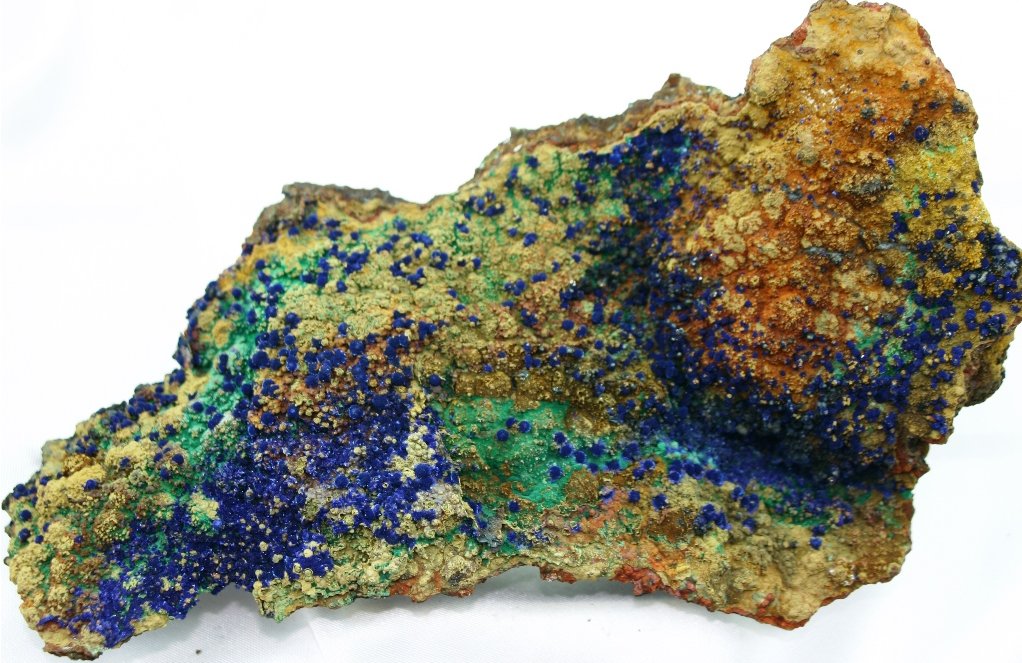
Azurite-Malachite
A stunning natural pairing of deep royal-blue azurite and vivid emerald-green malachite, formed together in copper ore zones.
- Azurite naturally converts to malachite over time as CO2 reacts with the copper carbonate - your specimen is literally in mid-transformation.
- Medieval European painters used ground azurite as their primary blue pigment for centuries before synthetic ultramarine was developed.
- The Malachite Room in Russia's Winter Palace is paneled floor-to-ceiling in Ural Mountain malachite - a 19th-century display of imperial wealth.
- Azurite's specific gravity of 3.77 makes it noticeably heavier than most stones of similar size - a useful identification test.
- Bisbee, Arizona's Copper Queen Mine produced azurite-malachite specimens so fine they now command premium prices in international mineral auctions.
- Mineral collectors who want a visually spectacular display specimen with genuine geological rarity
- Throat and third eye chakra practitioners who value visual drama in their crystal toolkit
- Gift givers seeking a unique, conversation-starting piece for an art-loving or earth-science friend
- Interior designers looking for vivid natural blue-green color without artificial dye
- Experienced crystal practitioners comfortable with soft stone care requirements
- Children or pet owners - copper carbonate dust from damaged specimens requires careful handling; choose blue lace agate for safer alternatives
- Jewelry wearers seeking a daily-wear stone - Mohs 3.5-4 is too soft for rings and bracelets; consider turquoise instead
- Those wanting water-safe stones for soaking or elixirs - copper minerals leach into water and are toxic if ingested
What Is Azurite-Malachite?
Azurite-malachite is a natural intergrowth of two copper carbonate hydroxide minerals - azurite (Cu3(CO3)2(OH)2) and malachite (Cu2CO3(OH)2) - that form together in the oxidized zones of copper ore deposits. Azurite contributes intense royal blue, while malachite provides banded emerald green. The combination produces some of the most visually striking specimens in mineralogy.
Both minerals share a monoclinic crystal system and nearly identical Mohs hardness of 3.5 to 4, making combined specimens internally consistent in terms of durability.
Azurite is metastable and naturally converts to malachite over geological time as carbon dioxide interacts with the copper carbonate - meaning azurite-malachite specimens preserve a transitional mineral state. Specific gravity ranges 3.7 to 3.9, noticeably heavy for the stone's size.
The world's finest azurite-malachite specimens come from Touissit and Mibladen in Morocco, the Kolwezi district of the Democratic Republic of Congo, and historic US deposits in Bisbee, Arizona, where the Copper Queen Mine produced museum-quality material.
Russian deposits at the Ural Mountains also yielded significant malachite with azurite, much of which was carved into decorative objects in the 19th century.
How Azurite-Malachite Compares
| Property | Azurite-Malachite | Turquoise | Chrysocolla |
|---|---|---|---|
| Hardness | 3.5 - 4 | 5 - 6 | 2 - 4 |
| Price / piece | $ Budget | $ Budget | $ Budget |
| Visual Appeal | Very High - dual color | High - sky blue | High - blue-green |
| Best For | Display, collecting | Jewelry, gifts | Display, meditation |
Meaning and Symbolism
Azurite's vivid blue has held cross-cultural significance for millennia. Ancient Egyptians ground azurite into blue pigment for cosmetics and painting; the Mayans used it ceremonially; and medieval European artists relied on azurite as a primary blue pigment before synthetic alternatives appeared.
The mineral carried associations with heavenly sky and divine authority across many traditions.
Malachite has equally ancient roots as a protective amulet in ancient Egypt and Rome, where it was carved into scarabs, jewelry, and protective talismans for children. Russian aristocracy used Ural Mountain malachite to panel entire rooms in the 19th century, including the famous Malachite Room in the Winter Palace.
The green color linked it to Venus, fertility, and natural abundance.
Together as azurite-malachite, practitioners describe a stone that bridges heaven and earth - blue sky above, green growing world below. In modern crystal healing tradition, the combination is said to facilitate insight (azurite's third eye energy) expressed through clear communication (malachite's heart and throat energy).
Many practitioners see the mineral transition from azurite to malachite as a symbol of transformation and evolution.
Historical Timeline
Healing Tradition
Emotional
Practitioners believe azurite-malachite combines two distinct emotional healing traditions in one stone. Azurite is said to support mental clarity, insight, and the release of limiting beliefs, while malachite is traditionally associated with emotional protection, heart healing, and the courage to change.
Many crystal workers describe the pairing as useful for moments when deep emotional truth needs to be seen clearly and then communicated honestly. The stone is used at the throat chakra by practitioners who want to articulate difficult feelings with compassion rather than reactivity.
It is traditionally associated with transformation - the courage to see what is true and act accordingly.
Spiritual
In crystal healing tradition, azurite's deep blue is associated with the third eye chakra and expanded intuitive perception, while malachite resonates with the heart and throat.
Practitioners use azurite-malachite to bridge intuitive knowing and clear verbal expression, describing it as useful for teachers, healers, and communicators who want their words to reflect genuine inner wisdom. The stone's geological nature - one mineral transforming into another - makes it a potent symbol in transformational ritual work.
Many practitioners use it during vision-setting practices at seasonal transitions, invoking its mineral transformation as a template for personal change.
Physical
Practitioners traditionally place azurite-malachite in wellness spaces for its visual and energetic presence, noting its copper mineral base has long been associated with joint and inflammatory conditions in folk traditions. Crystal healers sometimes position it near the upper chest and throat during relaxation sessions, following its chakra associations.
Important caution: azurite-malachite dust and water elixirs are potentially toxic due to copper content - handle with care, wash hands after touching, and never make water elixirs from this stone. Use it as a visual and meditative companion only, never in water-based wellness practices.
Zodiac, Birthstone and Gifts
Sagittarius, a sign associated with philosophical seeking and honest communication, resonates with azurite-malachite's dual tradition of insight and truth-telling. Practitioners suggest the stone supports Sagittarius's natural inclination toward wisdom and its occasional challenge of speaking bluntly rather than compassionately.
The third eye and throat chakra associations align with Sagittarius's quest for meaning expressed through words.
Capricorn's earth-sign practicality and affinity for transformative endurance connect to malachite's ancient protective tradition and azurite's capacity for clear-eyed realism. Practitioners recommend azurite-malachite for Capricorn individuals navigating major career or life structure changes, noting its symbolism of mineral transformation as resonant with Capricorn's steady, purposeful evolution.
Care and Cleansing
Never use water, salt, or wet methods to cleanse azurite-malachite. Both minerals are water-sensitive, and copper carbonates can leach harmful compounds into water. Salt can accelerate surface degradation of the soft carbonate surface. These are firm restrictions, not precautions - avoid all wet cleansing entirely.
Safe cleansing options include sound (singing bowls, bells, or tuning forks), moonlight on a dry windowsill, or selenite charging plates. Smudging with sage or palo santo is effective and completely safe.
Visualization cleansing - holding the stone and imagining light washing through it - is a traditional alternative that many practitioners use for delicate specimens like this one.
- DO NOT place in water, salt water, or use any wet cleansing method - copper minerals leach into water and the stone surface degrades.
- DO NOT make water elixirs or gem water with azurite-malachite - copper content is toxic if ingested.
- DO wash hands after handling, especially before touching face, eyes, or mouth.
- DO NOT expose to prolonged direct sunlight - azurite's vivid blue fades with sustained UV exposure.
- DO store on a padded surface away from harder minerals that could scratch the Mohs 3.5-4 surface.
- DO keep away from children and pets who may chew or lick mineral specimens.
- NOTE: surface dust from damaged azurite-malachite specimens should be handled with care; avoid inhaling mineral dust.
Real vs Fake
Genuine azurite-malachite specimens show natural transitional zones where deep azure blue gradually gives way to banded emerald green. The two colors merge in irregular, geologically authentic patterns - not sharp boundaries or perfectly alternating bands.
The surface often shows the characteristic concentric banding of malachite alongside azurite's more massive or crystalline blue zones.
Synthetic substitutes include dyed howlite or dyed jasper in blue-green tones, and resin composites that blend ground azurite and malachite with binder. Genuine specimens feel notably heavy for their size (specific gravity 3.7-3.9), while lightweight fakes with similar color are immediately suspicious.
Resin composites often show uniform texture without the surface variation of natural mineral.
The most reliable test is surface examination under magnification. Natural azurite-malachite shows genuine mineral crystal structure - malachite's characteristic silky fibrous or botryoidal texture and azurite's vitreous to dull surface. Painted or dyed stones show color sitting on a uniform base material.
A professional gemologist can confirm identity with specific gravity measurement and spectroscopy.
Azurite-Malachite Jewelry & Gifts
Azurite-malachite prices vary widely based on the quality and proportion of vivid azurite blue against malachite green. Small cabinet specimens with good color start around $15 to $40, while quality display pieces with strong azure blue and clear mineral banding range from $50 to $200.
Museum-grade specimens from Moroccan or Arizona sources can reach several hundred dollars at mineral shows.
The most desirable specimens show a generous proportion of deep, saturated azurite blue - this is the rarer and more visually dramatic component. Malachite-dominant pieces with minor azurite are less valued than those with roughly equal or azurite-heavy distribution.
Botryoidal (rounded grape-like) texture in the malachite zones alongside crystalline azurite clusters is considered optimal.
Buy from mineral dealers and reputable crystal shops rather than generic marketplaces where provenance is unclear. Moroccan material from Touissit and Mibladen mines is the most consistently available quality source. Ask about origin when purchasing display pieces - Arizona and Congolese specimens often command premium prices due to historical and quality associations.
Where to Buy Azurite-Malachite
Affiliate disclosure: Some links below earn us a small commission at no extra cost to you. See our affiliate disclosure page.
Handmade, raw, and tumbled pieces from independent sellers worldwide.
Shop Azurite-Malachite on Etsy →Accessories, tools, and specimen sets with fast Prime delivery.
Shop Azurite-Malachite on Amazon →Certified loose gemstones graded and photographed for online buyers.
Shop Azurite-Malachite on GemSelect →Pairs Well With


Where Azurite-Malachite Is Found


