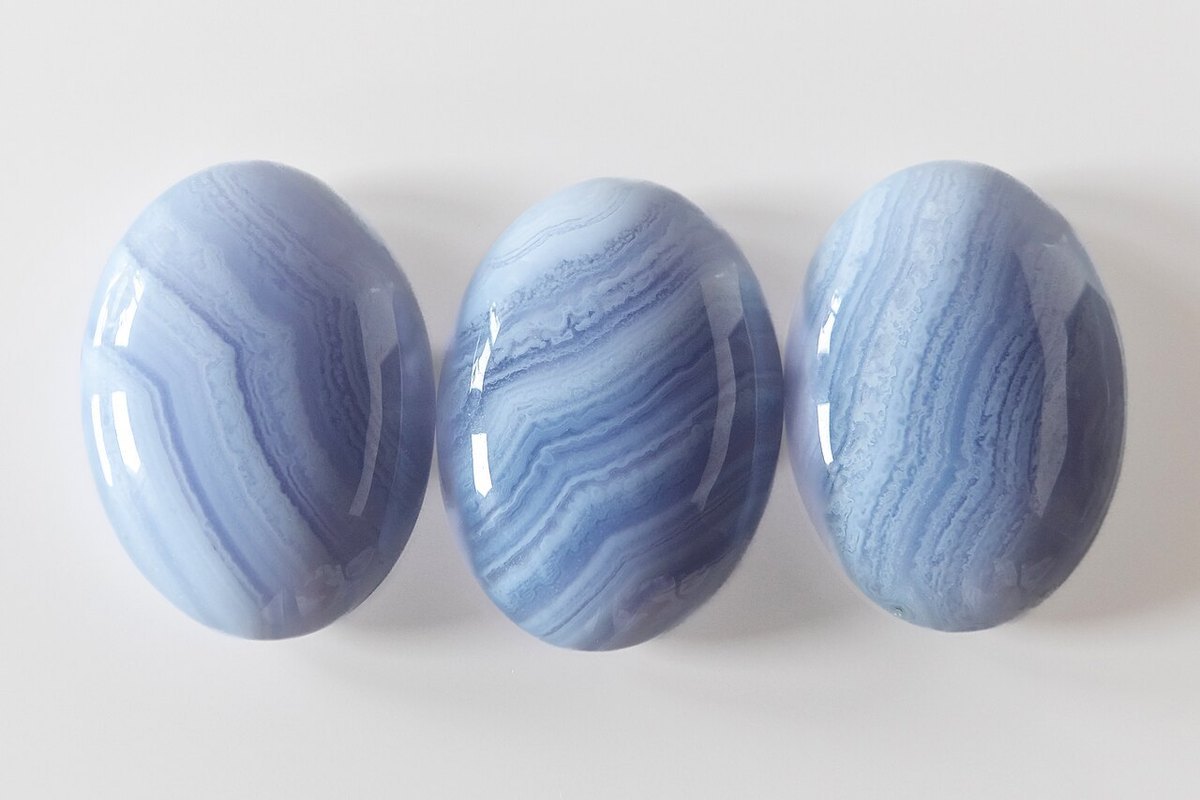
Blue Lace Agate
Soft sky-blue chalcedony banded with delicate lace-like patterns - blue lace agate is the gentle communication stone practitioners associate with calm speech and throat-chakra clarity.
- Blue lace agate's color comes from Rayleigh scattering, the same physics that makes the sky blue.
- The Ysterputs farm in Namibia is the only major commercial source.
- Each band in a cabochon can represent hundreds of thousands of years of silica deposition.
- Blue lace agate is often confused with blue chalcedony; the banding is the easy tell.
- Specimens lose their blue tint slightly under prolonged direct sunlight.
- Public speakers and teachers seeking voice support
- Anxious sleepers looking for calming bedside crystals
- Pisces and Gemini readers wanting a signature stone
- Spiritual practitioners working with the throat chakra
- Gift givers needing a soft-palette pastel stone
- Daily-wear ring buyers without bezel protection (try blue sapphire)
- Deep-color seekers (try lapis lazuli)
- Collectors wanting transparent facet-grade stones (try aquamarine)
What Is Blue Lace Agate?
Blue lace agate is a banded variety of chalcedony, which is the microcrystalline form of quartz with the formula SiO₂. What sets blue lace agate apart from other chalcedonies is its distinctive pattern of soft pale-blue and white bands in delicate parallel or wavy lines.
Often compared to lace fabric or watercolor brushstrokes. The color comes from tiny inclusions that scatter short-wavelength blue light rather than from trace elements, a physical-optical effect known as Rayleigh scattering.
The Ysterputs farm deposit in Namibia, discovered in the 1960s, produces the world's most recognized blue lace agate. The agate formed as silica-rich solutions filled cavities in ancient volcanic rocks, depositing layer after layer over millions of years.
Smaller deposits exist in South Africa, India, and Brazil, but Namibian material remains the benchmark for soft, evenly-banded blue color. Most retail blue lace agate reaching the US originates from this single region.
Blue lace agate has a Mohs hardness of 6.5 to 7 and no cleavage, giving it respectable everyday durability. Its specific gravity of approximately 2.58 to 2.64 matches other chalcedonies, and its refractive index of 1.530 to 1.540 is typical for the quartz family.
The stone takes a high polish, making it popular for cabochons, slabs, pendants, and tumbled pieces. It is commonly untreated, which adds to its value in the natural-stone market.
How Blue Lace Agate Compares
| Property | Blue Lace Agate | Aquamarine | Larimar |
|---|---|---|---|
| Hardness | 6.5 - 7 | 7.5 - 8 | 4.5 - 5 |
| Price / piece | $ Budget | $$ Mid-range | $ Budget |
| Transparency | Translucent | Transparent | Opaque |
| Best For | Meditation, casual jewelry | Fine jewelry | Statement jewelry |
Meaning and Symbolism
In crystal healing tradition, blue lace agate is considered one of the calmest of the agates. Practitioners associate its soft blue bands with peaceful communication, and the stone is commonly recommended for people who feel unheard or who struggle to speak up.
Many find blue lace agate especially suited to public-speaking rituals, where the stone is held or placed against the throat while rehearsing. The banded appearance is sometimes read as a visual metaphor for the layered nature of honest speech: each band a truth that builds on the last.
Because blue lace agate was only widely circulated after the 1960s Namibian discovery, it carries no ancient folklore. Its meaning was developed by mid-20th-century crystal authors who drew on general agate traditions of protection and balance, adding the specific throat-chakra associations that color theory suggested.
Today it is a staple recommendation for highly sensitive people, overstimulated workers, and anyone navigating hard conversations. Many users describe blue lace agate as a "dimmer switch" rather than an on-off calm.
Historical Timeline
Healing Tradition
Emotional
Blue lace agate is widely described by practitioners as a calming stone, and many find its pale blue color visually soothing during anxious moments. In crystal healing tradition the stone is said to support gentle honesty, helping users speak difficult truths without sharpness.
Readers who experience social anxiety often keep a tumbled blue lace agate in a pocket during events, reaching for it as a discreet grounding anchor. Many parents introduce blue lace agate to children as a first crystal because its soft color and smooth polish are inviting.
Practitioners believe the stone supports the nervous system response to overwhelm, though this is reported subjectively rather than demonstrated in controlled studies. Blue lace agate is also suggested for those who struggle with reactive anger, with crystal workers recommending a pause-and-hold ritual before responding to triggering messages.
These traditional uses are not a substitute for professional mental health care.
Spiritual
Blue lace agate is almost universally associated in modern crystal tradition with the throat chakra, which practitioners describe as the energy center governing expression and truth.
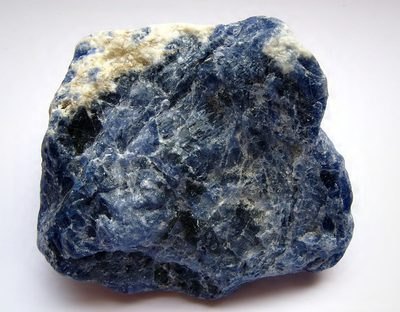
Many spiritual readers use blue lace agate in throat-chakra grids alongside aquamarine, sodalite, and lapis lazuli, placing the lace agate closest to the skin because of its gentle energy. Reiki practitioners sometimes hold a tumbled piece at the throat for one to three minutes during a session.
In guided meditation, blue lace agate is used to visualize layered clarity: imagining words becoming as smooth and flowing as the stone's bands. Some modern mystics also pair blue lace agate with selenite for what they describe as angelic communication work. These associations reflect late-20th-century crystal practice rather than historical tradition.
Physical
Practitioners believe blue lace agate offers symbolic support for the throat, thyroid, lymph, and voice, reflecting the traditional throat-chakra mapping. Some crystal healers use blue lace agate during vocal warmups or after overusing the voice, holding the stone to the throat as a reminder to rest and hydrate.
In folklore the stone is said to help readers recover after tension headaches, though no gemstone has been demonstrated in peer-reviewed research to relieve physical pain. Blue lace agate is safe for brief skin contact and is commonly set into neck jewelry. It is not a substitute for medical care.
Readers with thyroid conditions, voice problems, or other ongoing concerns should see a qualified clinician.
Zodiac, Birthstone and Gifts
Blue lace agate is not a traditional birthstone, but modern crystal astrology commonly links it to Pisces and Gemini. Pisces readers gravitate to blue lace agate for its watery calmness and its role in gentle communication, both aligned with the sign's emotional sensitivity.
Gemini readers use blue lace agate for the throat-chakra support that underwrites clear speech, a Gemini strength. Some astrologers also recommend the stone for Aquarius because of its soft blue tone and airy symbolism.
Regardless of sign, many crystal practitioners suggest blue lace agate to anyone entering a season of public speaking, negotiations, or difficult family conversations.
Care and Cleansing
Blue lace agate is safe for most common cleansing methods. Wash under running water with a drop of mild soap and a soft brush, then pat dry. The stone tolerates brief salt-water rinses and short sunlight exposure for cleansing, though sustained sun will fade the blue.
Ultrasonic cleaners are generally safe for untreated stones but should be avoided if the piece has been stabilized or dyed. Warm water and gentle detergent handle normal skin-oil buildup.
For energetic cleansing, practitioners recommend moonlight overnight, smoke cleansing with sage or cedar, sound baths with a singing bowl, or placement on a selenite plate. Blue lace agate pairs especially well with selenite because both stones are considered gentle.
Cleanse after difficult conversations, long days of teaching or speaking, or before using the stone in meditation. Many practitioners cleanse blue lace agate weekly if it is worn daily.
- DO avoid prolonged direct sunlight to preserve the blue tone.
- DO clean with warm water and mild soap.
- DO NOT drop onto hard floors; chalcedony can chip at edges.
- DO store separately from harder stones to avoid scratches.
- DO NOT expose to acidic cleaners or household ammonia.
- Note: blue lace agate tolerates brief water contact, so showering with jewelry is acceptable but not ideal.
- DO wipe with a soft cloth after wear to remove skin oils.
Real vs Fake
Genuine blue lace agate shows irregular, organic banding where each band has slightly different width, opacity, and color intensity. Under a loupe, the stone reveals fine microcrystalline texture rather than glassy uniformity.
Specific gravity of approximately 2.58 to 2.64 confirms chalcedony, and a refractive index reading of 1.530 to 1.540 rules out glass and most plastics. The banding should bend around surface curvature naturally rather than appearing painted on.
Dyed howlite is the most common imitation of blue lace agate. Howlite is a white porous mineral that absorbs dye unevenly, producing bold uniform blue with hairline black fractures from its natural veining; it lacks the soft scattered blue of true lace agate.
Dyed blue agate without the characteristic lace pattern is also sometimes sold as blue lace. Glass imitations show bubbles and swirl marks and feel lighter than expected. Plastic imitations feel warm to the touch and dent under a fingernail.
Treatment in blue lace agate is uncommon because the natural material is already beautiful and affordable. Occasional stabilization with resin exists for specimens with fractures, and sellers should disclose this. For high-value cabochons or sculptural pieces over $100, ask the seller if any treatment has been used.
Small-scale dyeing can intensify the blue of poor-color material; a rolled cotton swab with acetone will lift dye from a treated stone.
Blue Lace Agate Jewelry & Gifts
Blue lace agate is affordable across its quality range. Small tumbled pieces cost $3 to $10, cabochons run $10 to $40, and fine slabs and specimen hand-pieces with well-developed lace banding reach $50 to $200. Large carved sculptures and exceptional Namibian pieces with strong saturated blue can exceed $300.
Jewelry pieces in silver mounts typically retail between $25 and $150 for pendants and earrings.
When buying, prioritize pieces with clear flowing bands and even blue color rather than patchy or grayish specimens. Ysterputs Namibian material remains the benchmark. South African and Indian blue lace agate tends to be paler with coarser banding; these are legitimate alternatives at lower prices.
Ask sellers whether the stone has been dyed; untreated natural material is the norm and should be the default expectation. For online purchases, request multiple angles including a backlit photo that reveals the banding structure.
Where to Buy Blue Lace Agate
Affiliate disclosure: Some links below earn us a small commission at no extra cost to you. See our affiliate disclosure page.
Handmade, raw, and tumbled pieces from independent sellers worldwide.
Shop Blue Lace Agate on Etsy →Accessories, tools, and specimen sets with fast Prime delivery.
Shop Blue Lace Agate on Amazon →Certified loose gemstones graded and photographed for online buyers.
Shop Blue Lace Agate on GemSelect →Pairs Well With


Where Blue Lace Agate Is Found


