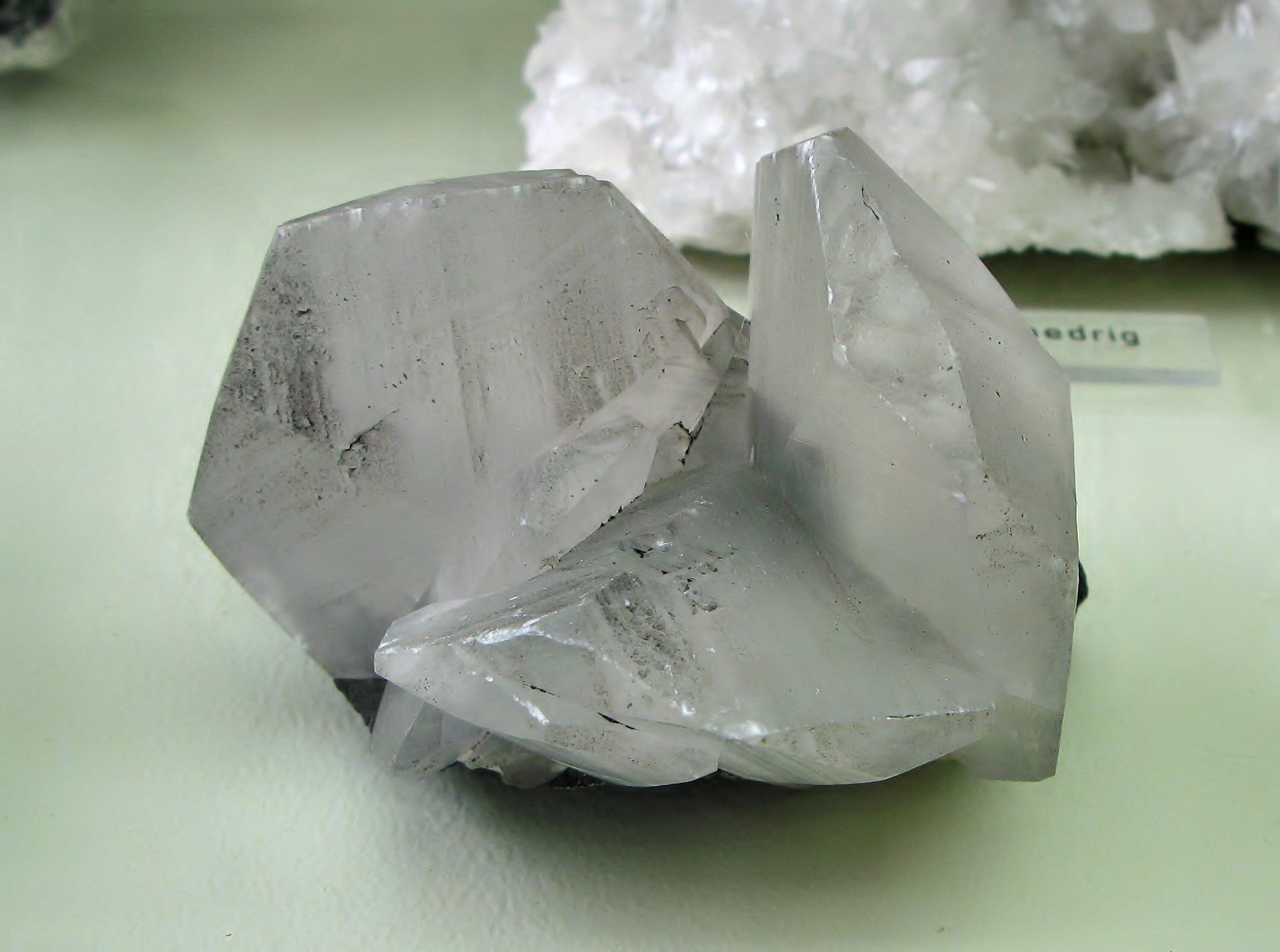
Calcite Rhombohedron
A perfectly cleaved calcite crystal in its natural rhombohedral form - ancient navigators used it to locate the sun through overcast skies.
- A calcite rhombohedron's double refraction (birefringence 0.172) is so strong that a line of text beneath the crystal appears to split into two clearly separate images.
- Iceland spar calcite from Helgustadir, Iceland, was so important to early optics that the mine was quarried extensively in the 17th-19th centuries for scientific instruments.
- The same double-refracting property that makes calcite useful in optics makes it the only common mineral where polarization of light is directly visible to the naked eye.
- Calcite is the primary mineral in marble, limestone, chalk, and coral - it is one of the most abundant minerals in Earth's crust.
- During World War II, optical-grade calcite was a classified strategic mineral used in targeting equipment.
- Collectors who appreciate mineralogy's most perfect natural geometric forms
- Science and optics enthusiasts - double refraction is directly visible in a quality specimen
- Crystal practitioners seeking clarity and amplification work
- Gift for a curious mind who loves unusual natural phenomena
- Display piece with genuine scientific history and optical properties
- Jewelry use - Mohs 3 scratches easily and perfect cleavage means it chips on impact
- Wet environments - calcite dissolves slowly in acidic or sustained water contact
- Those seeking rare stones - optical calcite is widely available and inexpensive
What Is Calcite Rhombohedron?
Calcite rhombohedra are natural cleavage fragments of calcium carbonate (CaCO3) that have broken along the mineral's three perfect cleavage planes, producing characteristic parallelogram-faced geometric forms. It rates 3 on the Mohs hardness scale.
The trigonal crystal system gives calcite **birefringence of 0.172** - the highest of any common mineral - making transparent specimens visibly split every line of text viewed through them into two separate images. This *double refraction* is immediately apparent to the naked eye.
The variety known as *Iceland spar* (originally from Helgustadir, Iceland) provided the historical material for Christiaan Huygens's 1678 discovery of double refraction and is thought to have been used by Norse Vikings as a navigational 'sunstone' to locate the sun through clouds.
Modern research published in 2013 in the Proceedings of the Royal Society A supports the navigational hypothesis based on the optical properties of the material.
Hardness is exactly 3 on the Mohs scale, and perfect cleavage in 3 directions means calcite breaks cleanly into perfect rhombohedra naturally. Specific gravity of 2.71 is standard. Optical-grade transparent material comes primarily from Iceland, Mexico (Chihuahua), and the United States.
Most commercially sold rhombohedra are cleavage pieces rather than natural crystal faces, but the form is geologically correct.
How Calcite Rhombohedron Compares
| Property | Optical Calcite | Clear Quartz | Selenite |
|---|---|---|---|
| Hardness | 3 | 7 | 2 |
| Birefringence | 0.172 (extreme) | None | 0.010 |
| Price / piece | $ Budget | $ Budget | $ Budget |
| Clarity | Very high | Variable | Translucent-opaque |
Meaning and Symbolism
The calcite rhombohedron is a crystal of clarity and amplification. Practitioners believe its ability to split light into two paths symbolizes the capacity to see two truths simultaneously - the literal and the symbolic, the personal and the universal, the seen and the unseen.
The stone is said to amplify intention and make subtle energies visible, much as it makes hidden optical phenomena visible.
In crystal healing tradition, optical calcite is associated with cutting through illusion and confusion, dissolving mental fog, and bringing clarity where ambiguity has accumulated. The crown and third eye associations reflect its transparency - a quality practitioners interpret as the absence of obscuration, the mineral equivalent of a clear, unfiltered view.
The Viking navigational legacy adds a layer of meaning around finding one's direction even when the sky is overcast - a natural metaphor for spiritual guidance in dark or uncertain times. Many practitioners who work with clarity and direction themes use calcite rhombohedra specifically for this symbolism.
Historical Timeline
Healing Tradition
Emotional
Practitioners believe calcite rhombohedra amplify emotional clarity and dissolve the confusion that accumulates when feelings are not examined. The stone is said to show things as they truly are rather than as fear or habit shapes them. Many find that meditating with optical calcite helps distinguish genuine emotion from conditioned response.
In crystal healing tradition, it is associated with the dissolution of self-deception and the courage to see clearly.
Spiritual
In crystal healing tradition, optical calcite amplifies spiritual intention and accelerates energy work, making it a popular addition to crystal grids as an activating element. The stone is said to help practitioners perceive the energy field more clearly and to bring subtle spiritual impressions into conscious awareness.
The crown and third eye associations link it to expanded consciousness and the reception of higher guidance. Many practitioners use it at the beginning of meditation to clear energetic static before deeper work.
Physical
Optical calcite is traditionally associated with supporting clarity of perception - including eyesight, mental acuity, and sensory awareness - in crystal healing tradition. The double-refracting optical property is taken as a symbolic link to the refinement of physical vision. Practitioners sometimes place it on the third eye or forehead during meditation.
Crystal practices are complementary to, not replacements for, professional medical care.
Zodiac, Birthstone and Gifts
Calcite rhombohedra are associated with Cancer and Pisces in crystal astrology - both water signs with strong intuitive and perceptive qualities. Cancer's connection to clarity of emotional truth and the Moon's reflective light resonates with optical calcite's amplifying and transparent nature.
Pisces's spiritual sensitivity and ability to perceive subtle realities aligns with the stone's third eye associations. Practitioners working with either sign often use optical calcite to enhance intuitive clarity and dissolve confusion in emotional or spiritual matters.
Care and Cleansing
Calcite dissolves slowly in acidic solutions and is weakened by extended water exposure. Use dry cleansing methods: moonlight, sunlight (brief), or selenite plates. These are the most effective and safest for the stone.
Sound cleansing is excellent for optical calcite - place a singing bowl nearby and let the vibration clear the stone without any physical contact or moisture risk. Use regularly for display pieces.
Smudging with sage or palo santo is safe and traditional. Pass through smoke gently for 30-60 seconds. Avoid acidic or salt-based methods entirely.
- DO NOT soak in water - calcite dissolves slowly in water; extended contact will etch the surface.
- DO NOT use salt cleansing - abrasive and reactive with carbonate chemistry.
- DO NOT store loose with harder stones - Mohs 3 scratches against virtually all other minerals.
- NOTE: Perfect rhombohedral cleavage means sharp impacts cause clean splitting - handle gently.
- DO wrap in soft cloth for transport to protect the naturally formed cleavage faces.
- NOTE: Optical calcite is non-toxic and safe - the only hazard is physical fragility.
Real vs Fake
Genuine calcite rhombohedra demonstrate double refraction visually - place any text beneath the crystal and observe whether a single line appears as two distinct lines. This test is definitive: no common imitation material shows birefringence approaching calcite's 0.172. Glass, plastic, and most other minerals show little or no visible doubling.
Test hardness: a copper coin (Mohs 3.5) should scratch calcite easily. Any material that resists a coin scratch is not calcite. Also test cleavage: genuine calcite, when broken or chipped, fractures along the 3 rhombohedral cleavage directions at characteristic ~75 degree angles.
Optical calcite is widely available and inexpensive, so there is minimal incentive to fake it with expensive materials. The primary concern is distinguishing optically clear material from milky or included material that shows poor double refraction.
Calcite Rhombohedron Jewelry & Gifts
Optical calcite rhombohedra are among the most affordable mineral specimens available. Small pieces (2-4 cm) that show clear double refraction start at $5-15. Larger, perfectly clear specimens with sharp cleavage faces and no inclusions range from $15-50. Museum-grade large Iceland spar with documented provenance can reach $100-300 for substantial display pieces.
Key quality factors: transparency (the more water-clear, the better the double refraction), size (larger pieces show the effect more dramatically), and sharpness of cleavage faces (clean, natural faces are more aesthetically pleasing than rough broken surfaces).
No treatments are applied to optical calcite. The clarity is entirely natural. Mexican and Icelandic material are both excellent; Iceland spar carries extra historical cachet.
Where to Buy Calcite Rhombohedron
Affiliate disclosure: Some links below earn us a small commission at no extra cost to you. See our affiliate disclosure page.
Handmade, raw, and tumbled pieces from independent sellers worldwide.
Shop Calcite Rhombohedron on Etsy →Accessories, tools, and specimen sets with fast Prime delivery.
Shop Calcite Rhombohedron on Amazon →Certified loose gemstones graded and photographed for online buyers.
Shop Calcite Rhombohedron on GemSelect →Pairs Well With


Where Calcite Rhombohedron Is Found


