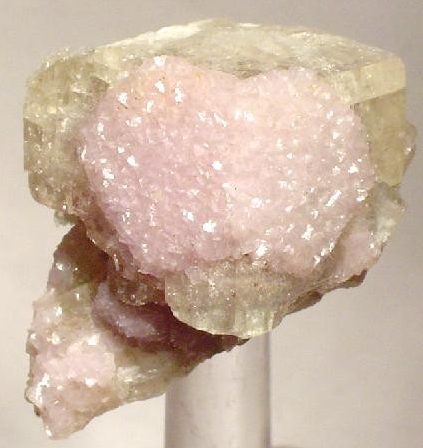
Cobaltoan Calcite
Vivid hot-pink calcium carbonate colored by cobalt - one of the most intensely beautiful mineral colors in the crystal world.
- The cobalt substitution in Cobaltoan Calcite is typically only a small percentage of the total calcium content - yet even trace cobalt creates one of the most intense natural pinks in the mineral kingdom.
- Cobalt takes its name from the German word Kobold, meaning goblin - medieval German miners blamed mischievous goblins for the arsenic-releasing properties of cobalt ores that poisoned smelters.
- The same cobalt that creates Cobaltoan Calcite's extraordinary pink is the element used in rechargeable batteries and the pigment cobalt blue - one of history's most stable and prized blue pigments.
- Cobaltoan Calcite occurs alongside other cobalt-bearing minerals including erythrite (cobalt arsenate) which is also a vivid pink - the two together create mineral assemblages of almost unnatural pink intensity.
- The Bou Azzer cobalt mining district in Morocco that produces the finest Cobaltoan Calcite has been mined for cobalt since the 1930s; the spectacular mineral specimens are a byproduct of industrial mining rather than the primary objective.
- Heart chakra work and joyful love energy
- Collectors seeking rare intensely colored minerals
- Display specimens for meditation altars and sacred spaces
- Libra and Taurus heart resonance
- Anyone drawn to the most vivid natural pink in the mineral world
- Jewelry applications - too soft and cobalt-sensitive
- Those with pets who chew stones - cobalt compounds toxic if ingested
- Budget buyers - fine specimens command significant premiums
What Is Cobaltoan Calcite?
Cobaltoan Calcite is calcium carbonate in which cobalt ions replace some calcium ions in the crystal lattice, producing one of the most vivid pink-to-hot-pink-to-magenta colors found in the mineral kingdom. The cobalt substitution creates an intense, almost neon pink that has no equivalent in other naturally occurring calcite varieties.
The stone occurs in cobalt-bearing mineral deposits, most notably in Morocco's Bou Azzer cobalt district and the copper-cobalt belt of the Democratic Republic of Congo. Its association with cobalt mining contexts means it often occurs alongside other cobalt-bearing minerals in striking mineralogical assemblages.
Cobaltoan Calcite is not common - fine crystalline specimens with vivid color are genuinely rare and command significant prices from collectors. More affordable massive and botryoidal forms are available but lack the visual drama of well-crystallized material.
The stone's extraordinary color has made it one of the most instantly recognizable minerals in any collection.
How Cobaltoan Calcite Compares
| Property | Cobaltoan Calcite | Rose Quartz | Rhodochrosite |
|---|---|---|---|
| Hardness | 3 | 7 | 3.5-4 |
| Price/ct | $ Budget | $ Budget | $ Budget |
| Color Intensity | Extreme hot pink | Soft pale pink | Pink to red bands |
| Best For | Collectors, display, heart work | Everyday carry, love energy | Collectors, heart-solar work |
Meaning and Symbolism
Cobaltoan Calcite is traditionally associated with pure, exuberant joy - the kind that does not require a reason, that simply wells up from being alive and open to the beauty of existence.
Practitioners believe the stone's extraordinary hot-pink intensity mirrors an emotional quality of heart chakra activation at its most vivid and undefended.
The stone is said to awaken love in all its forms - romantic, familial, self-directed, and universal. Unlike the soft, nurturing pink of rose quartz, Cobaltoan Calcite's energy is said to be more vivid and activating - less a gentle softening of the heart and more a sudden, clear opening that lets love move through freely.
Cobaltoan Calcite is also associated with emotional courage - specifically the willingness to feel fully, to be genuinely moved by beauty and connection, and to remain open to love even in the face of past hurt.
Practitioners describe it as a stone that argues against the protective emotional armoring that blocks joy as effectively as it blocks pain.
Historical Timeline
Healing Tradition
Emotional
Practitioners believe Cobaltoan Calcite opens the heart with an intensity that mirrors its visual vibrancy - this is not the gentle, gradual softening of quieter pink stones but a vivid activation of joy, love, and the willingness to be fully, vulnerably alive.
The stone is said to be particularly powerful for those who have become emotionally guarded after significant hurt, carrying the specific medicine of the argument that remaining open to love is worth the risk of pain.
Crystal workers sometimes describe it as showing the heart that the beauty of full emotional engagement is worth more than the safety of protection.
It is traditionally associated with self-love in its most direct form - not the affirmation-based intellectual commitment to valuing oneself, but the spontaneous, felt experience of finding one's own existence delightful.
The stone is also said to dissolve the heavy seriousness that grief and disappointment accumulate over time, replacing it with the lightness of genuine joy.
Spiritual
Cobaltoan Calcite is associated in crystal healing traditions with what practitioners call the high heart - the spiritual dimension of heart chakra that connects love for specific people and things with love for existence itself.
The stone is said to activate this universal love quality, the capacity to feel genuinely moved by beauty, kindness, and the simple fact of being alive in a world full of extraordinary things.
Practitioners believe Cobaltoan Calcite's cobalt element carries a specific vibrational signature associated with cosmic love - the understanding that the universe is fundamentally benevolent and that love is its deepest nature. This is considered an advanced spiritual realization, and the stone is said to make it felt rather than merely believed.
Some practitioners use it in ceremonies dedicated to the heart's opening and in practices of loving-kindness (metta) meditation as a vibrational amplifier for the practice.
Physical
Cobaltoan Calcite is not a medical treatment and no health claims are made here. In wellness traditions, vivid pink heart chakra stones are associated with circulatory health and the relationship between emotional openness and physical heart wellbeing. Cobaltoan Calcite is sometimes used by practitioners in heart-focused relaxation layouts.
Important safety note: cobalt compounds can be toxic if ingested; keep away from small children and pets who might chew or swallow stones. For display and meditation use by adults, normal handling is not considered hazardous. Always consult a qualified healthcare provider for any health concerns.
Zodiac, Birthstone and Gifts
Cobaltoan Calcite resonates with Libra and Taurus - both Venus-ruled signs associated with beauty, love, and the appreciation of extraordinary sensory experience. For Libra, the stone amplifies this sign's natural heart-centered orientation and desire for beautiful, balanced relationships, supporting the courage to remain open to connection even when past experience has made caution seem sensible.
Practitioners believe Cobaltoan Calcite helps Libra choose wholehearted engagement over protective withdrawal. For Taurus, the stone complements this sign's earthy sensory pleasure with the specifically emotional dimension of beauty - the joy of loving and being loved rather than merely owning beautiful things.
Care and Cleansing
Cobaltoan Calcite is sensitive to both water and prolonged sunlight - avoid soaking (carbonate is water-soluble) and limit sun exposure to prevent fading of the cobalt-based pink color over time. Brief gentle dusting or barely damp cloth cleaning is the safe limit.
Moonlight is the ideal charging method - the gentle, indirect lunar light does not risk color fading and resonates beautifully with the stone's heart and love associations. A full moon overnight placement is the most resonant option.
Selenite charging plate is the safest and most effective option for regular maintenance - place on selenite overnight for a thorough energetic reset without any risk to the delicate carbonate structure or the sensitive cobalt coloring.
- DO NOT soak in water or salt water - carbonate is water-soluble and surface damage will result.
- DO NOT leave in direct sunlight for extended periods - cobalt-based pink colors can fade with prolonged UV exposure.
- IMPORTANT: Keep away from small children and pets who might ingest the stone - cobalt compounds are toxic if swallowed.
- DO handle with exceptional care - Mohs 3 calcite with perfect cleavage is highly fragile.
- DO NOT store with harder minerals; even brief contact with quartz, topaz, or most other gemstones will scratch Cobaltoan Calcite's soft surface.
Real vs Fake
Cobaltoan Calcite's extraordinary color is its most distinctive quality and also the most frequently imitated. Dyed white calcite, dyed quartz, and even resin materials are sometimes sold under the name.
The definitive identification is mineralogical: genuine cobaltoan calcite at Mohs 3 is scratched by a copper coin (penny), shows double refraction in transparent areas, and has the specific gravity of calcium carbonate.
Natural cobaltoan calcite color is deeply internal - the pink comes from cobalt ions within the crystal lattice, not a surface treatment. The color should be consistent throughout a crystal cross-section rather than concentrated at the surface.
Dyed material often shows color pooled at surface fractures and boundary zones where dye solution penetrated. Under magnification, the uniform internal color distribution of genuine cobaltoan calcite contrasts clearly with the surface-concentrated pattern of dye enhancement.
The cool initial touch test and appropriate heft for calcite density provide quick initial screening. Genuine calcite and dyed calcite both pass these tests - the distinction between natural cobalt coloring and dye requires more careful examination.
For significant purchases, buying from established mineral dealers with locality documentation - specifically Bou Azzer, Morocco or the Congo copper belt - provides the most reliable authenticity assurance. The extraordinary prices fine specimens command justify careful due diligence.
Cobaltoan Calcite Jewelry & Gifts
Cobaltoan Calcite ranges from moderately priced massive forms to expensive fine crystallized specimens. Tumbled stones and small polished pieces sell for $15-$50. Fine crystallized specimens from Moroccan localities sell from $50 to several hundred dollars for exceptional pieces.
The key quality criterion is color intensity and distribution. The finest specimens show consistent, vivid hot-pink or magenta throughout with no fading or color irregularity. Pale washed-out pink is lower grade.
Moroccan material from the Bou Azzer cobalt district is the most prized and consistently vivid source. Congolese material also appears in specialist markets. US material from cobalt-bearing deposits is less common commercially.
Crystal habit adds collector value - well-formed scalenohedral or rhombohedral crystals in vivid cobaltoan pink are the most sought-after forms. Botryoidal (grape-like) masses in vivid pink are also highly prized for their visual appeal. Both forms are genuine and beautiful.
When buying online, require close-up photographs that demonstrate consistent internal color - not just surface appearance. Video showing the stone from multiple angles helps verify color consistency and crystalline quality for significant purchases.
Where to Buy Cobaltoan Calcite
Affiliate disclosure: Some links below earn us a small commission at no extra cost to you. See our affiliate disclosure page.
Handmade, raw, and tumbled pieces from independent sellers worldwide.
Shop Cobaltoan Calcite on Etsy →Accessories, tools, and specimen sets with fast Prime delivery.
Shop Cobaltoan Calcite on Amazon →Certified loose gemstones graded and photographed for online buyers.
Shop Cobaltoan Calcite on GemSelect →Pairs Well With



Where Cobaltoan Calcite Is Found


