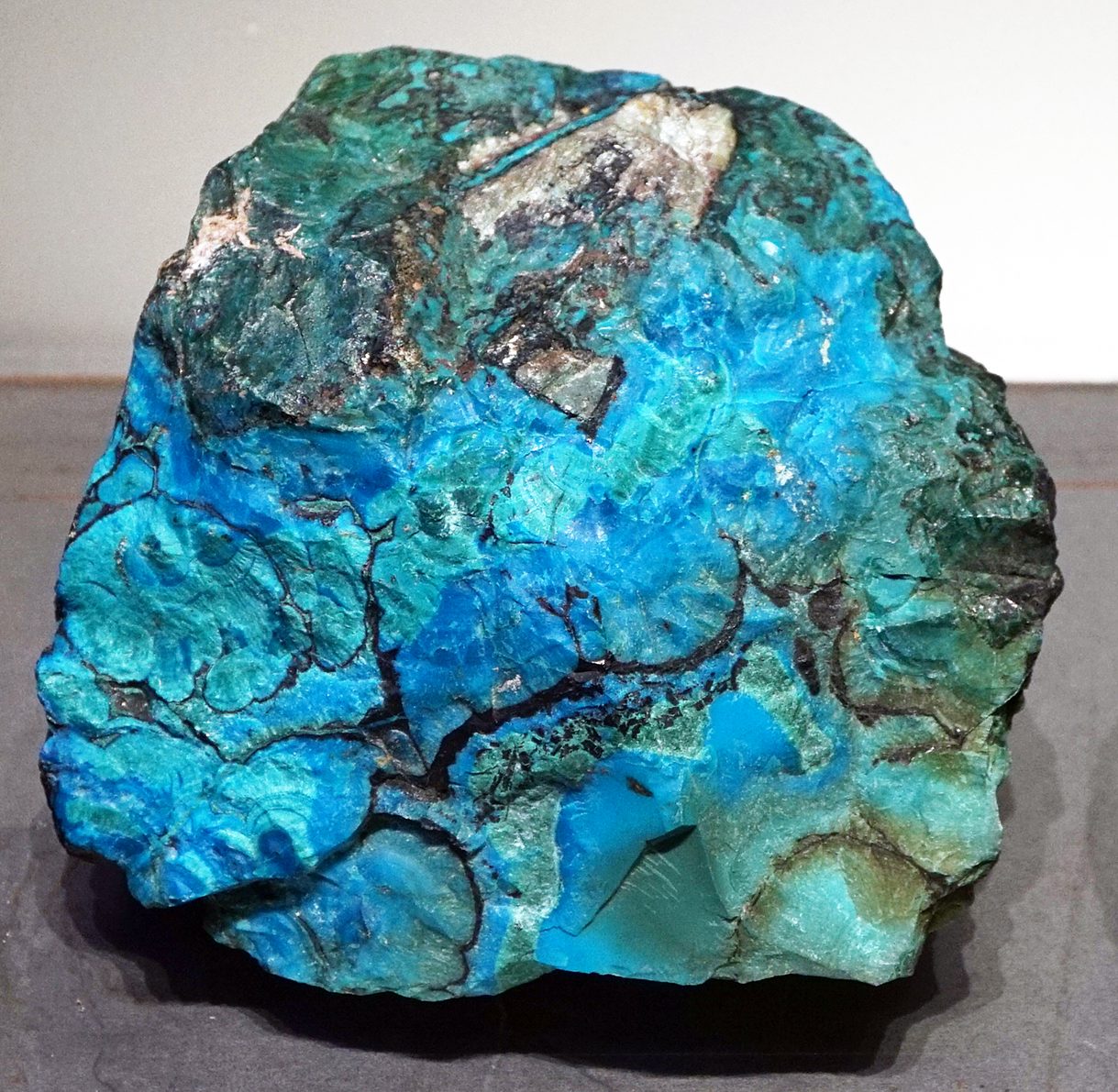
Eilat Stone
Mined from the ancient copper deposits of King Solomon's Mines near Eilat, Israel.
- Eilat stone is not a mineral - it is a geological composite of up to 6 different copper minerals growing together.
- The Timna Valley mines operated intermittently for over 6,000 years, making them among the oldest continuously used mines on Earth.
- No 2 Eilat stones have identical patterning, because the mineral ratios shift across even adjacent centimeters of host rock.
- Ancient Egyptians referred to copper-mineral composites from this region as 'the blue stone of the desert.'
- The stone's blue-green palette comes entirely from copper: malachite gives green, azurite gives deep blue, chrysocolla gives teal.
- Collectors seeking a rare Israeli gem with documented ancient history
- Spiritual practitioners working on heart and throat chakra balance
- Gift givers looking for a uniquely meaningful piece connected to biblical lore
- Anyone drawn to the swirling blue-green tones of copper-based minerals
- Travelers or those with a connection to Israel or the Middle East
- Daily-wear jewelry buyers - Mohs 3-4 scratches easily; consider chrysocolla instead
- Shoppers on a tight budget - authentic specimens command premium prices for rarity
- Those wanting a single-mineral gem - Eilat stone is always a composite
What Is Eilat Stone?
Eilat stone is a composite copper-bearing mineral found near the port city of Eilat in southern Israel, close to the ancient copper mines historically called King Solomon's Mines. It forms when multiple copper minerals - primarily malachite, turquoise, and chrysocolla - grow together in copper-rich volcanic host rock.
The result is a stone with swirling zones of blue, green, and teal that no two specimens share exactly.
Geologically, Eilat stone is not a single mineral species. It typically contains chrysocolla, turquoise, malachite, azurite, and sometimes native copper in varying proportions. The Mohs hardness ranges from 3 to 4, reflecting the softer components.
The Timna Valley mines in the Negev Desert are the primary and historically documented source, with copper extraction in this region dating back over 6,000 years.
Israel declared Eilat stone its national gemstone, a designation that reflects both geological rarity and cultural pride. Commercial mining of gem-quality material is extremely limited today, and much material on the market is stabilized or treated to improve durability. Authentic unstabilized specimens are increasingly sought by collectors.
How Eilat Stone Compares
| Property | Eilat Stone | Turquoise | Chrysocolla |
|---|---|---|---|
| Hardness | 3 - 4 | 5 - 6 | 2 - 4 |
| Uniqueness | Nationally symbolic, rare | Common worldwide | Very common |
| Price / carat | $ Budget | $ Budget | $ Budget |
| Best For | Collectors, gifts | Jewelry, healing | Affordable healing |
Meaning and Symbolism
Eilat stone carries the weight of nearly 6,000 years of human history. The copper mines at Timna Valley - linked in tradition to King Solomon - are among the oldest continuously worked metal sources on earth.
Ancient Egyptians extracted copper here as early as 4000 BCE, and the blue-green minerals left behind became prized ornamental objects throughout the ancient Near East.
In Hebrew tradition, the stone has long been associated with wisdom, communication, and divine connection, drawing symbolism from its proximity to the land where the Torah was received. Modern crystal healing practitioners carry those associations forward.
Many find it useful for bridging rational thought with intuitive knowing - a quality the stone's blended nature seems to embody literally.
As Israel's national gemstone, Eilat stone appears in diplomatic gifts and museum collections worldwide. Its rarity outside the Negev Desert gives it a geographic identity few gems can claim. Collectors prize verified Israeli-origin specimens for both mineralogical interest and cultural significance.
Historical Timeline
Healing Tradition
Emotional
Practitioners believe Eilat stone encourages emotional openness and honest communication. Many find it helpful when they feel blocked in expressing difficult truths to loved ones. The blended nature of the stone - many minerals working together - is said to reflect the value of integration over separation in emotional life.
Crystal healing tradition associates it with the ability to hold multiple perspectives simultaneously, easing the kind of either-or thinking that drives interpersonal conflict. Some practitioners use it during relationship counseling settings or personal journaling to encourage clarity.
Spiritual
In crystal healing tradition, Eilat stone is said to activate both the heart and throat chakras, linking the ability to feel deeply with the ability to speak truthfully. Practitioners describe it as a stone of 'compassionate truth' - one that helps practitioners express spiritual insights without losing warmth or connection.
Its ancient mining heritage is often invoked in meditation as a way of connecting with ancestral wisdom and the long lineage of human spiritual seeking. Many find placing it over the heart or throat during breathwork deepens the sense of opening.
Physical
Crystal healing tradition associates Eilat stone with the respiratory and circulatory systems, reflecting the copper content that connects it to bodily warmth and flow. Practitioners believe it may be supportive during periods of throat discomfort or low energy. As always, crystal work is complementary to, never a replacement for, qualified medical care.
Some practitioners recommend it during recovery periods for its traditionally calming energy, particularly for those who find green and blue tones visually soothing.
Zodiac, Birthstone and Gifts
Sagittarius - the eternal seeker of truth - resonates strongly with Eilat stone's heritage of ancient wisdom and cross-cultural connection. The stone's blue-green palette echoes Sagittarian energy: expansive, searching, linked to far horizons and philosophical depth.
Aquarius, ruled by the principle of humanitarian connection, finds in Eilat stone a reflection of the copper mines' 6,000-year role in human civilization - individual stones embedded in a vast shared story.
Care and Cleansing
Eilat stone's composite mineral structure means many standard cleansing methods require care. Avoid salt water and extended water immersion entirely - the malachite and chrysocolla components are soft and porous, and salt can degrade them rapidly.
A brief rinse under cool running water (under 30 seconds) is acceptable for non-stabilized pieces if dried immediately.
Smoke cleansing with sage, cedar, or palo santo is the safest and most recommended method. Pass the stone slowly through the smoke 3 times, holding the intention of releasing any accumulated energy. Sound cleansing with a singing bowl or tuning fork works equally well and carries no risk to the stone's surface.
Moonlight charging on a windowsill is gentle and effective - avoid direct intense sunlight, which can fade some of the blue-green hues over time.
- DO NOT soak in water - the soft copper minerals absorb moisture and can weaken or crack.
- DO NOT use salt water or salt beds for cleansing - salt degrades malachite and chrysocolla.
- DO NOT expose to perfume, hairspray, or cleaning chemicals - apply these before putting on jewelry.
- DO NOT store loose with harder gems - Mohs 3-4 scratches easily against quartz or harder stones.
- DO wrap in soft cloth or keep in individual pouches when traveling.
- NOTE: Many commercial specimens are stabilized with resin - ask your seller for disclosure.
Real vs Fake
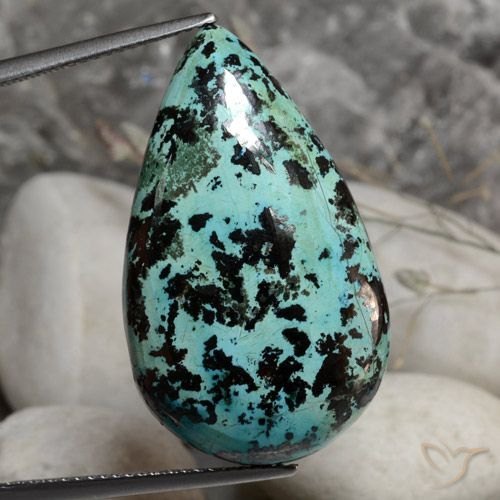
Authentic Eilat stone shows irregular, organic patterning where the different minerals blend naturally. Malachite produces concentric banding, chrysocolla creates smooth teal zones, and azurite introduces darker navy spots - all within the same specimen.
Dyed howlite or dyed calcite is sometimes sold as Eilat stone; these fakes lack the multi-mineral complexity and feel unnaturally uniform in color.
Weight and hardness are useful tests. Eilat stone at Mohs 3-4 will scratch with a copper coin or a fingernail on particularly soft zones. Fakes made from glass or harder dyed stones will resist scratching. Genuine material is also relatively lightweight compared to glass imitations of the same size.
Ask for provenance. Authentic Eilat stone comes with documentation of Israeli origin, and reputable dealers can trace material to the Timna Valley region. Generic 'blue-green composite' labeled as Eilat stone without origin documentation should be treated with skepticism.
Price is also a signal: genuine material rarely sells below $15-20 per piece for even small tumbles.
Eilat Stone Jewelry & Gifts
Authentic Eilat stone is priced by visual quality, mineral complexity, and provenance. Well-defined multi-mineral patterning with clear zones of malachite green, chrysocolla teal, and azurite blue commands the highest prices - typically $50-150 per polished piece for mid-sized specimens. Simple or muddy-looking pieces may sell for $15-30.
Ask sellers specifically whether the stone is stabilized. Stabilization (resin impregnation) improves durability but changes the metaphysical community's view of the stone - many practitioners prefer natural unstabilized material. For jewelry use, stabilized pieces are actually more practical, as they resist the moisture and impact that can damage soft natural material.
Purchase from dealers who can document Israeli origin. The term 'Eilat stone' is sometimes applied loosely to any blue-green copper composite, regardless of origin. True Timna Valley material is rare and the documentation matters to both collectors and gift recipients who value the King Solomon's Mines heritage.
Where to Buy Eilat Stone
Affiliate disclosure: Some links below earn us a small commission at no extra cost to you. See our affiliate disclosure page.
Handmade, raw, and tumbled pieces from independent sellers worldwide.
Shop Eilat Stone on Etsy →Accessories, tools, and specimen sets with fast Prime delivery.
Shop Eilat Stone on Amazon →Certified loose gemstones graded and photographed for online buyers.
Shop Eilat Stone on GemSelect →Pairs Well With



Where Eilat Stone Is Found


