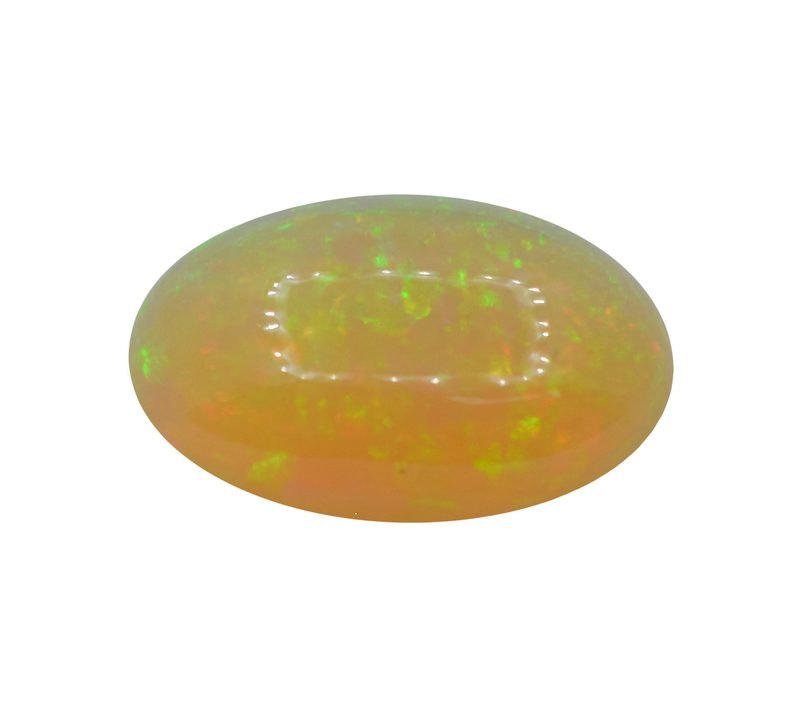
Fire Opal
A vivid orange-to-red opal from Mexico, fire opal is the sacral-chakra gem of creative passion.
- Aztec rulers called fire opal the stone of the bird of paradise for its brilliant colors.
- Fire opal contains 3 to 10 percent water by weight in its amorphous silica structure.
- Mexican fire opal has been mined commercially since the 1830s at the Queretaro deposits.
- Ethiopian fire opal from Welo is hydrophane and temporarily changes appearance when wet.
- Some fire opal shows play-of-color alongside its warm body tone, combining both opal optical effects.
- Buyers drawn to warm orange-to-red transparent gems
- Practitioners working with sacral and solar plexus creative passion
- Collectors of Mexican gems and pre-Columbian cultural heritage
- Gift givers shopping for October birthdays seeking opal alternatives to black opal
- Readers wanting a faceted opal rather than play-of-color cabochon
- Daily-wear ring buyers (fire opal is sensitive; consider padparadscha sapphire)
- Those avoiding temperature-sensitive stones (try spessartite garnet)
- Buyers seeking play-of-color flashes (consider black opal or white opal)
What Is Fire Opal?
Fire opal is a variety of opal distinguished by its warm body color (orange, red, yellow-orange) rather than by the play-of-color effect that characterizes precious opal. It rates 5.5 - 6.5 on the Mohs hardness scale.
The classical Mexican fire opal is transparent to translucent with a vivid saturated orange body color and is often faceted rather than cut as cabochon. At Mohs 5.5 to 6.5, fire opal is softer than most jewelry gems and sensitive to temperature change, dehydration, and mechanical shock.
The stone contains 3 to 10 percent water by weight in its amorphous silica structure, which is why opal can craze (develop fine surface cracks) if exposed to dry environments or sudden temperature shifts.
Fire opal comes primarily from Mexico (the Queretaro and Jalisco deposits) and Ethiopia (Welo Province), with smaller quantities from Brazil, Australia, Honduras, Oregon, Turkey, and Indonesia.
Mexican fire opal is the traditional classical source and has supplied the gem trade since Aztec times. Ethiopian fire opal entered commercial supply after 1994 discoveries and has grown rapidly in market share.
Some fire opal shows play-of-color in addition to its warm body tone (called Mexican fire opal with play or simply cherry opal), combining the two opal-defining optical effects in a single stone. This variety is particularly prized by collectors.
How Fire Opal Compares
| Property | Fire Opal | Black Opal | Spessartite Garnet |
|---|---|---|---|
| Hardness | 5.5 - 6.5 | 5.5 - 6.5 | 7 - 7.5 |
| Price / carat | $$ Mid-range | $$$ Premium | $$ Mid-range |
| Color | Vivid orange-red body | Dark body w/ play-of-color | Orange to red-orange |
| Best For | Faceted statement stones | Heirloom, investment | Fine jewelry, daily wear |
Meaning and Symbolism
Fire opal has a deep history in Mexican culture extending to pre-Columbian times. Aztec civilization valued fire opal as a sacred stone of transformation, and Aztec rulers reportedly wore fire opal in ceremonial jewelry.
The Aztec name for opal was vitzitziltecpatl, roughly translated as the stone of the bird of paradise for its brilliant colors.
After the Spanish conquest, fire opal entered European trade through Mexican viceregal colonial networks. Spanish and later French jewelers incorporated fire opal into colonial-era jewelry and decorative art. The Queretaro mines of central Mexico have produced fire opal continuously since the 1830s and remain the classical commercial source.
Ethiopian fire opal from Welo Province was only discovered in 1994 but has since grown to rival Mexican supply in commercial volume. Ethiopian material is often hydrophane (absorbs water) and must be handled differently from Mexican opal.
In modern crystal healing tradition, fire opal is associated with the sacral and solar plexus chakras and with qualities of creative passion, warm vitality, and transformative energy. Practitioners often recommend fire opal for people in creative emergence phases, entrepreneurial ventures, or recovery from prolonged emotional winters.
The stone pairs naturally with carnelian (sacral chakra family), with citrine (solar plexus warmth), and with sunstone for combined fire-element vitality work.
Historical Timeline
Healing Tradition
Emotional
Practitioners believe fire opal supports creative passion, emotional warmth after loss, and the rekindling of vital energy during recovery periods. In crystal healing tradition, it is often recommended for people emerging from grief, creative blocks, or depression, because the stone's visual warmth echoes returning emotional fire.
Many readers wear fire opal during creative emergence phases and describe a sense of enthusiastic renewal during these weeks.
Practitioners pair fire opal with carnelian for amplified sacral vitality, with sunstone for combined warm solar-plexus confidence, or with rose quartz when emotional warmth involves tender relationship work.
Because fire opal's reputation is active and passionate rather than soothing, it is often described as a day-work stone or creative-session stone rather than a bedtime companion. Readers sometimes describe fire opal as particularly useful for artists, entrepreneurs, and anyone stepping into a visibly passionate new venture.
Spiritual
Fire opal is traditionally associated with the sacral and solar plexus chakras and with what crystal workers call transformative creative fire.
In modern metaphysical tradition, fire opal is sometimes linked with Aztec transformation ceremonies and with the mythological phoenix as a symbol of rebirth from ashes.
Many readers keep a fire opal on a creative workspace altar or hold one during brief ceremonial meditations focused on creative emergence. It pairs readily with clear quartz for amplified intention and with carnelian for sacral-chakra family work.
Because fire opal is delicate and requires careful handling, practitioners often reserve it for specific ceremonial or creative-ritual work rather than daily continuous wear.
Physical
Practitioners believe fire opal supports what they describe as circulation, sexual vitality, and general energetic warmth. Folk tradition across Mexican and crystal healing cultures associates fire opal with reproductive system wellness and with supporting energy during recovery from prolonged emotional or creative depletion.
In modern crystal healing practice, fire opal is most often placed over the sacral area during brief sessions focused on creative vitality.
Many readers wear fire opal jewelry during creative projects and describe the stone as a visual anchor for passionate energy. It is not a substitute for medical care, and practitioners frame its role as supportive alongside proper treatment.
Because fire opal is fragile and sensitive to temperature change, jewelry should be removed during showers, exercise, and any activity involving sudden temperature shifts or impact.
Zodiac, Birthstone and Gifts
Fire opal is traditionally associated with Leo in Western astrology because of the sign's fire-sign warmth and its connection with passionate creative energy.
For Scorpio, fire opal is recommended as a supporting stone for transformational creative work, and for Sagittarius it aligns with the sign's philosophical fire and enthusiasm.
Fire opal is one of the alternative October birthstones alongside black opal, white opal, and pink tourmaline. It is particularly popular as an October gift for readers drawn to warm rather than cool color palettes.
Care and Cleansing
Fire opal requires very gentle cleansing methods because of its softness, porosity, and sensitivity to temperature change.
Smoke cleansing with sage, palo santo, or cedar is the traditional favorite and carries no risk of damage. Sound cleansing with a singing bowl is safe. A short session of moonlight on a windowsill is effective and gentle.
Brief rinses under lukewarm water are acceptable for Mexican fire opal but should be limited. Ethiopian fire opal is hydrophane and will temporarily change color and transparency when wet, returning to normal after drying.
Salt, saltwater soaks, ultrasonic cleaners, steam cleaners, and acidic solutions should all be avoided. Prolonged direct sunlight can dehydrate opal and cause crazing (fine surface cracks) that permanently diminishes the stone.
Many readers place fire opal on a selenite plate overnight for routine refresh, and some collectors store loose opal in soft pouches with small pieces of damp cotton to maintain humidity.
- DO NOT expose fire opal to ultrasonic or steam cleaners.
- DO NOT soak fire opal in water, saltwater, or cleaning chemicals for extended periods.
- DO store fire opal in a soft pouch separate from harder stones.
- DO remove fire opal jewelry before showering, exercise, and hot environments.
- DO store loose fire opal in moderate humidity; avoid long dry storage.
- DO use protective bezel or halo settings for fire opal rings.
- Note: Ethiopian fire opal is hydrophane and temporarily changes color when wet; this is natural.
Real vs Fake
Genuine fire opal shows warm transparent-to-translucent body color (orange, red, yellow-orange) with specific gravity around 2.0 to 2.2, noticeably lighter than most transparent gems. Under 10x magnification, natural fire opal often shows small gas inclusions, milk-cloud zones, or faint waviness characteristic of silica-gel solidification.
Common imitations include synthetic opal (produced by Pierre Gilson and later companies), plastic and resin imitations in fire-opal colors, orange glass, and orange quartz varieties. Each has specific identification markers.
Synthetic opal shows regularity in its silica sphere structure under magnification that natural opal does not. Plastic imitations feel warm and are much lighter than natural opal.
For Ethiopian fire opal specifically, the hydrophane test is definitive: a drop of water on a hidden surface of genuine Ethiopian fire opal will be slightly absorbed and the stone will temporarily become more transparent, returning to normal when dry.
Mexican fire opal is generally not hydrophane and does not show this effect.
For significant fire opal purchases, insist on origin disclosure (Mexican versus Ethiopian) and, for investment-grade stones, laboratory documentation. Reputable dealers provide detailed information about hydrophane status, treatment history (some fire opal is smoke-treated or filled), and source documentation.
Fire Opal Jewelry & Gifts
Fire opal prices range from $50 per carat for small, pale, or heavily included commercial stones to over $500 per carat for top Mexican material with vivid saturated orange-to-red color and clean transparency.
Standard 1-2 carat faceted Mexican fire opal typically runs $100 to $250 per carat. Exceptional stones with deep cherry-red color reach $300 to $600 per carat.
Ethiopian fire opal is typically less expensive than Mexican material because of its shorter commercial history and hydrophane nature, which some buyers consider a drawback. Fire opal with play-of-color in addition to warm body tone commands a significant premium over plain fire opal.
Treatment concerns include smoke treatment (darkens body color; must be disclosed), sugar-acid treatment (rare; must be disclosed), and oil or resin impregnation for stability (uncommon but must be disclosed).
When buying, examine the stone under multiple light sources to assess body color, check for eye-clean clarity under a 10x loupe, and ask about origin and hydrophane status. For Mexican material, look for Queretaro or Jalisco provenance. For Ethiopian material, acknowledge the hydrophane property and plan storage accordingly.
Where to Buy Fire Opal
Affiliate disclosure: Some links below earn us a small commission at no extra cost to you. See our affiliate disclosure page.
Handmade, raw, and tumbled pieces from independent sellers worldwide.
Shop Fire Opal on Etsy →Accessories, tools, and specimen sets with fast Prime delivery.
Shop Fire Opal on Amazon →Certified loose gemstones graded and photographed for online buyers.
Shop Fire Opal on GemSelect →Pairs Well With



Where Fire Opal Is Found


