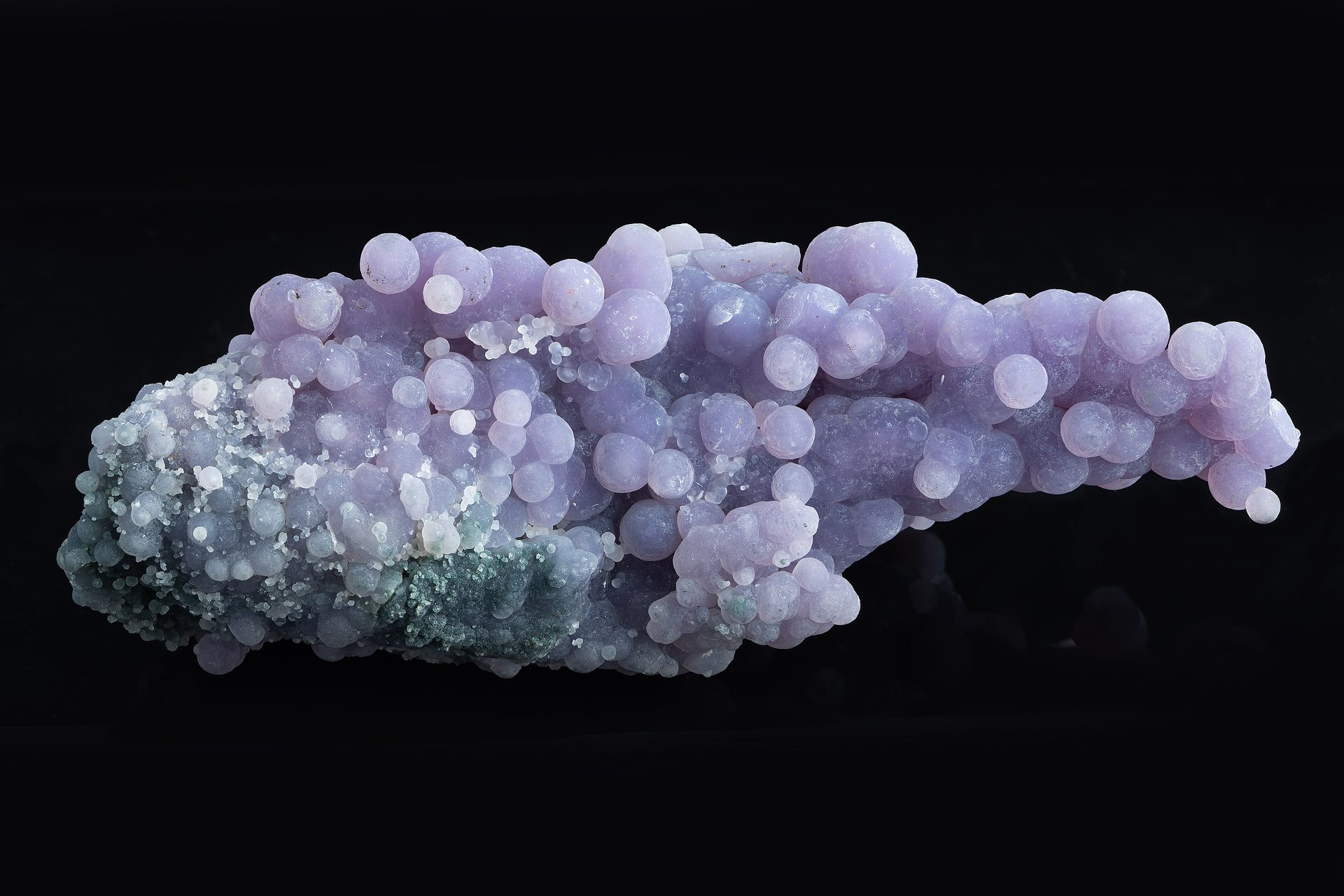
Grape Chalcedony
Nature's most whimsical gem - lavender grape clusters from Sulawesi that bridge dreamworlds and waking life
- Grape chalcedony forms exclusively in volcanic basalt - the silica in the hydrothermal fluids precipitates in concentric shells around microscopic nuclei attached to the basalt surface, building the characteristic spheres one layer at a time.
- Each individual sphere in a grape chalcedony cluster can take thousands of years to form as silica deposits at geological rates - making these seemingly simple stones the result of extraordinarily patient geological processes.
- The Mamuju district of West Sulawesi, the primary source, sits in one of the most geologically active zones in the Pacific Rim - where the Indo-Australian and Eurasian plates meet, creating the conditions for the hydrothermal activity that produces the stone.
- Grape chalcedony color can range from pale lilac to deep grape purple to greenish-gray - all from the same deposit. The purple color is most prized commercially, while gray-green varieties are rarer and sought by specialist collectors.
- Sulawesi is also the source of another famous collector stone - starburst-pattern tartan agate from the same general volcanic geology, making the island one of the most mineralogically interesting sources of chalcedony-family stones globally.
- collectors seeking unique and visually distinctive specimens
- those drawn to Sulawesi Indonesian minerals
- practitioners of dreamwork and intuitive development
- fans of purple and lavender crystal aesthetics
- gift-givers wanting something truly memorable
- those seeking common, affordable tumbles
- buyers wanting a subtle or inconspicuous stone
- collectors focused on traditional Western mineral specimens
What Is Grape Chalcedony?
Grape Chalcedony is a botryoidal (bubble-cluster) form of purple chalcedony found almost exclusively in the Mamuju district of West Sulawesi, Indonesia. Its rounded, grapelike formations develop when silica precipitates in concentric layers around nucleation points on volcanic basalt, building up sphere-by-sphere into the distinctive cluster formations that make this stone immediately recognizable.
The lavender to deep purple color comes from trace amounts of iron and manganese within the microcrystalline quartz structure. What distinguishes grape chalcedony from other purple chalcedony is entirely its formation habit - the botryoidal texture creates a tactile, three-dimensional quality unlike any other chalcedony variety, with each rounded sphere covered in a silky waxy luster.
Grape chalcedony became known to international mineral markets relatively recently - large-scale availability began in the 1990s to early 2000s when Indonesian mining operations in Sulawesi expanded.
Its immediate visual appeal made it a rapid success in both the collector and crystal healing markets, where its whimsical appearance and distinctive purple color drew buyers who had never seen anything quite like it.
Grape Chalcedony vs. Similar Botryoidal Stones
| Property | Grape Chalcedony | Smithsonite | Botryoidal Malachite |
|---|---|---|---|
| Hardness | 6.5-7 | 4.5 | 3.5-4 |
| Price | $ Budget | $ Budget | $ Budget |
| Rarity | Uncommon | Uncommon | Common |
| Best For | Display, dreamwork | Collector display | Transformation |
Meaning and Symbolism
Grape chalcedony carries all the spiritual associations of purple chalcedony - intuition, dreamwork, crown chakra activation - but its unique form adds a layer of meaning that practitioners find compelling. The rounded, clustered growth pattern is seen as representing community, interconnectedness, and the way individual consciousness clusters into collective awareness.
In crystal traditions, the stone is said to embody the principle of "holding many in one" - each sphere separate yet part of the whole cluster, mirroring how individual beings maintain distinctness while participating in larger energetic fields.
This quality makes it particularly valued for group meditation, community healing work, and practices related to collective consciousness.
Practitioners also associate grape chalcedony with joy, abundance, and the playful abundance symbolism of grapes themselves - used across cultures as symbols of harvest, celebration, and the sweetness available in life. Despite its serious spiritual associations, the stone carries a lightness and whimsy that distinguishes it from heavier purple stones.
Historical Timeline
Healing Tradition
Emotional
Practitioners describe Grape Chalcedony as emotionally joyful and uplifting in a way that defies its serious purple-crystal associations. Many describe it as the most playful stone in the purple crystal family - said to dissolve heaviness, bring lightness to deep spiritual processing, and remind practitioners that spiritual work need not be solemn.
Crystal healers use it for clients dealing with spiritual bypassing or over-seriousness, believing the stone's whimsical grape-cluster form is itself a teaching in abundance, sweetness, and the joy of simply being alive and connected.
Spiritual
In spiritual practice, grape chalcedony is believed to support the same crown and third eye activation as other purple chalcedony varieties, but with additional qualities from its clustered form. It is said to be especially effective for group meditation, collective healing ceremonies, and practices aimed at sensing the interconnectedness of all things.
Practitioners use it on altars honoring community, lineage, and the webs of relationship that support each individual life. It is also associated with access to what some traditions call "the joy of the spheres" - a state of spiritual bliss accessible in deep meditation.
Physical
Some crystal wellness practitioners associate Grape Chalcedony with the nervous system, restful sleep, and conditions related to the endocrine and lymphatic systems. Its crown chakra association links it to neurological calm in some holistic frameworks. No scientific evidence supports these associations. Consult a qualified healthcare provider for health concerns.
Zodiac, Birthstone and Gifts
Pisces's dreamy, boundless nature resonates deeply with grape chalcedony's dreaming and collective consciousness associations - the stone is said to support Piscean sensitivity without creating overwhelm. Aquarius's connection to collective awareness and innovative thinking aligns with the stone's community and interconnectedness symbolism.
Care and Cleansing
Moonlight cleansing is ideal for grape chalcedony - place on a windowsill or outdoors under a full moon, allowing the silvery light to bathe the spherical surfaces. This is the most widely recommended method and poses no risk to the delicate botryoidal structure.
Brief rinsing under cool running water is safe for grape chalcedony. Use gentle water pressure only - avoid aiming strong water jets at the individual spheres, which could chip the delicate botryoidal formations. Dry thoroughly and gently with a soft cloth.
Sound cleansing with a singing bowl or bell is particularly gentle and non-invasive - ideal for a stone whose delicate structure makes physical contact cleansing somewhat risky. Pass the stone through sustained sound vibrations for 2-3 minutes.
- DO handle with care - the rounded botryoidal spheres are delicate and can chip if dropped on hard surfaces.
- DO NOT expose to prolonged direct sunlight as UV may fade the lavender-purple color over time.
- DO NOT use high-pressure water or abrasive materials on the delicate sphere surfaces.
- NOTE that grape chalcedony clusters vary significantly in color from pale lilac to deep purple - deep purple is most commercially prized but all colors are genuine.
- DO NOT store loose with other minerals - individual spheres can break off if jostled against harder stones.
Real vs Fake
Genuine grape chalcedony from Sulawesi has a distinctive, irregular botryoidal texture where each sphere is subtly different in size and surface quality. The overall cluster has organic variation that is very difficult to replicate artificially.
The most common fake is dyed botryoidal smithsonite or calcite sold as grape chalcedony. Both are softer (4-4.5 vs 6.5-7 for chalcedony). A hardness test with a steel file will reveal softer fakes: chalcedony resists a file; smithsonite and calcite do not.
Color in genuine grape chalcedony is internally consistent throughout each sphere. Dyed fakes often show color concentrated at sphere surfaces and lighter interior when a sphere is broken or viewed at a chip point.
The specific origin of genuine grape chalcedony is almost exclusively Sulawesi, Indonesia - specifically the Mamuju district of West Sulawesi. Material claimed to come from other locations should be questioned carefully.
Purchase from reputable mineral dealers who specify the Sulawesi origin and can provide authentication. The stone's popularity has led to imitation; paying slightly more from a verified source is worthwhile for a stone this distinctive.
Grape Chalcedony Jewelry & Gifts
Small grape chalcedony specimens (fist-sized clusters) run $20-$80; medium display pieces $60-$200; large impressive clusters $150-$500+. Prices have risen steadily as demand has grown and the most accessible portions of the Sulawesi deposits have been worked.
Color saturation and uniformity are the primary quality factors - deep, even lavender-purple throughout the cluster is most valued. Pale lilac specimens are cheaper and still beautiful; greenish-gray variants are rarer and sought by specialist collectors.
Sphere completeness matters for display quality - look for clusters with minimal broken or chipped spheres. Some sellers discount specimens with minor edge damage; these are excellent value for practitioners who prioritize energy over perfect aesthetics.
The contrast between the lavender chalcedony and any remaining dark basalt matrix dramatically affects visual appeal. Pieces retaining some dark matrix show the stone's natural context and are often more visually interesting than fully cleaned specimens.
Avoid suspiciously low prices on large, perfectly uniform-colored grape chalcedony clusters - these may be dyed smithsonite. Genuine grape chalcedony at fair market prices from a dealer with consistent Sulawesi sourcing is worth seeking out.
Where to Buy Grape Chalcedony
Affiliate disclosure: Some links below earn us a small commission at no extra cost to you. See our affiliate disclosure page.
Handmade, raw, and tumbled pieces from independent sellers worldwide.
Shop Grape Chalcedony on Etsy →Accessories, tools, and specimen sets with fast Prime delivery.
Shop Grape Chalcedony on Amazon →Certified loose gemstones graded and photographed for online buyers.
Shop Grape Chalcedony on GemSelect →Pairs Well With


Where Grape Chalcedony Is Found

