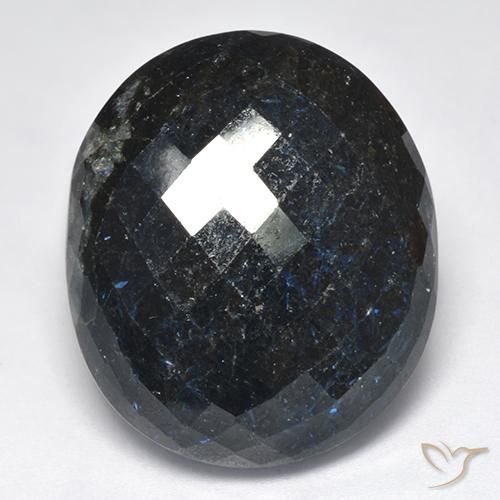
Nuummite
A 3-billion-year-old amphibole rock from Greenland with iridescent gold-and-blue flash, sometimes called the sorcerer's stone.
- Nuummite is approximately 3 billion years old, making it one of the oldest rock materials cut for jewelry use.
- The stone takes its name from Nuuk, the capital of Greenland, near the only commercial source.
- Inuit peoples of Greenland have known nuummite for centuries as ulamertorsuaq, meaning the great patterned stone.
- Mining for jewelry-grade nuummite is limited to a brief Arctic summer window because of the harsh Greenlandic climate.
- The trade nickname sorcerer's stone was applied to nuummite in the 1990s by metaphysical writers, despite no actual historical association with European or Inuit magical practice.
- Practitioners working with deep ancestral memory and shadow integration
- Collectors interested in geologically ancient rocks with Greenlandic provenance
- Pendant and earring shoppers wanting one-of-a-kind iridescent statement stones
- Capricorn and Sagittarius readers drawn to ancient earth-element personal talismans
- Spiritual readers cultivating advanced meditation or shamanic practice
- Buyers wanting bright transparent gems (nuummite is dark and opaque)
- Beginners; nuummite is sometimes described as too intense for early crystal practice
- Practitioners seeking heart-centered or calming energy (try rose quartz or amethyst)
What Is Nuummite?
Nuummite is a metamorphic rock composed primarily of two intergrown amphibole minerals, anthophyllite and gedrite, with characteristic iridescent flash from intergrown crystal layers. The stone takes its name from Nuuk, the capital of Greenland, near where the rock was discovered. It rates 5.5 - 6 on the Mohs hardness scale.
Mineralogically, nuummite is a rock rather than a single mineral species; the parent amphibole minerals have IMA symbols Ath (anthophyllite) and Ged (gedrite). Nuummite is famous for the iridescent labradorescence-like flash that appears as gold, blue, violet, or green tones across the stone's dark body.
The stone forms from extremely ancient ultramafic rocks that were deeply metamorphosed, with the source rocks dated to approximately 3 billion years old. This makes nuummite one of the oldest rock materials cut for jewelry use, predating most other gem-grade stones by over a billion years.
The Isua greenstone belt and surrounding areas in southwestern Greenland contain some of the oldest known rocks on Earth.
Nuummite occurs commercially in only one significant area worldwide: a few specific outcrops near Nuuk on Greenland's southwestern coast. The remote location, harsh Arctic climate, and limited access mean that mining is small-scale and supply is extremely limited.
Nuummite has a Mohs hardness of 5.5 to 6 and is durable enough for pendants, earrings, and bezel-set rings, though it benefits from protective settings rather than exposed prong mounts. Most material is cut as cabochons that maximize the iridescent flash, with each stone showing unique color patterns.
How Nuummite Compares
| Property | Nuummite | Labradorite | Spectrolite |
|---|---|---|---|
| Hardness | 5.5 - 6 | 6 - 6.5 | 6 - 6.5 |
| Price / carat | $ Budget | $ Budget | $ Budget |
| Age | ~3 billion years | ~1 billion years | ~1 billion years |
| Best For | Ancient earth meditation, collectors | Daily wear, transformation | Statement jewelry |
Meaning and Symbolism
Nuummite carries a uniquely modern story among popular crystals because the stone was unknown to international markets until the 1980s, when Greenlandic mining and gemological literature established it as a recognized collector category.
Despite this short modern history, nuummite has been adopted by metaphysical practitioners as one of the oldest energetic resources available, drawing on the rock's actual geological age of approximately 3 billion years. The Inuit peoples of Greenland have known the stone for centuries as ulamertorsuaq (translated approximately as the great patterned stone).
Modern crystal practitioners gave nuummite the trade nickname sorcerer's stone in the 1990s and 2000s, drawing on its dark mysterious appearance and association with deep magical traditions. The name has stuck in metaphysical contexts even though the stone has no actual historical association with European or Inuit magical practice.
Greenlandic mining for jewelry-grade nuummite is limited to a brief Arctic summer window because of the climate, which contributes to the stone's reputation as a finite spiritual resource.
In modern crystal practice, nuummite is traditionally associated with the root chakra and with what practitioners call the soul star chakra above the head, bridging deep earth energy with high spiritual perception.
Practitioners believe the stone's geological age makes it a powerful focal point for ancestral memory work, shadow integration, and the recognition of patterns inherited from earlier generations. Many find nuummite useful as a meditation centerpiece for practice that involves long timescales of personal or collective history.
Historical Timeline
Healing Tradition
Emotional
Practitioners believe nuummite is a stone of deep emotional integration and the kind of patient shadow work that brings long-buried material into conscious awareness for healing.
In crystal healing tradition, it is said to support readers willing to work with ancestral patterns, generational trauma, and inherited emotional content over months and years rather than expecting quick catharsis. Many find nuummite useful as a focal point for journaling practice, dream work, or therapeutic processes that emphasize slow self-discovery.
The stone has long been associated in modern tradition with personal integrity, said to support readers in recognizing and breaking patterns that no longer serve them.
Practitioners often pair nuummite with rose quartz for self-compassion during difficult discoveries, with clear quartz for amplified focus, or with black tourmaline for grounded protection during deep work. Nuummite is sometimes recommended for advanced practitioners cultivating sustained shadow integration practice within stable spiritual frameworks.
Spiritual
Nuummite is traditionally associated with the root chakra and what practitioners call the soul star chakra above the head, bridging deep earth energy with high spiritual perception. Practitioners believe the stone's exceptional geological age makes it a powerful focal point for connection to ancient earth wisdom and ancestral memory.
It has long been considered a stone for advanced practitioners rather than beginners.
Many find nuummite useful in meditation focused on shadow integration, ancestral healing work, and the recognition of patterns inherited from earlier generations or from collective cultural and ecological history. The stone pairs well with clear quartz for amplified focus and with labradorite as a sister iridescent transformation companion.
Practitioners typically reserve nuummite for ritual contexts rather than continuous wear, treating it as a focal point for occasional deep practice rather than a daily companion. It is generally considered a daytime working stone.
Physical
Practitioners believe nuummite supports what they describe as the body's deep regenerative and grounding systems, drawing on the stone's exceptional geological age and earth-element character.
In folklore developed since the stone's modern popularization, it has been associated with the bones, spine, and the slow physical processes that benefit from steady support over time. It is sometimes recommended for readers managing chronic conditions that benefit from patient long-term work.
The stone is also traditionally associated with the immune system in modern crystal healing practice, particularly for readers whose health challenges practitioners associate with deep emotional or ancestral patterns. Nuummite is durable enough for daily-wear pendants and is sometimes carried during periods of intensive healing work.
Nuummite is not a substitute for medical care, and practitioners are careful to frame its role as supportive rather than curative. The stone is sometimes used in shamanic-style energy work as a focal point for grounding scattered energy back into the body.
Zodiac, Birthstone and Gifts
Nuummite is most often associated with Capricorn in modern crystal astrology because of its earth-element character, exceptional age, and Saturn associations. Practitioners believe the stone supports Capricorn readers in cultivating long-term work that draws on deep wisdom and patient persistence.
It has long been recommended for Capricorn readers undertaking major shadow integration practice or career transitions that involve ancestral patterns.
Sagittarius is the secondary association because of nuummite's connection to deep wisdom and exploration of ancient knowledge. Astrologers sometimes suggest the stone for Sagittarius readers drawn to philosophical or shamanic practice, particularly work that involves engaging with very old traditions or geological deep time.
Care and Cleansing
Nuummite tolerates most gentle cleansing methods, though its softer hardness and value require some care. A soft dry cloth wipe is the safest routine, with a brief lukewarm soapy water rinse acceptable for occasional deeper cleaning.
Avoid ultrasonic and steam cleaners, which can stress fissures common in cabochon material. Avoid prolonged direct sunlight, which is generally safe for the dark body color but can stress fragile mountings.
Energetic cleansing with smoke from sage, palo santo, or cedar is widely used and considered safe for nuummite. Sound cleansing with a singing bowl or tuning fork works well, and brief moonlight exposure is the most aligned method for the stone's deep meditation character.
Avoid prolonged salt contact, which can dull polish and corrode metal settings. Many practitioners recharge nuummite by burying it in fresh garden soil overnight to honor the stone's earth-element character, or by resting it on a clear quartz cluster.
- DO use bezel rather than prong settings for nuummite cabochons in jewelry.
- DO NOT use ultrasonic or steam cleaners on nuummite, since fissures can stress.
- DO store nuummite separately from harder gems to prevent scratches.
- DO NOT subject nuummite to sudden temperature changes or impact.
- DO ask whether the stone is genuine Greenlandic material or a substitute.
- DO request documented Greenlandic provenance for premium grade purchases.
- Note: stones marketed as nuummite below $30 per cabochon may be other amphibole rocks or imitations.
Real vs Fake
Genuine nuummite shows a dark gray to black body with diagnostic iridescent flash that appears as gold, blue, violet, or green tones moving across the stone surface. Under magnification you can see the intergrown crystal layers responsible for the iridescence, with characteristic parallel orientation that distinguishes nuummite from other iridescent stones.
Each stone shows unique flash patterns, and two cabochons cut from the same rough will differ in flash distribution.
Common substitutes and confused stones include labradorite (lighter body color, less complex flash patterns), spectrolite (similar but lighter body, higher iridescence intensity), and black moonstone (different mineral chemistry, different flash character).
A reputable independent gemological lab can confirm the species using refractive index measurements; nuummite has refractive index 1.633 to 1.671 and specific gravity 3.20 to 3.30. Some commercial stones marketed as nuummite are actually similar amphibole rocks from other localities.
At home, look for the diagnostic dark body color with intricate iridescent flash, the cool feel of true silicate rock, and the characteristic intergrown texture visible under good magnification. Watch for stones with suspiciously bright uniform flash, since these are often labradorite or spectrolite priced as the rarer Greenlandic species.
Reputable sellers disclose the country of origin (Greenland for genuine premium nuummite) and provide documentation that supports the Greenlandic provenance, which matters for collector value and metaphysical authenticity.
Nuummite Jewelry & Gifts
Nuummite pricing depends on flash quality, color range, cabochon size, and origin documentation. Standard cabochons with limited flash run $30 to $80 per stone, mid-grade stones with strong gold and blue flash cost $80 to $200 per cabochon, and premium stones with intense full-spectrum iridescence reach $200 to $500 per cabochon.
Exceptional pieces with rare color combinations or unusual size can exceed $1,000, and finished jewelry with fine nuummite centers typically runs $300 to $2,000 depending on metal and design.
Nuummite is generally untreated, and reputable sellers disclose Greenlandic origin and provide documentation that supports the provenance. Watch for amphibole rocks from other localities marketed as Greenlandic nuummite at suspiciously low prices.
For collectors and serious practitioners, documented Greenlandic material represents the premium end of the market. supply remains tight due to the brief Arctic mining window and increasing demand from metaphysical practitioners worldwide.
Where to Buy Nuummite
Affiliate disclosure: Some links below earn us a small commission at no extra cost to you. See our affiliate disclosure page.
Handmade, raw, and tumbled pieces from independent sellers worldwide.
Shop Nuummite on Etsy →Accessories, tools, and specimen sets with fast Prime delivery.
Shop Nuummite on Amazon →Certified loose gemstones graded and photographed for online buyers.
Shop Nuummite on GemSelect →Pairs Well With



Where Nuummite Is Found


