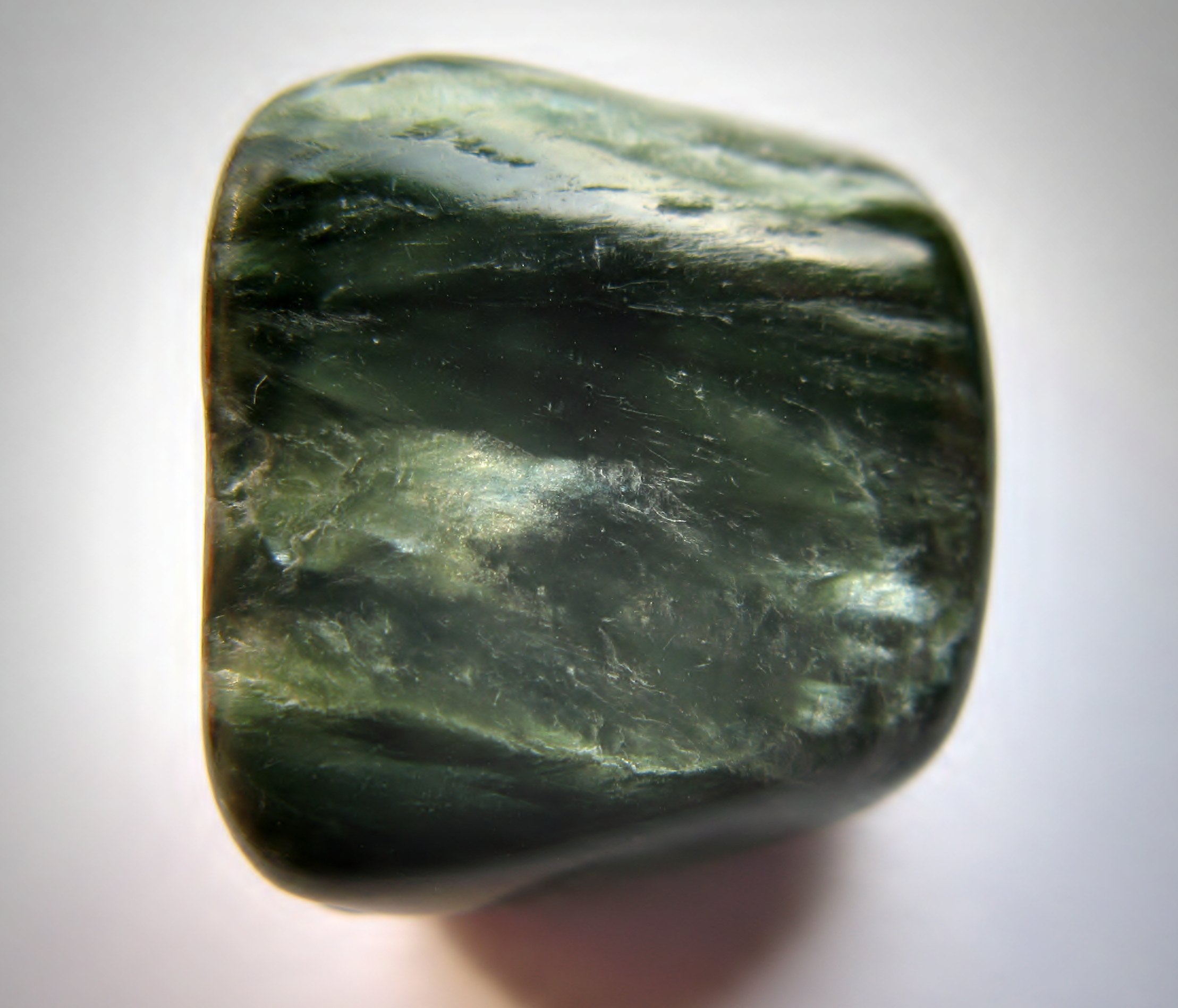
Seraphinite
Feathered with silvery-white chatoyancy on a deep forest green, seraphinite is the Siberian stone named for the highest angelic.
- Seraphinite is a trade name for chatoyant clinochlore, a chlorite mineral rather than a distinct species.
- The stone is named for the seraphim, the highest order of angels in Abrahamic tradition.
- Virtually all commercial seraphinite comes from a single region near Lake Baikal in Siberia.
- The silvery feather pattern comes from parallel mica platelets embedded in the clinochlore matrix.
- Seraphinite was popularized in the early 1990s by American crystal-industry pioneer Nicholas Kouri.
- Heart-chakra practitioners drawn to feathered silver-on-green chatoyancy
- Cabochon collectors who love single-source collector stones
- Readers interested in angelic symbolism across crystal tradition
- Gift buyers for healers, yoga practitioners, and caregiving roles
- Pendant and display shoppers willing to handle a fragile stone with care
- Ring buyers seeking daily durability (seraphinite is too soft)
- Budget shoppers under $15 per carat for large sizes
- Readers who need transparent faceted gems (seraphinite is opaque)
What Is Seraphinite?
Seraphinite is a trade name for a chatoyant variety of clinochlore, a member of the chlorite group of hydrous magnesium-aluminum silicates. The stone is named after the seraphim, the highest order of angels in Abrahamic religious tradition, because its feathered silvery-white fibers on a deep forest-green background resemble angelic wings.
Seraphinite forms when clinochlore crystallizes with parallel bands of mica-like flakes in iron-rich metamorphic environments.
The stone is found almost exclusively near Lake Baikal in the Korshunovskoye iron mine in Siberian Russia. This single-source supply gives seraphinite a niche but distinct collector identity.
Mineralogically, clinochlore crystallizes in the monoclinic system and has a Mohs hardness of 2.5 to 3.5, which is soft enough that seraphinite must be handled carefully and is typically cut as cabochons rather than faceted. The IMA symbol for clinochlore is Clc.
The characteristic chatoyant effect (the silvery feather pattern) is caused by parallel platelets of mica embedded in the clinochlore matrix. When light strikes the polished cabochon surface, the platelets reflect in a feather-like pattern that shifts with viewing angle, producing what dealers call silver schiller or angel feathers.
Specific gravity is approximately 2.60 to 2.85, and the stone is opaque with a dark green body color that ranges from forest green to nearly black with prominent silver fibers.
How Seraphinite Compares
| Property | Seraphinite | Malachite | Moss Agate |
|---|---|---|---|
| Hardness | 2.5 - 3.5 | 3.5 - 4 | 6.5 - 7 |
| Price / carat | $ Budget | $ Budget | — |
| Rarity | Moderate (single source) | Common | Common |
| Best For | Cabochon pendants, angelic altars | Cabochon carvings, heart chakra | Jewelry, garden magic |
Meaning and Symbolism
Seraphinite is an entirely modern gemstone in cultural terms, emerging in the international crystal market only in the 1990s after Soviet-era restrictions eased and Siberian clinochlore reached Western collector channels.
The trade name seraphinite was coined by Nicholas Kouri, who is credited with popularizing the stone and its angelic connotation in American crystal-healing communities in the early 1990s.
The name references the highest order of angels in Jewish and Christian tradition, whose six-winged form is echoed metaphorically in the stone's feathered silver pattern.
In contemporary crystal tradition, seraphinite is associated primarily with the heart chakra and with what practitioners describe as angelic or higher-guidance energy. Many crystal writers place seraphinite in the category of stones specifically recommended for emotional healing after loss, for readers in healing professions or caregiving roles.
For those working with angelic symbolism in meditation or prayer.
The silver fibers are often read metaphorically as wings, and the stone has become a visual icon of contemporary crystal kits aimed at emotional and spiritual support.
Because seraphinite comes from a single region near Lake Baikal, its meaning carries a specific Siberian character in the contemporary crystal community: the stone is framed as deep-earth, ancient, and isolated, all qualities that fit the angelic feather symbolism as well.
Practitioners often treat seraphinite as an occasional-use altar or pendant stone rather than a daily carry, both because of the stone's softness and because of its reserved reputation in crystal literature. Seraphinite is also increasingly used in bereavement jewelry and memorial pieces in contemporary markets.
Historical Timeline
Healing Tradition
Emotional
Practitioners believe seraphinite is a stone of gentle emotional healing, particularly suited to readers in caregiving or healing professions. In crystal healing tradition, it is said to support a wearer during bereavement, long caregiving seasons, or times of emotional depletion where tender restoration is needed rather than dramatic change.
Many find seraphinite a useful companion during grief work, recovery from burnout, or reflective periods of questioning one's role in caring for others. Seraphinite is often paired with rose quartz for self-compassion, with smoky quartz when old grief needs grounding, and with clear quartz when amplifying specific heart-centered intentions.
Practitioners tend to describe seraphinite as quiet, feathered, and restorative rather than bold or energizing.
Spiritual
In crystal healing tradition, seraphinite is said to anchor the heart chakra with a specifically angelic quality, bridging the ordinary heart and what contemporary crystal literature describes as higher guidance or angelic presence.
Practitioners believe the stone supports readers whose spiritual path includes angelic symbolism, prayer, or any practice that involves listening for inner wisdom. Because seraphinite is a modern crystal-tradition stone, it carries no classical planetary assignment.
Contemporary practitioners often associate it with Venus for its heart themes and with the air element for its feather imagery. Carrying seraphinite during memorial rituals, bereavement visits, or meditation on loss and acceptance is a common practice in contemporary crystal communities.
Physical
Practitioners believe seraphinite supports what they describe as gentle cellular regeneration, lymphatic balance, and recovery from chronic fatigue, folklore that draws on the stone's feather imagery and its association with restorative care.
Crystal healing tradition associates seraphinite with the heart as a physical organ, the lungs (through the feather-wing symbolism), and general immunity in gentle metaphorical terms. Many find carrying a small seraphinite palm stone during convalescence, long caregiving periods, or post-surgical recovery comforting.
Seraphinite is not a substitute for medical care, and practitioners frame its role as supportive rather than curative. Readers with chronic conditions, cardiovascular concerns, or respiratory issues are encouraged to rely on qualified medical guidance and treat crystal practice as one gentle element of a broader routine.
Zodiac, Birthstone and Gifts
Seraphinite has no traditional birthstone role and is adopted in contemporary astrology based on color, symbolism, and temperament. Many astrologers suggest seraphinite for Sagittarians drawn to stones with mystical and higher-guidance associations, and for Pisceans with an affinity for restorative, watery-soft emotional stones.
Modern Western astrology associates seraphinite with Venus for its heart themes and with the air element for its angelic feather imagery. Because seraphinite is a modern crystal-tradition stone, Vedic astrology (Jyotish) does not include it among classical gem prescriptions. Contemporary practitioners use it on an intention basis rather than a chart-driven one.
Care and Cleansing
Seraphinite requires gentle cleansing because of its softness and layered structure. Dry cloth wiping handles daily maintenance, and a soft brush can remove dust. Brief lukewarm rinses are acceptable for loose stones if dried immediately.
Avoid ultrasonic and steam cleaners, saltwater, and strong household cleaners, all of which can damage the stone's delicate layered structure.
Smoke cleansing with palo santo or sage is the most commonly recommended method. Moonlight cleansing is traditionally appropriate and fits the stone's gentle symbolism. Short sunlight exposure is safe since seraphinite is color-stable. Sound cleansing with a singing bowl placed near rather than on the stone is appropriate.
Many practitioners recharge seraphinite overnight on a clear quartz cluster or selenite slab, a passive method that avoids any risk to the softer structure.
- DO store seraphinite in a padded box away from harder stones.
- DO NOT use ultrasonic or steam cleaners on seraphinite.
- DO handle seraphinite gently; the mica layers can delaminate under stress.
- DO NOT soak seraphinite in saltwater, strong cleaners, or prolonged water exposure.
- DO wipe seraphinite with a soft cloth and avoid abrasive polishes.
- DO ask whether a cabochon has been stabilized with resin; stabilization is sometimes applied.
- Note: seraphinite is only found near Lake Baikal in Siberia; other green feathered stones are not seraphinite.
Real vs Fake
Genuine seraphinite shows deep green body color with distinctive silvery-white feathered chatoyancy that shifts with viewing angle. The feather pattern should look layered and organic rather than printed or uniform.
Common substitutes and confusions include other feathered chlorite-group stones (such as some varieties of chlorite schist), polished serpentine with silver flecks, and dyed or printed imitations of the silver-feather pattern.
Under 10x magnification, real seraphinite shows the characteristic parallel mica platelets within the clinochlore matrix, and the feather chatoyancy comes from light reflecting off these embedded layers rather than from any surface treatment.
A scratch test with a copper coin (Mohs 3) will typically mark seraphinite, which helps distinguish it from harder substitutes. The stone's specific gravity and the precise Lake Baikal provenance are the definitive identification markers.
Practical at-home clues include checking whether the silver feathers shift with viewing angle (this is chatoyancy from natural mica platelets, not a printed pattern), examining the edge of a cabochon for layered structure, and asking the seller for provenance information.
Because seraphinite is modestly priced and the Siberian provenance is so specific, outright fakes are uncommon, but some lower-grade green chlorite stones from other localities are occasionally sold under the seraphinite name; a reputable dealer with Siberian sourcing is the most reliable guarantee of authenticity.
Seraphinite Jewelry & Gifts
Seraphinite pricing is moderate for a single-source collector stone. Small tumbled stones run $5 to $20, palm stones $15 to $50, cabochons $10 to $100 depending on size and feather quality, and finished pendants in silver $40 to $200.
Designer cabochons with exceptional feather chatoyancy can reach $150 to $300 per piece, and large display cabochons above 50 carats with dramatic feathering can exceed $400.
Essentially all commercial seraphinite comes from the Korshunovskoye region near Lake Baikal in Siberian Russia. There is no widely recognized secondary source, which makes the Siberian provenance essentially universal for genuine seraphinite.
Treatments are uncommon; occasional resin stabilization is applied to soft cabochons to improve durability for jewelry use, and reputable dealers disclose this. For buyers, look for strong feather chatoyancy (the silver pattern is the stone's main aesthetic appeal), deep green body color (lower-grade stones can look muddy or brownish).
A reputable dealer with clear Siberian sourcing.
Where to Buy Seraphinite
Affiliate disclosure: Some links below earn us a small commission at no extra cost to you. See our affiliate disclosure page.
Handmade, raw, and tumbled pieces from independent sellers worldwide.
Shop Seraphinite on Etsy →Accessories, tools, and specimen sets with fast Prime delivery.
Shop Seraphinite on Amazon →Certified loose gemstones graded and photographed for online buyers.
Shop Seraphinite on GemSelect →Pairs Well With



Where Seraphinite Is Found
