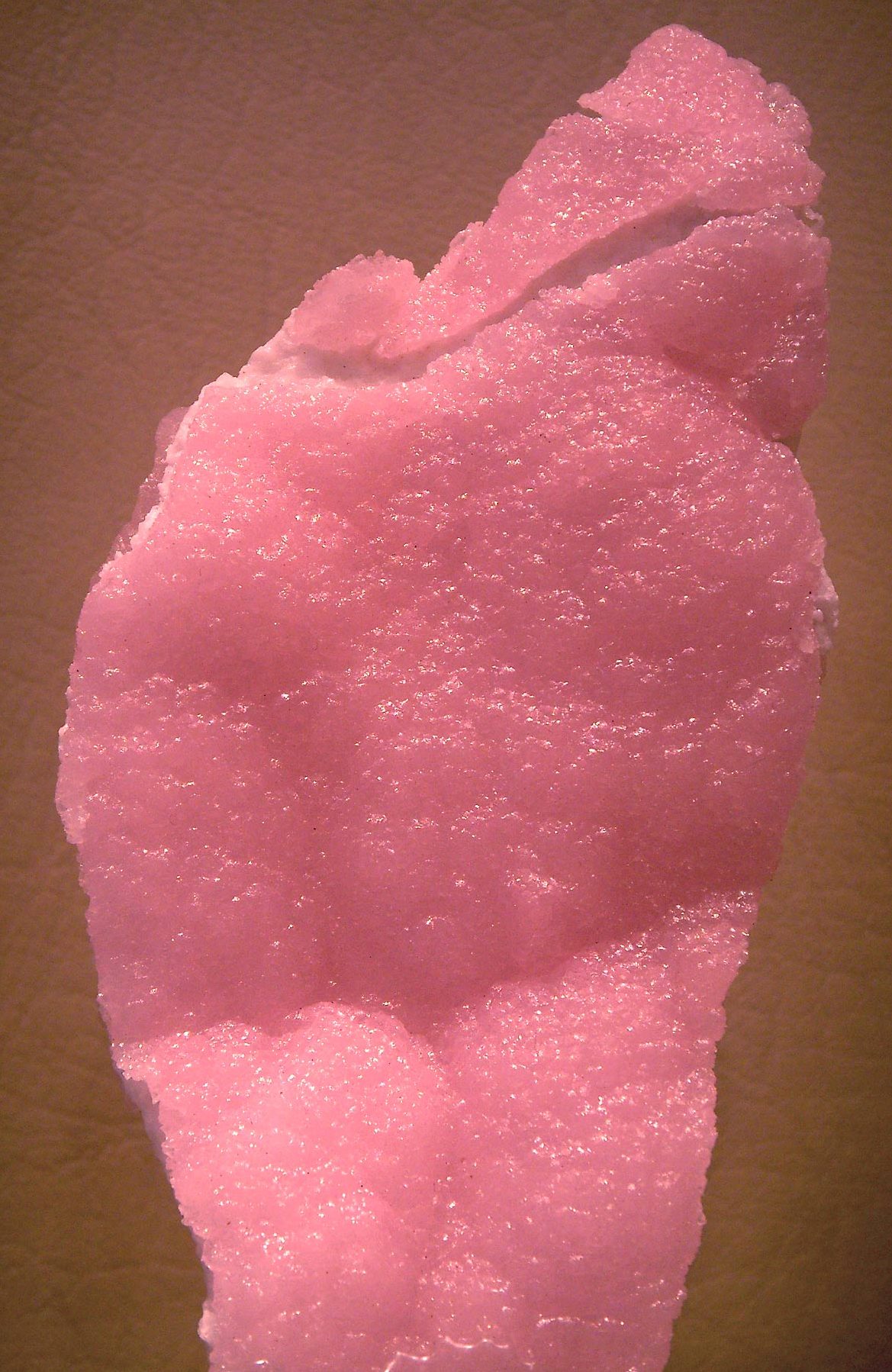
Smithsonite Pink
Pink Smithsonite forms in gentle bubble-like clusters of soft rose, lavender-pink, and mint - a zinc carbonate that looks impossibly soft for something made of mineral chemistry
- James Smithson never visited America but left his estate to the US, funding the Smithsonian Institution - the mineral named for him appears in the Smithsonian's own collection.
- Smithsonite was historically called calamine and was used as a zinc source ore before modern metallurgy identified it as a distinct species.
- The Kelly Mine in New Mexico is considered among the finest pink smithsonite localities in the world; much of the material reaching collectors today was mined decades ago.
- Smithsonite's high specific gravity (4.30-4.45) makes it noticeably heavy for its size - a mineralogical fingerprint of its zinc content.
- Cobalt impurities produce lavender-pink smithsonite; manganese produces rose; copper produces blue-green - each color reflects a different trace element story.
- Collectors building a pastel mineral cabinet - pink smithsonite is among the most coveted soft-color specimens
- Crystal healers drawn to gentle pink heart and crown stones at moderate price points
- Gift givers who want something genuinely rare and beautiful for a mineral lover
- Practitioners doing heart healing or grief work who want a physically soft-energy stone
- Interior designers seeking unique natural objects with delicate pink color
- Daily wear jewelry buyers - Mohs 4-4.5 is too soft for rings and is fragile in bracelets
- Those needing water-safe stones for rituals - carbonate dissolves
- Budget buyers - fine pink smithsonite carries collector-grade pricing
What Is Smithsonite Pink?
Smithsonite is zinc carbonate (ZnCO3), named for James Smithson, the English mineralogist whose bequest founded the Smithsonian Institution. It crystallizes in the trigonal system and most commonly forms botryoidal or stalactitic masses with a smooth, rounded bubble-like surface texture that is immediately recognizable. Color varies widely - zinc smithsonite can be blue-green, yellow-green, brown, or white, but cobalt-bearing material produces lavender-pink, and manganese-bearing material produces rose to bubblegum pink.
Pink smithsonite forms in the oxidized zones of zinc ore deposits, where manganese or cobalt impurities color the carbonate as it precipitates from hydrothermal solutions. The best pink specimens come from Kelly Mine in New Mexico, the Tsumeb Mine in Namibia, and various Mexican localities. The soft pastel color combined with the distinctive bubbly botryoidal texture makes pink smithsonite one of the most visually distinctive minerals in any collection.
Smithsonite is relatively soft at Mohs 4-4.5 and is a carbonate mineral, meaning it reacts with acids (including household vinegar) and dissolves slowly in water. It is a display and meditation specimen rather than a wearable gem or water-cleansing stone. Handle with care - the delicate botryoidal surfaces scratch and abrade easily.
How Pink Smithsonite Compares
| Property | Pink Smithsonite | Rose Quartz | Rhodochrosite |
|---|---|---|---|
| Hardness | 4-4.5 | 7 | 3.5-4 |
| Form | Botryoidal bubbles | Massive/crystal | Banded/stalactitic |
| Water Safety | No - dissolves | Yes | No - carbonate |
| Price | — | — | — |
Meaning and Symbolism
Smithsonite carries a gentle, almost maternal energy in crystal healing tradition - perhaps because its rounded, bubble-like botryoidal form evokes softness, nurturing, and the organic shapes of living things. Pink and lavender varieties are associated with unconditional love, self-compassion, and the healing of emotional wounds that have been carried for a long time.
Practitioners believe pink smithsonite is particularly useful for those who have difficulty receiving care and love - people who have learned to give generously but struggle to accept nurturing in return. The stone is said to dissolve the defensive armor around the heart without overwhelming the holder with vulnerability, working gently over extended time.
The zinc content of smithsonite carries its own symbolic resonance for some practitioners - zinc is associated with immunity, protection, and the body's ability to heal. Whether this mineral chemistry translates into crystal energy is a matter of tradition rather than evidence, but the association appears in several crystal healing frameworks.
Historical Timeline
Healing Tradition
Emotional
Practitioners believe pink smithsonite offers a gentle, sustained invitation to open the heart without forcing it. Many crystal workers describe it as a stone for those who have been emotionally hurt and are slowly rebuilding their capacity to trust and receive care. It is said to work over weeks and months rather than in a single session - placed near the bed, on a dresser, or held during quiet contemplation. The visual softness of the botryoidal surface is itself said to model the quality of gentle opening.
Spiritual
In crystal healing tradition, pink smithsonite bridges heart and crown chakra frequencies, supporting the experience of love as both personal and universal. Practitioners believe it helps dissolve the spiritual isolation that can accompany grief or trauma - the feeling of being fundamentally alone or unlovable. Some use it in practices focused on self-compassion and inner child healing.
Physical
Crystal healing practitioners associate smithsonite with the lymphatic system and immune function, drawing on the zinc symbolism in its chemistry. It is sometimes placed at the thymus area with the intention of supporting the body's natural healing capacity. These are traditional associations without clinical validation.
Zodiac, Birthstone and Gifts
Virgo's tendency toward self-criticism and perfectionism finds a gentle counterbalance in pink smithsonite's self-compassion energy. The stone is said to soften the inner critic and remind Virgo of the need to offer themselves the same nurturing they extend to others. Pisces connects with the stone's capacity for deep emotional healing and unconditional love - qualities central to the Piscean nature. Both signs dealing with heart-centered growth may find pink smithsonite one of their most valuable allies.
Care and Cleansing
Never cleanse smithsonite in water or salt - both degrade carbonate minerals. Sound cleansing with a singing bowl tuned to F (heart frequency) is ideal and completely safe. Place the singing bowl nearby rather than around the specimen.
Moonlight on a dry surface is safe and resonant for this stone. Selenite charging plate is one of the best options - place smithsonite on selenite overnight for a gentle, non-invasive reset. Smudge with rose or lavender smoke for a scent-matched cleansing ritual.
- DO NOT place in water - carbonate minerals dissolve in water over time.
- DO NOT use salt cleansing - salt solutions are acidic and reactive with carbonates.
- DO NOT expose to acids, vinegar, or acid-based cleaners.
- DO handle gently - the botryoidal surface scratches and abrades easily.
- DO store in padded boxes when not on display.
- DO NOT expose to prolonged direct sunlight - the pink color may fade with extended UV exposure.
Real vs Fake
Genuine pink smithsonite has natural color variation within the botryoidal mass - deeper pink at crystal centers and lighter at edges. Dyed white smithsonite or dyed howlite can be detected by a vinegar drop test: genuine smithsonite fizzes immediately (carbonate + acid = CO2); howlite does not react.
The specific gravity test is reliable: smithsonite (SG 4.30-4.45) feels remarkably heavy for its size - much heavier than glass, plastic, or howlite imitations of comparable volume. This is one of the clearest physical identifiers.
Buy from established mineralogy dealers who can provide locality documentation (Kelly Mine, New Mexico, or specific Mexican locality). Generic pink mineral specimens labeled smithsonite without provenance may be howlite or dyed calcite.
Smithsonite Pink Jewelry & Gifts
Botryoidal coverage, color intensity, and specimen size drive value. The finest pink smithsonite shows densely packed, well-developed bubble formations with consistent soft rose to lavender-pink coloration across the specimen. Partial coverage on matrix or muddy-pink color reduces value significantly.
Entry specimens start at $30-$100. Fine quality matrix pieces with dense pink botryoidal coverage run $200-$1,000+. Exceptional large specimens or Tsumeb material can reach much higher. Buy from mineralogy specialists rather than general crystal shops, which often lack species authentication for smithsonite.
Where to Buy Smithsonite Pink
Affiliate disclosure: Some links below earn us a small commission at no extra cost to you. See our affiliate disclosure page.
Handmade, raw, and tumbled pieces from independent sellers worldwide.
Shop Smithsonite Pink on Etsy →Accessories, tools, and specimen sets with fast Prime delivery.
Shop Smithsonite Pink on Amazon →Certified loose gemstones graded and photographed for online buyers.
Shop Smithsonite Pink on GemSelect →Pairs Well With


Where Smithsonite Pink Is Found


