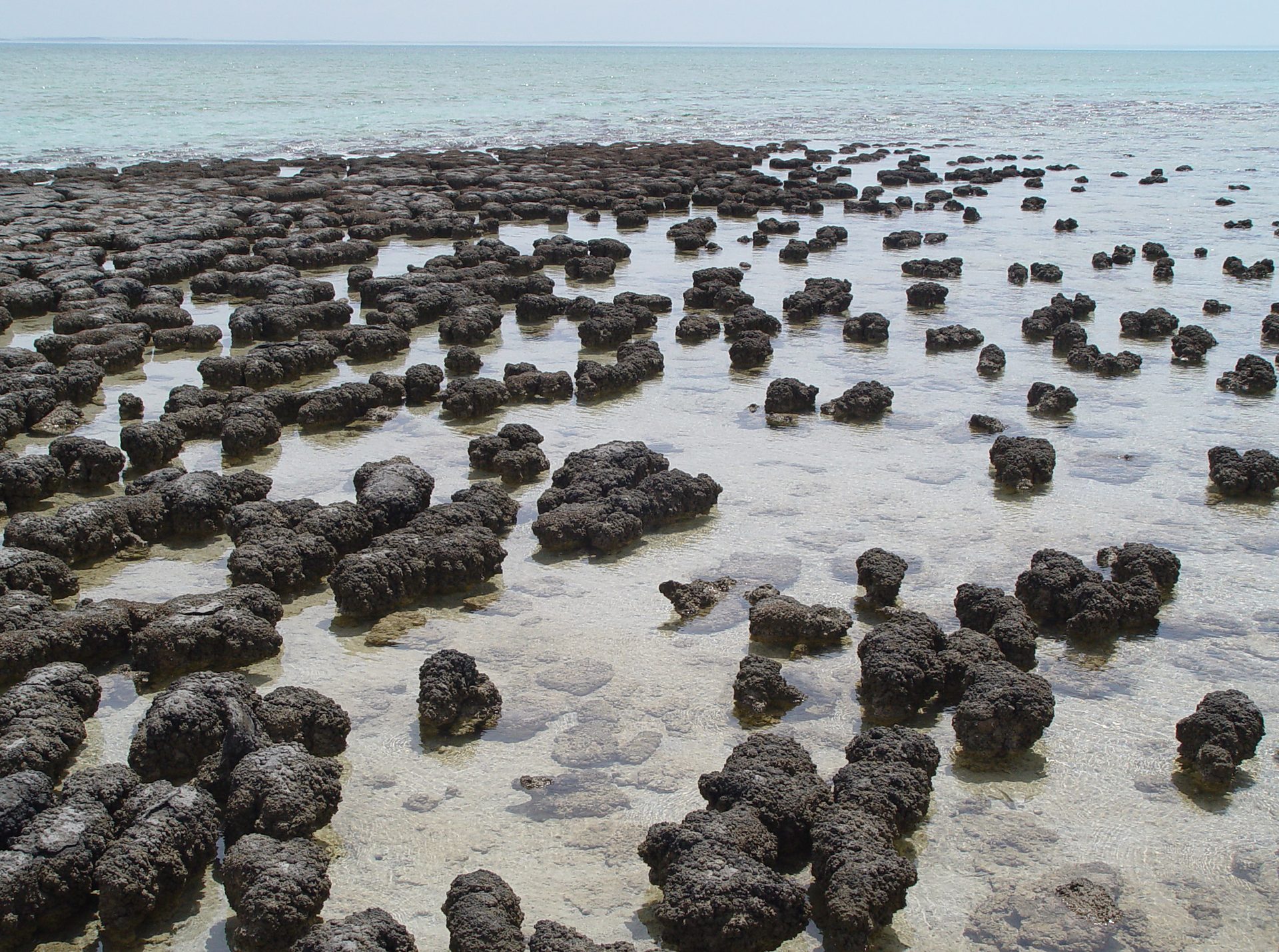
Stromatolite
Layered fossil records of Earth's earliest life - microbial mats that built the first reef structures 3.5 billion years ago.
- Stromatolites are responsible for the Great Oxidation Event about 2.4 billion years ago - cyanobacteria in stromatolites essentially created the oxygen-rich atmosphere that makes all complex life (including humans) possible.
- The living stromatolites at Shark Bay, Western Australia, are a UNESCO World Heritage Site - they represent one of the oldest and most significant biological communities still operating on Earth.
- Some of the oldest confirmed stromatolites at Dresser Formation in the Pilbara are 3.48 billion years old - older than the emergence of any animal, plant, or fungus.
- Ancient stromatolites contain some of the earliest microfossils of individual cyanobacteria cells, making them a key resource for understanding the origin and early evolution of life.
- Modern genetic studies of living cyanobacteria show they are essentially unchanged from their 3.5-billion-year-old predecessors - making stromatolites among the most biologically conservative lineages in life's history.
- Anyone drawn to the oldest tangible evidence of life on Earth
- Practitioners who work with ancestral connection, deep time, and Earth energy
- Fossil and natural history collectors who want something truly ancient
- Educators seeking tangible ancient biology for Earth-history teaching
- Grounding practitioners who resonate with primordial earth and water origins
- Everyday jewelry - hardness of 3.5-4 scratches easily
- Those wanting bold color or mineral flash in their stones
- Buyers seeking genuinely rare material - common Australian examples are widely available
What Is Stromatolite?
Stromatolite is a fossil structure formed by layered communities of cyanobacteria and other microorganisms that trapped sediment and minerals over billions of years, building distinctive domed, columnar, or stratiform structures. It rates 3.5-4 on the Mohs hardness scale.
The oldest confirmed stromatolites date to approximately 3.5 billion years ago in Australia's Pilbara region - making them the oldest known fossil evidence of life on Earth.
Ancient stromatolites are responsible for producing most of the oxygen in Earth's early atmosphere, transforming a methane-rich world into the oxygen-rich environment that made complex animal life possible.
When polished, fossilized stromatolites display beautiful concentric or wavy layering in brown, tan, cream, and sometimes rusty red-orange. The pattern records the layered growth of microbial mats, grain by grain and season by season over geological time. Each ring or wave represents a period of biological activity preserved forever in stone.
The material is typically carbonate (limestone) or silicified (replaced by silica), giving it varying hardness depending on the original composition.
Living stromatolites still exist today in a few locations - most famously at Shark Bay in Western Australia, where the shallow hypersaline waters create conditions similar to early Earth oceans. Seeing living stromatolites is genuinely like looking at life forms that have been essentially unchanged for 3.5 billion years.
Polished fossil stromatolites from ancient Precambrian deposits make this deep time accessible as a tangible, holdable object.
How Stromatolite Compares
| Property | Stromatolite | Ammonite | Petrified Wood |
|---|---|---|---|
| Hardness | 3.5-4 | 3.5-4 | 6-7 |
| Price/piece | $ Budget | $ Budget | $ Budget |
| Age | Up to 3.5 billion yrs | 66-400 million yrs | Varies |
| Best For | Deep-time grounding | Sacred geometry | Grounding, display |
Meaning and Symbolism
Practitioners who work with Stromatolite describe it as carrying the deepest ancestral energy available in any gem material - not the personal ancestral memory of Larimar or the cultural heritage of Lapis Lazuli, but the most fundamental biological ancestry: the very organisms that made the atmosphere breathable for all life that followed.
It is said to resonate with the deepest possible level of Earth connection and life's essential continuity.
In crystal-working traditions, Stromatolite is associated with the Earth Star chakra - the energy center below the feet that connects to the planetary body itself.
Practitioners believe working with Stromatolite grounds the energetic body at a depth that few other stones can access, creating a sense of being held by the Earth not just physically but biologically, as a member of the great community of life that these ancient organisms helped create.
The stone is associated with patience and with the power of collective, incremental effort. The cyanobacteria that built these reefs did not do so quickly or dramatically - they built the world one microscopic layer at a time, over billions of years.
Practitioners believe Stromatolite carries this quality of steady, cumulative creation and say it supports those who are building something long-term, whether a practice, a relationship, or a life's work.
Historical Timeline
Healing Tradition
Emotional
Practitioners describe Stromatolite as providing a uniquely deep emotional grounding - not just calming the surface emotions but settling the nervous system at the most fundamental level, as though connecting to the planetary body itself creates a stability that nothing else quite replicates.
It is said to be particularly helpful for existential anxiety - the kind that comes from feeling small, temporary, or without meaning in a vast indifferent universe.
The stone's message, in practitioners' framing, is the opposite: you are part of a chain of life billions of years long, your existence is part of this extraordinary story, and you are never as alone or as disconnected as anxiety claims.
Crystal workers describe it as working slowly and subtly, like the organisms that made it - not a quick fix but a deep recalibration over sustained use.
Spiritual
In spiritual practice, Stromatolite is associated with deep-earth spirituality - the dimension of practice that connects to planetary consciousness, ancient wisdom, and the life force that has been animating matter since the earliest moments of biological chemistry.
Practitioners believe it activates the Earth Star chakra with unusual depth, grounding the subtle bodies in a field that extends below the individual and into the planetary body itself.
Some practitioners use it in ceremony marking passages of long time - long marriages, major milestones, or ancestral honoring - as a material witness to the fact that life persists and builds across inconceivable spans.
It is associated with the nature-based spiritual traditions that revere the Earth as a living intelligence older and wiser than any human culture.
Physical
Crystal-working traditions associate Stromatolite with the circulatory and lymphatic systems, given cyanobacteria's relationship to oxygen. No scientific evidence supports these claims. Practitioners sometimes place it near the feet or base of the spine during grounding sessions, believing it draws excess energy out of the nervous system and into the earth, leaving the body calm and well-rooted.
Zodiac, Birthstone and Gifts
Taurus, the earth sign of steadiness, patient accumulation, and deep physical rootedness, resonates profoundly with Stromatolite's geological patience and biological continuity. Practitioners believe it amplifies Taurus's capacity for long-term commitment and the quiet confidence of being deeply in the body and on the earth.
Virgo, who honors the small and cumulative - the incremental improvements and careful work that build lasting excellence - finds in Stromatolite a geological mirror: billions of microscopic acts of metabolism that transformed a planet.
Both signs are said to find in this ancient fossil a companion for their deep-earth, long-horizon way of moving through the world.
Care and Cleansing
Brief water contact is acceptable for most silicified stromatolites, but avoid prolonged soaking - carbonate varieties are water-sensitive and may etch or develop surface bloom. A quick rinse followed by immediate drying is fine for most pieces; when in doubt, use dry methods.
Preferred methods: dry moonlight, earth burial for a few hours (connecting it back to the earth is poetically appropriate), smoke cleansing, or sound. Many practitioners feel stromatolite benefits from occasional burial in dry garden soil for a day - returning it symbolically to its geological context.
Avoid salt cleansing on carbonate stromatolites - salt can react with calcium carbonate and leave surface deposits. Silicified pieces are more salt-tolerant.
- DO store away from harder stones - Mohs 3.5-4 means quartz and most minerals will scratch the surface.
- DO NOT use salt water or acidic cleaners - carbonate minerals react with acid, etching the surface.
- DO NOT leave in prolonged direct sunlight on a reflective surface - heat can stress surface polish.
- NOTE: Polished pieces maintain best with a light coat of lapidary wax applied annually.
- DO NOT use ultrasonic cleaners - vibration can stress the layered fossil structure.
Real vs Fake
Genuine fossilized stromatolites show the characteristic concentric or wavy layering that records microbial mat growth - the pattern is organic and irregular, not uniform. No two pieces are identical; the layers undulate in the way that biological growth does, distinct from purely chemical mineral banding.
The material is typically tan to brown with cream to rust layering, sometimes with dark manganese dendrites. When polished, it shows a somewhat dull to waxy luster typical of carbonate fossils. Hard, glassy material sold as stromatolite may be a different mineral.
Age claims vary by locality - Precambrian Australian material is genuinely ancient (500 million to 3.5 billion years); material from younger deposits is also sold as stromatolite and is real, just younger. Be wary of extravagant unsubstantiated age claims for inexpensive pieces.
Purchase from fossil dealers, natural history suppliers, or crystal dealers with geological credentials. The widespread availability of genuine material means faking is uncommon; the main risk is unsubstantiated extreme age claims rather than outright material substitution.
A simple hardness test (Mohs 3.5-4 - a steel knife should scratch it with light pressure) and the organic layering pattern together confirm most genuine specimens.
Stromatolite Jewelry & Gifts
Stromatolite is among the more affordable fossil gem materials, with polished palm stones and tumbled pieces running $5-$20 and carved shapes or larger display pieces $20-$60. Exceptional large, well-patterned slabs can reach $100-$200 from specialist fossil dealers.
The visual quality that matters most is the clarity and contrast of the layered pattern - pieces with well-defined, colorful banding are more desirable than dull, uniform-colored material. Brown-and-cream banding with occasional rust or black accents makes the most striking pieces.
Australian material from the Pilbara (the genuinely ancient stuff) is priced higher than younger Proterozoic material from other localities and sold by fossil specialists rather than general crystal shops. For purely meditative use, any authentic stromatolite works regardless of age.
For display, carved half-spheres (hemispheres) that show both the dome profile and the layered interior simultaneously make the most visually interesting presentations of the material.
Reliable sources: fossil and natural history dealers, Australian mineral exporters, established crystal shops with geological knowledge, and museum gift shops at natural history institutions.
Where to Buy Stromatolite
Affiliate disclosure: Some links below earn us a small commission at no extra cost to you. See our affiliate disclosure page.
Handmade, raw, and tumbled pieces from independent sellers worldwide.
Shop Stromatolite on Etsy →Accessories, tools, and specimen sets with fast Prime delivery.
Shop Stromatolite on Amazon →Certified loose gemstones graded and photographed for online buyers.
Shop Stromatolite on GemSelect →Pairs Well With


Where Stromatolite Is Found


