
Sugilite
A vivid violet-purple cyclosilicate from the Wessels mine in South Africa, sugilite became a New Age favorite after its 1979 gem-grade.
- Sugilite is named for Japanese geologist Ken-ichi Sugi, who first identified the species in 1944.
- The stone is sometimes marketed under the trade names luvulite or royal lavulite for commercial purposes.
- The Wessels manganese mine in South Africa produces essentially all gem-quality sugilite reaching the world market.
- The original Japanese material was pale yellowish-brown with no gem value; the famous violet color comes only from the South African deposit.
- Transparent gem-quality sugilite is exceptionally rare; almost all jewelry uses translucent to opaque cabochon material.
- Practitioners working with third eye and crown chakra spiritual development
- Healers and energy workers seeking a high-vibration psychic protection stone
- Collectors interested in rare South African mineral specimens with documented provenance
- Pisces and Virgo readers drawn to violet-purple stones for meditation
- Pendant and earring shoppers wanting a distinctive New Age signature stone
- Daily-wear ring buyers; sugilite's Mohs 5.5 to 6.5 makes it vulnerable to scratches
- Buyers under $80 per gram for fine grade material (consider amethyst or charoite)
- Anyone wanting a recognized birthstone gift (try amethyst for February)
What Is Sugilite?
Sugilite is a rare alkali metal cyclosilicate first identified in 1944 by Japanese geologist Ken-ichi Sugi on Iwagi Island, Japan, and named in his honor. The original Japanese material was a pale yellowish-brown rock-forming mineral with no commercial gem value, and the species remained obscure for over three decades.
Gem-quality vivid purple sugilite was not discovered until 1979, when a major find at the Wessels manganese mine in South Africa transformed it into a sought-after metaphysical stone.
The mineral's deep purple to violet color comes from manganese in the crystal structure, with iron contributing pink and reddish tones in some specimens. The IMA symbol is Sgl. Sugilite forms in manganese-rich metamorphic environments where alkali-bearing fluids interacted with manganese deposits, conditions found at very few localities worldwide.
The stone is sometimes marketed under the trade name luvulite or royal lavulite, especially in commercial contexts.
South Africa's Wessels mine in the Northern Cape Province has produced essentially all gem-quality sugilite reaching the global market since 1979. Smaller occurrences exist in Japan (the type locality), Italy, India, Canada, and Australia, but commercial supply depends almost entirely on the Wessels operation.
Sugilite has a Mohs hardness of 5.5 to 6.5, which makes it suitable for cabochons, beads, and pendants but more vulnerable than harder gems. Most material is opaque to translucent, with rare transparent gem-quality stones commanding exceptional premiums.
How Sugilite Compares
| Property | Sugilite | Charoite | Amethyst |
|---|---|---|---|
| Hardness | 5.5 - 6.5 | 5 - 6 | 7 |
| Price / gram | $$ Mid-range | $ Budget | $ Budget |
| Rarity | Very rare | Rare | Common |
| Best For | Spiritual healing, pendants | Meditation, decor | Daily wear, calm |
Meaning and Symbolism
Sugilite carries a uniquely modern origin story among popular crystals. The species was scientifically described in 1944 but remained essentially unknown to the public until the 1979 Wessels mine discovery transformed obscure pale-brown specimens into vivid violet jewelry-grade material.
The stone arrived on the New Age scene in the 1980s and was rapidly adopted by metaphysical practitioners as one of the highest-vibration purple stones available, alongside charoite and amethyst.
Practitioners adopted sugilite quickly because its vivid color and rarity made it stand out from other purple stones. The Wessels mine, primarily a manganese operation, produces sugilite as a byproduct of base-metal mining, which means supply has always been irregular and dependent on commercial extraction priorities.
Several major sugilite finds have been depleted, contributing to the stone's reputation as a finite spiritual resource.
In modern crystal practice, sugilite is traditionally associated with spiritual love, psychic protection, and the integration of higher consciousness into everyday life. Practitioners believe it activates the third eye and crown chakras while drawing higher-frequency energy down through the body.
Many find sugilite useful as a personal talisman during periods of intensive spiritual development, with the stone treated as a focal point for serious practice rather than a casual daily carry.
Historical Timeline
Healing Tradition
Emotional
Practitioners believe sugilite is a stone of spiritual love, psychic protection, and emotional shielding for highly sensitive readers. In crystal healing tradition, it is said to help empaths maintain energetic boundaries while still remaining open to deep connection.
Many find sugilite especially supportive during periods of caregiving, healing work, or any role that requires holding space for others' difficult emotions without absorbing them.
The stone has long been used in modern crystal practice for grief, especially the kind of complicated grief that includes spiritual or existential dimensions. Practitioners often pair sugilite with rose quartz when the work involves heart healing combined with spiritual support, or with clear quartz for amplified meditation focus.
Sugilite is sometimes recommended for readers managing the emotional aftermath of trauma, and is considered a gentle but powerful companion for shadow integration work conducted within a stable spiritual framework.
Spiritual
Sugilite is traditionally associated with the third eye and crown chakras together in modern crystal practice. Practitioners believe it activates higher psychic perception while anchoring spiritual experience in embodied compassion, which is the combination that makes it a favorite of healers and energy workers.
It has long been considered one of the highest-vibration purple stones, alongside charoite and select amethyst.
Many find sugilite useful in meditation focused on spiritual purpose, soul-level integration, and the question of how to bring higher-consciousness experience into daily life. The stone pairs well with clear quartz for amplified focus and with black tourmaline for grounding support during intensive psychic work.
Sugilite is sometimes used in psychic protection ceremonies and is traditionally worn by readers who do hands-on healing or energy work professionally.
Physical
Practitioners believe sugilite supports what they describe as the body's energetic alignment with higher purpose, which is interpreted in modern crystal healing as supporting the nervous system, the head, and the upper body. Folklore is sparse because the stone became popular only in the 1980s.
It is sometimes recommended for readers managing chronic pain, especially pain that practitioners associate with spiritual or emotional roots.
Sugilite is often suggested as a comfort companion during long-term illness in folk practice, particularly because of its purple color's traditional association with healing in Western symbolism. The stone is not a substitute for medical care, and practitioners are careful to frame its role as supportive rather than curative.
For readers who experience the kind of headaches that practitioners associate with spiritual opening or empathic overload, sugilite is sometimes carried alongside black tourmaline as a balanced energy support.
Zodiac, Birthstone and Gifts
Sugilite is most often associated with Virgo in modern crystal astrology because of its connection to integrated spiritual service. Practitioners believe the stone supports Virgo readers who feel called to healing or service work and need the energetic protection to do that work sustainably.
It has long been recommended as a personal talisman for Virgo healers and counselors.
Pisces is the secondary association because of sugilite's high-vibration spiritual character. Astrologers sometimes suggest the stone for Pisces readers seeking to channel their natural intuitive gifts while maintaining clear personal boundaries, especially for those working in artistic, mystical, or healing fields.
Care and Cleansing
Sugilite tolerates most gentle cleansing methods, though its softer hardness and vivid color require some care. A soft dry cloth wipe is the safest routine, with a brief lukewarm soapy water rinse acceptable for occasional deeper cleaning.
Avoid ultrasonic and steam cleaners, which can stress fissures common in cabochon material, and avoid prolonged sun exposure, which can fade the violet color over months.
Energetic cleansing with smoke from sage, palo santo, or cedar is widely used and considered safe for sugilite. Sound cleansing with a singing bowl or tuning fork works well, and brief moonlight exposure is the most aligned method for the stone's high-vibration character.
Avoid salt of any kind, which can corrode metal settings and dull the polish. Many practitioners recharge sugilite by resting it on a clear quartz cluster or selenite plate overnight between uses.
- DO store sugilite separately from harder gems to prevent scratches.
- DO NOT leave sugilite in direct sunlight for extended periods, since color can fade over time.
- DO use bezel settings rather than prongs for sugilite cabochons in jewelry.
- DO NOT use ultrasonic or steam cleaners on sugilite, especially material with visible fissures.
- DO ask whether the stone is natural Wessels mine material or a substitute.
- DO request a reputable independent gemological lab certificate for any high-value purchase.
- Note: stones marketed as sugilite below $30 per gram are often dyed howlite, charoite, or other purple substitutes.
Real vs Fake
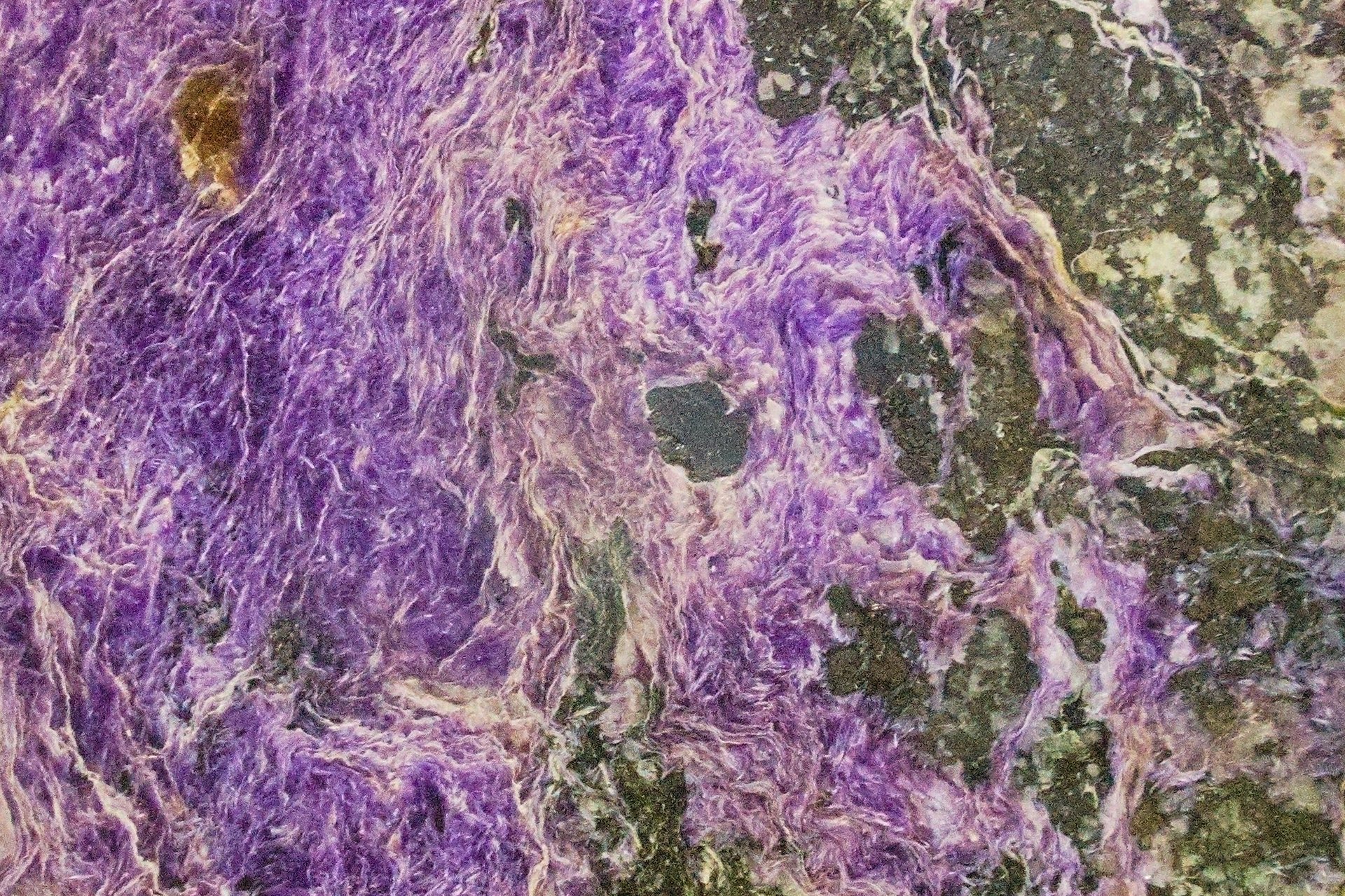
Genuine sugilite shows vivid violet to purple color with characteristic translucent to opaque appearance and often subtle marbling or banding caused by associated manganese minerals. Under magnification you may see typical inclusions such as manganese-rich black streaks, small pyrite specks, or pectolite patches.
The color is uniformly distributed in fine material rather than appearing as surface dye, and the stone has a distinctive cool, slightly waxy feel.
Common imitations include dyed howlite (a much softer white mineral), dyed magnesite (similar to howlite), purple plastic resin, and lower-grade purple charoite sold under the sugilite name.
A reputable independent gemological lab can confirm the species using refractive index and density measurements; sugilite has a refractive index of 1.594 to 1.611 and specific gravity of 2.74 to 2.80. Charoite is similar but typically shows more fibrous structure and has different chemistry.
At home, look for vivid uniform color with subtle natural variation, the cool feel of true silicate stone, and the subtle inclusions characteristic of Wessels mine material. Watch for stones priced below $30 per gram claiming to be sugilite, since these are almost always dyed substitutes.
Reputable sellers disclose the country of origin (almost always South Africa for gem-quality material) and provide photographs that show the natural variation in pattern. Stones with suspiciously perfect uniform color and no internal variation are often dyed.
Sugilite Jewelry & Gifts
Sugilite pricing is generally expressed per gram rather than per carat because most material is sold as cabochons or beads. Standard opaque purple material runs $30 to $80 per gram, while higher-grade translucent material with strong color reaches $80 to $300 per gram.
Top-grade gel-translucent sugilite with vivid color and minimal matrix can exceed $500 per gram in collector circles. Beads and small cabochons are typically priced individually, with quality finished pendants ranging from $200 to $2,000.
Sugilite is generally untreated, and reputable sellers disclose origin (almost always Wessels mine, South Africa) and material grade. Watch for stones marketed below $30 per gram; these are almost always dyed howlite, magnesite, or other substitutes priced as the rarer species.
For collectors, gel-grade translucent material from the Wessels mine represents the premium end of the market and is increasingly difficult to source. supply has tightened due to mining priorities at Wessels, which has driven prices upward across all grades.
Where to Buy Sugilite
Affiliate disclosure: Some links below earn us a small commission at no extra cost to you. See our affiliate disclosure page.
Handmade, raw, and tumbled pieces from independent sellers worldwide.
Shop Sugilite on Etsy →Accessories, tools, and specimen sets with fast Prime delivery.
Shop Sugilite on Amazon →Certified loose gemstones graded and photographed for online buyers.
Shop Sugilite on GemSelect →Pairs Well With




Where Sugilite Is Found


