Charoite
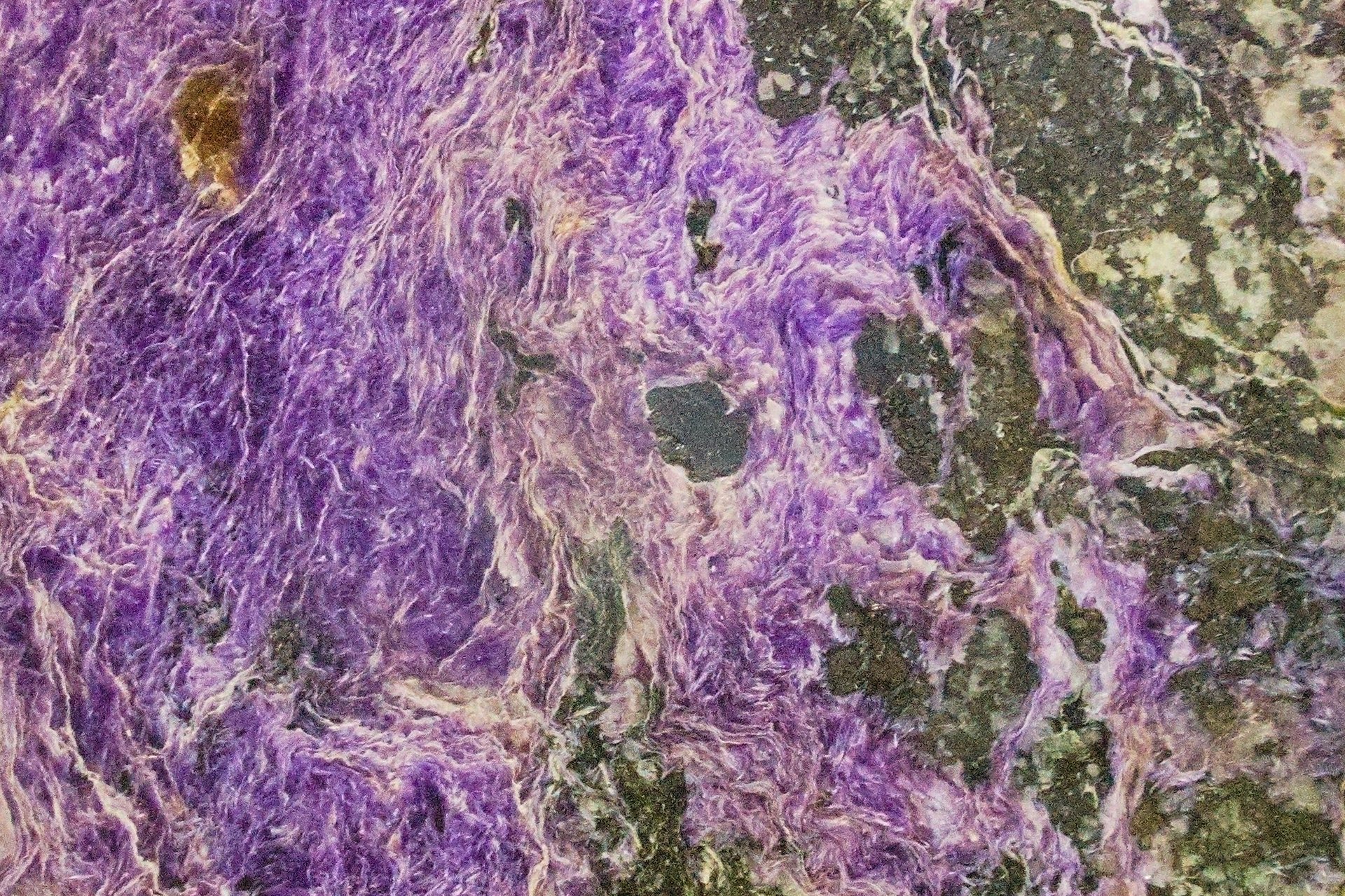
Born only in the Murun massif of Siberia, charoite is the swirling purple stone of transmutation, discovered in the 20th century.
- Charoite comes from only one deposit in the world: the Murun massif in Siberia's Sakha Republic.
- The stone was only scientifically described in the 1970s, making it one of the youngest gem materials.
- Charoite's name is derived from the Chara River near the type locality.
- No synthetic charoite is produced commercially because of the complex mineral aggregate structure.
- Charoite typically contains interwoven black aegirine and white feldspar that create its swirling appearance.
- Collectors who appreciate a single-deposit mineral from a remote Siberian locality
- Practitioners working with transformation, spiritual protection, and crown chakra themes
- Readers drawn to swirling purple patterns unique among commercial gemstones
- Crystal workers seeking an unusual pairing with amethyst and sugilite
- Gift buyers looking for a distinctive and rare specimen for a significant occasion
- Buyers wanting affordable daily-wear rings (Mohs 5 to 6; consider amethyst)
- Readers seeking stones with ancient folklore (charoite was only described in the 1970s)
- Shoppers looking for faceted transparent stones (charoite is cabochon-only material)
What Is Charoite?
Charoite is a rare potassium calcium silicate mineral found at only one locality in the world: the Murun massif in the Sakha Republic (formerly Yakutia) of eastern Siberia. The stone's distinctive swirling violet patterns come from fibrous crystal aggregates interwoven with black aegirine, white feldspar, and occasional tinaksite.
The result is a visual texture unlike any other mineral, often described as flowing or feathery.
At Mohs 5 to 6, charoite is moderately soft and is typically cut as cabochons, beads, and carvings rather than faceted gems. Its refractive index of 1.550 to 1.559 gives the polished surface a subtle silky luster, sometimes showing chatoyancy (cat's-eye effect) from the fibrous aggregates.
The stone is never transparent in the gem sense and is valued for its pattern and color rather than optical clarity.
Charoite was first described scientifically in the 1970s, making it one of the most recently discovered gem materials. It was named after the Chara River, near the type locality.
Commercial supply comes exclusively from Russian mining operations, and material is traded internationally as beads, cabochons, tumbled stones, and decorative objects. Because there is only one deposit, charoite quality and availability depend entirely on Russian extraction volume, and geopolitical conditions affect supply reliability.
How Charoite Compares
| Property | Charoite | Sugilite | Lepidolite |
|---|---|---|---|
| Hardness | 5 - 6 | 5.5 - 6.5 | 2.5 - 3 |
| Price / carat | $ Budget | $$ Mid-range | — |
| Rarity | Very Rare | Rare | Common |
| Best For | Cabochons, collector pieces | Fine cabochon jewelry | Calming tumbles |
Meaning and Symbolism
Charoite was only identified scientifically in the 1970s, so like tanzanite and hiddenite it lacks ancient folklore. Its meaning has been built entirely in modern crystal healing tradition, drawing on its swirling purple pattern, its single-deposit origin, and its associations with the crown chakra.
Practitioners often describe charoite as a stone of transmutation, linking its flowing patterns to alchemical symbolism of transformation.
In modern crystal healing tradition, charoite is associated with spiritual protection, release of fear, and connection to higher guidance. The stone's Siberian origin and limited supply have given it an aura of mystery in metaphysical circles, and practitioners often suggest it for readers navigating significant spiritual awakenings or difficult healing work.
Its color alignment with purple and violet stones places it alongside amethyst and sugilite in crown chakra practice.
Crystal workers sometimes describe charoite as a soul stone, fitting for readers working through past trauma, addiction recovery, or boundary-setting with difficult relationships. The stone's single-deposit rarity adds symbolic weight for practitioners who associate limited materials with concentrated energy.
Modern tradition has also linked charoite specifically with transformation during life passages like marriage, career changes, or becoming a parent.
Historical Timeline
Healing Tradition
Emotional
Practitioners believe charoite is a stone of transmutation, traditionally associated with releasing fear, transforming difficult patterns, and finding steady ground during significant life changes. In crystal healing tradition, it is said to support readers working through addiction recovery, trauma processing, and boundary-setting with difficult relationships.
Many readers wear charoite pendants during therapy or spiritual awakening periods. Practitioners often pair charoite with amethyst for crown chakra alignment and with rose quartz when transformation work needs heart tenderness.
Crystal workers typically describe charoite as a steady, reassuring presence during intense emotional seasons, suitable for readers who have already begun the inner work and need support to continue.
The stone's visual flow is often read as a metaphor for the transformation process itself, and practitioners suggest holding a charoite cabochon during journaling or introspective work as a tactile companion.
Spiritual
In crystal healing tradition, charoite is linked with the crown, third eye, and heart chakras, bridging multiple energy centers. The stone's complex mineral aggregate structure is read as reflecting the complexity of human spiritual development. Many readers use charoite as a focal anchor during soul retrieval, past-life regression, or deep meditation work.
Practitioners often describe charoite as a soul stone, with the swirling pattern interpreted as the movement of energy through emotional bodies. Crystal workers suggest charoite for readers engaged in spiritual work that spans multiple dimensions of growth.
Charoite pairs naturally with sugilite and lepidolite in purple-stone healing grids, and with clear quartz for amplification. The stone's Siberian origin connects it in modern practice with shamanic traditions of northern Asia, a modern symbolic association rather than direct tradition.
Physical
Practitioners believe charoite is traditionally associated with cardiovascular health, liver function, and what they describe as cellular-level cleansing. Folklore and modern crystal writers link the stone with recovery from toxic exposure, both physical and emotional, and with steady energy through healing periods, framed as supportive accompaniment rather than medical intervention.
Many readers wear charoite as pendants or rings during recovery periods from illness, stress, or major life transitions. The stone is not a substitute for healthcare and practitioners are consistent in describing its role as accompanying rather than treating.
Some crystal workers suggest charoite pairs well with hematite in grids focused on physical transformation and steady vitality. Because charoite contains multiple mineral components and is relatively soft, direct gem elixirs are generally avoided, and practitioners prefer indirect preparation.
Zodiac, Birthstone and Gifts
Charoite is not a traditional birthstone, but modern astrologers often associate it with Sagittarius for the sign's expansive spiritual interests and with Scorpio for the transformation-depth associations.
For Sagittarius readers drawn to metaphysical exploration, charoite is often recommended as a companion for extended meditation or travel to sacred places. Scorpio readers navigating deep emotional work tend to find charoite's transformation symbolism resonant. Practitioners sometimes pair charoite with amethyst for Sagittarius and with obsidian for Scorpio in zodiac kits.
Care and Cleansing
Charoite requires gentle cleansing methods because of its multi-mineral structure and moderate hardness. Wipe with a dry or barely damp soft cloth and mild soap for light cleaning. Avoid ultrasonic and steam cleaners, salt water soaks, and prolonged water immersion, all of which can affect the aggregate structure or dull the polish.
Short lukewarm rinses are tolerated for quick surface cleaning.
Moonlight is the preferred energetic cleansing method for charoite. Sound cleansing with a singing bowl is safe and effective. Brief smoke cleansing with palo santo or sage is acceptable. Many practitioners rest charoite on selenite plates overnight as a preferred method that avoids water and direct light entirely.
Dry salt cleansing should be limited to a few hours and is not generally preferred.
Sunlight should be limited because prolonged UV exposure can slowly lighten charoite's characteristic purple color. Brief indirect daylight is acceptable, but long storage in sunny windows or direct sun baths is not recommended. Crystal workers often cleanse charoite with sound or selenite to avoid any risk of color fade during cleansing.
- DO store charoite in a soft pouch away from direct sunlight.
- DO NOT use ultrasonic or steam cleaners on charoite because of its mineral aggregate structure.
- DO wipe charoite with a dry or barely damp cloth and mild soap.
- DO NOT soak charoite in water, saltwater, or any strong cleanser.
- DO set charoite rings in protective bezel mountings rather than prong settings.
- DO remove charoite jewelry before swimming, showering, and hand washing.
- Note: charoite is found at only one deposit in Siberia; supply and pricing can vary.
Real vs Fake
Genuine charoite shows swirling violet patterns with visible interwoven black (aegirine) and white (feldspar) elements visible to the naked eye and under magnification. The stone's refractive index of 1.550 to 1.559 and specific gravity of 2.54 to 2.78 confirm identification in gemological testing.
Under a 10x loupe, natural charoite shows fibrous aggregate structure and organic flow patterns that are difficult to replicate synthetically.
Common imitations and confusions include dyed quartz, dyed howlite, dyed calcite, and purple glass composites. Dyed stones show uniform color without the natural interweaving of aegirine and feldspar. Glass lacks the fibrous structure entirely and often shows gas bubbles under magnification. Composite resins feel warm and lightweight compared to genuine stone.
Because charoite comes from only one deposit, origin authentication is straightforward: it is either Russian (Sakha Republic) or not genuine charoite. Reputable sellers include provenance information, and for significant purchases a laboratory identification confirms the complex mineral aggregate structure.
Synthetic charoite does not exist commercially because the interwoven mineral composition is impractical to reproduce.
Charoite Jewelry & Gifts
Charoite spans a moderate price range driven by pattern quality and color saturation. Small tumbled pieces typically cost $5 to $25, bead strands run $30 to $150, and quality cabochons range from $20 to $300 depending on size and swirl complexity.
Top-quality cabochons with vivid purple color, distinct pattern flow, and clean integration of black aegirine and white feldspar can reach $100 to $500 or more for collector-grade pieces. Large carvings command higher prices.
Treatment is essentially not used on charoite because the natural color and pattern require no enhancement. For jewelry, favor cabochons with strong color saturation and interesting pattern flow, and use protective bezel settings to manage the stone's moderate hardness.
Ask reputable sellers whether material is genuine Russian charoite or a cheaper dyed substitute like dyed howlite or purple glass composite.
Where to Buy Charoite
Affiliate disclosure: Some links below earn us a small commission at no extra cost to you. See our affiliate disclosure page.
Handmade, raw, and tumbled pieces from independent sellers worldwide.
Shop Charoite on Etsy →Accessories, tools, and specimen sets with fast Prime delivery.
Shop Charoite on Amazon →Certified loose gemstones graded and photographed for online buyers.
Shop Charoite on GemSelect →Pairs Well With




Where Charoite Is Found
