Tourmaline Quartz
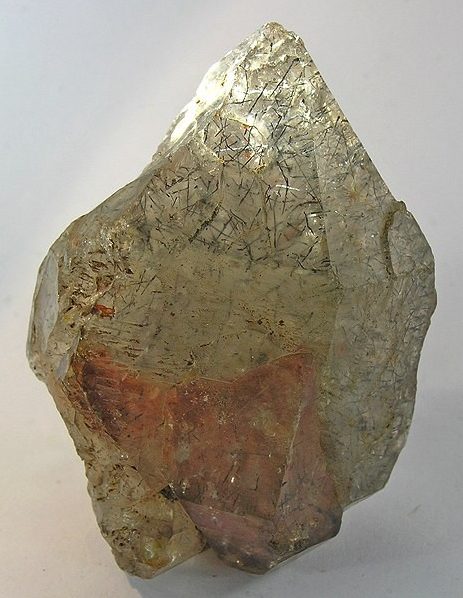
- The black needles in tourmaline quartz are schorl - the most abundant tourmaline variety on Earth, making up roughly 95% of all natural tourmaline.
- Some tourmaline quartz specimens show piezoelectric properties from both minerals - apply pressure and both quartz and tourmaline generate a tiny electrical charge.
- The Minas Gerais region of Brazil has produced tourmaline quartz specimens with needles aligned in perfect parallel arrays, caused by directional crystal growth in pressurized hydrothermal veins.
- Unlike rutilated quartz (TiO2 needles), the tourmaline inclusions in tourmaline quartz are hollow borosilicate tubes - you can sometimes see minute voids along their length under magnification.
What Is Tourmaline Quartz?
The black inclusions are schorl, the most common tourmaline variety, composed of sodium iron aluminum borosilicate. They formed simultaneously with the quartz or were engulfed as the quartz grew, creating a permanent two-mineral composite. No two specimens look identical. It rates 7 (quartz matrix) on the Mohs hardness scale.
Brazil's Minas Gerais state produces the world's finest tourmaline quartz, where pegmatite pockets allow both minerals to crystallize together in hydrothermal veins. Specimens range from a few dark strands to dense parallel needle arrays that turn the stone almost opaque.
Metaphysically, practitioners call tourmaline quartz a 'self-contained protection system' - the black tourmaline component is said to deflect negative energy while the quartz amplifies intention. It is traditionally associated with balancing opposing forces within a single stone.
How Tourmaline Quartz Compares
| Tourmaline Quartz | 7 | Black schorl needles, metallic luster on needles | Budget-Mid |
| Rutilated Quartz | 7 | Gold, red, or silver rutile needles - TiO2 not tourmaline | Budget-Mid |
| Actinolite Quartz | 7 | Green fiber inclusions from actinolite mineral | Budget |
| Black Tourmaline | 7-7.5 | Pure schorl crystal, no quartz matrix | Budget |
Meaning and Symbolism
Tourmaline quartz is traditionally associated with integrating opposites - dark and light, grounding and illumination. Practitioners describe it as a stone that refuses to let you have insight without anchoring that insight in your body and daily life, grounding a mineral system documented at Britannica.
In crystal healing traditions, the black tourmaline component is said to absorb and neutralize dense or scattered energy, while the quartz matrix is believed to amplify whatever intention the user sets. Together, they are traditionally called a protective amplifier.
The stone is often placed at thresholds - doorways, desks, or altars - where it is said to filter incoming energies while maintaining mental clarity. Those drawn to it frequently report a need to think more clearly without losing their sense of security.
Historical Timeline
Healing Tradition
Emotional
Practitioners associate tourmaline quartz with clearing mental fog and helping the mind stay calm under pressure. The stone is traditionally used in grief work to provide a grounded sense of protection while emotions process.
Crystal healers often recommend it for people who feel emotionally scattered, saying it helps integrate conflicting feelings without suppression.
Spiritual
In metaphysical traditions, tourmaline quartz is said to align all chakras by grounding lower chakras through schorl while activating higher chakras through quartz. It is traditionally associated with spiritual discernment - the ability to perceive clearly without being overwhelmed by what is perceived.
Practitioners describe it as creating a strong auric field that maintains clarity during meditation, energy work, or times of heightened sensitivity.
Physical
Crystal healers traditionally place tourmaline quartz near the spine or joints, associating it with structural integrity and nervous system support. No scientific studies support gemstone healing. All physical associations are part of traditional crystal healing practice only.
The stone is sometimes held during breathwork or yoga to support body-mind integration, according to practitioners.
Care and Cleansing
- Avoid prolonged heat, which can cause differential expansion along inclusion planes and crack the quartz.
- Do not use ultrasonic cleaners - the vibration can fracture quartz along tourmaline needle boundaries.
- Polish with a soft cloth. Abrasive cleaners may scratch the quartz surface at Mohs 7.
- Check settings on tourmaline quartz jewelry periodically - the stone is hard but inclusions create internal stress points.
Where to Buy Tourmaline Quartz
Affiliate disclosure: Some links below earn us a small commission at no extra cost to you. See our affiliate disclosure page.
Handmade, raw, and tumbled pieces from independent sellers worldwide.
Shop Tourmaline Quartz on Etsy →Accessories, tools, and specimen sets with fast Prime delivery.
Shop Tourmaline Quartz on Amazon →Certified loose gemstones graded and photographed for online buyers.
Shop Tourmaline Quartz on GemSelect →Pairs Well With