Uvarovite
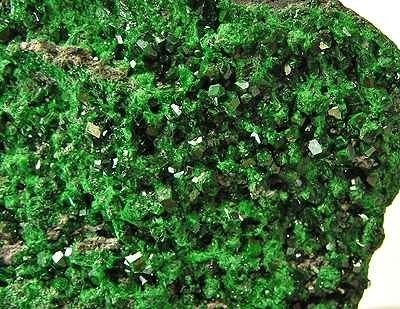
The vivid emerald-green chromium garnet, uvarovite is a druzy specimen practitioners associate with abundant heart energy and prosperity.
- Uvarovite is named for Count Sergei Uvarov, a 19th-century Russian statesman and patron of science.
- The vivid emerald color comes from chromium, the same element that colors emerald and chrome diopside green.
- Most uvarovite crystals are tiny (under 2mm) and grow in dense druzy coatings on black chromite matrix.
- Faceted uvarovite is one of the rarest gem materials in existence; clean stones above one carat are extraordinary.
- The Saranovskoye mine in Russia's Urals has supplied collector-grade uvarovite specimens continuously since the 1830s.
- Practitioners working with heart chakra abundance and prosperity intentions
- Collectors building a complete garnet-species reference suite
- Mineral specimen enthusiasts drawn to vivid druzy crystal coatings
- Crystal grid builders seeking a high-vibration green stone for prosperity work
- Designers creating statement pendants from druzy slabs
What Is Uvarovite?
Uvarovite is the chromium-rich end-member of the calcium garnet group, with the chemical formula Ca3Cr2(SiO4)3. Its emerald-green color comes from chromium substituting for aluminum, the same element that colors emerald and chrome diopside. It rates 6.5 - 7.5 on the Mohs hardness scale.
The mineral was discovered in 1832 in the Urals and named for Russian statesman and amateur mineralogist Count Sergei Uvarov.
Uvarovite forms almost exclusively in chromite-bearing serpentinites and skarns where calcium-rich fluids react with chromium-rich rocks. The crystals are typically very small, often less than 2mm, and grow in dense druzy coatings on chromite or dark serpentine matrix.
Larger transparent uvarovite crystals are extraordinarily rare, making faceted uvarovite one of the scarcest gem materials in existence.
Most uvarovite on the market is sold as druzy specimens with thousands of tiny brilliant green crystals coating black matrix. The visual effect is striking: a uniform sparkling green crust that catches light dramatically.
Russia's Saranovskoye mine in the Urals remains the type locality and primary source. Finland, Canada, the USA, South Africa, and Pakistan produce smaller but still significant occurrences. Faceted uvarovite, when it appears, typically comes from rare clean spots in larger crystals and almost never exceeds one carat.
How Uvarovite Compares
| Property | Uvarovite | Tsavorite | Demantoid |
|---|---|---|---|
| Hardness | 6.5 - 7.5 | 7 - 7.5 | 6.5 - 7 |
| Price / specimen | $ Budget | $$$ Premium | $$$ Premium |
| Form | Druzy crystals on matrix | Faceted gem | Faceted gem with horsetail |
| Best For | Specimen, prosperity work | Fine jewelry | Investment collecting |
Meaning and Symbolism
Uvarovite carries a relatively short symbolic history because the mineral was only discovered in 1832 and was unknown to ancient and medieval traditions. Its name commemorates Count Sergei Uvarov, a Russian statesman, classicist, and patron of science who served as president of the St.
Petersburg Academy of Sciences in the early 19th century. The naming gave uvarovite a quietly aristocratic European mineralogical lineage from the start.
Modern crystal tradition has built meaning around uvarovite's vivid emerald-green color and its rarity. Practitioners associate the stone with abundance, prosperity, and the kind of heart-centered wealth that includes love, friendship, and meaningful work alongside material support.
Because chromium gives uvarovite its color, the stone is sometimes grouped symbolically with other green chromium gems like emerald and chrome diopside as members of a heart-centered abundance family.
Practitioners believe uvarovite supports the heart chakra by anchoring abundance work in genuine emotional warmth rather than scarcity-driven striving. Many find the stone useful in prosperity grids, where its dense druzy coating concentrates many crystal points in a small area.
Uvarovite is also commonly recommended for readers shifting their relationship with money or success, particularly those moving from a scarcity mindset to a more open and trusting one.
The stone's rarity itself has become symbolic in modern crystal lore: uvarovite is sometimes called the wealthy garnet because of its pure brilliant chromium green and limited supply.
Historical Timeline
Healing Tradition
Emotional
Practitioners believe uvarovite supports a heart-centered approach to abundance and emotional generosity. In crystal healing tradition, it is said to help readers move from scarcity-driven thinking into trusting expansive presence, particularly in relationships and creative work.
Many find uvarovite useful during periods of financial transition, career shifts, or rebuilding after loss when the emotional work involves both grief and forward motion. The stone is often paired with rose quartz for soft heart practice and with citrine for grounded confidence in receiving.
Because uvarovite is rare and visually striking, practitioners often use it as an altar centerpiece rather than a daily-carry stone. It is rarely described as a stone for catharsis or rapid mood shift; its reputation is steady, expansive, and slightly aspirational in the most useful sense.
Many readers describe uvarovite as a stone that holds space for big intentions without demanding immediate action.
Spiritual
In crystal healing tradition, uvarovite is one of the high-vibration green stones associated with the heart chakra. Practitioners believe its dense druzy structure concentrates and radiates green chromium energy across a wide field, supporting prosperity meditation, gratitude practice, and what practitioners describe as heart-led manifestation.
The stone is widely used in crystal grids focused on abundance, particularly in conjunction with citrine and pyrite for combined wealth themes.
Many practitioners use uvarovite during meditation focused on receiving rather than striving, treating the brilliant green sparkle as a visual anchor for what one is opening to. The stone pairs naturally with clear quartz for amplification, with green aventurine for layered prosperity work, and with rose quartz for heart-soft companion practice.
Its traditional Venus association emphasizes love, beauty, and the quiet pleasure of sufficient resources.
Physical
Practitioners believe uvarovite's vivid chromium-rich green energy supports what traditions describe as the heart, circulation, and the kind of physical vitality that accompanies emotional well-being. Most physical correspondences are 20th-century in origin, since uvarovite has no ancient folklore tradition.
Uvarovite is not a substitute for medical care, and crystal traditions frame it as supportive rather than curative.
Many readers display uvarovite druzy near their workspace or bedside, framing the visual presence as an anchor for steady physical pace and heart-centered self-care. Practitioners sometimes use small druzy specimens in body grids placed near the heart during rest, never directly on bare skin (the tiny crystal points can scratch).
In contemporary gem therapy, uvarovite is sometimes paired with chrome diopside and emerald for shared chromium-energy work.
Zodiac, Birthstone and Gifts
Uvarovite is not a classical birthstone, but modern crystal writers often suggest it for Aquarius readers seeking a unique high-vibration heart stone, and for Pisces readers wanting expansive, gentle prosperity work. Astrologers traditionally associate uvarovite with Venus, the planet of love, beauty, and abundance.
Taurus and Libra, both Venus-ruled, also respond well to uvarovite's combination of beauty and prosperity symbolism. Earth signs often appreciate the stone as an altar piece during long abundance-focused meditation. Fire signs sometimes pair uvarovite with grounding stones like black tourmaline to balance the high-vibration heart frequency.
Care and Cleansing
Uvarovite tolerates gentle cleaning but the druzy structure requires care. Lukewarm water with a very soft brush removes dust between the tiny crystal points; rinse and dry with a soft lint-free cloth. Avoid ultrasonic and steam cleaners because the small crystals are easily dislodged from matrix. Skip prolonged soaking and saltwater entirely.
Smoke cleansing with sage, palo santo, cedar, or frankincense is the safest method for uvarovite druzy. Sound cleansing with a singing bowl is also fine.
Brief moonlight exposure is the traditional recharging method; many practitioners prefer moonlight over sunlight for uvarovite given its quiet, expansive Venus character. Recharging on a clear quartz cluster is also standard between major prosperity-focused cycles.
- DO NOT use ultrasonic or steam cleaners on uvarovite druzy; tiny crystals dislodge easily.
- DO clean gently with a soft brush and dry promptly with a lint-free cloth.
- DO store uvarovite separately from harder stones to avoid surface scratches and dislodged crystals.
- DO NOT wear uvarovite druzy rings during sports, gardening, or manual work.
- DO use protective bezel settings for any uvarovite jewelry to shield the fragile crystal tips.
- DO handle specimens by the matrix base rather than the crystal-coated surface.
- Note: druzy specimens should be kept away from young children who may rub the surface and damage the crystals.
Real vs Fake
Genuine uvarovite druzy shows tiny brilliant green crystals coating dark matrix. Real specimens vary in crystal density, color uniformity, and matrix quality across the surface; perfectly uniform bright green coating without any irregularity is suspicious.
Dyed quartz druzy is a common substitute, usually colored with neon-bright green dye that lifts with acetone on a cotton swab.
Color and crystal habit are key checks. Real uvarovite is a deep emerald green from chromium, not lime green or yellow-green. The crystals show characteristic dodecahedral or trapezohedral garnet faces under 10x magnification.
Stones marketed as uvarovite that show hexagonal crystal symmetry are quartz druzy; those with cubic symmetry but wrong color are likely dyed.
At home, you can examine the crystal points under a loupe (real uvarovite shows sharp garnet faces), test the streak (uvarovite leaves a white streak; dyed stones leave colored streaks), and check matrix association (real uvarovite grows on chromite or dark serpentine, not on white quartz or sandstone).
Be cautious of glued reattached specimens; chipped uvarovite plates are sometimes repaired and not always disclosed.
For higher-priced specimens above $100, request locality information; Saranovskoye Russian material commands provenance interest. Faceted uvarovite is so rare that any stone marketed as faceted should come with a lab report from an independent gemological lab.
Uvarovite Jewelry & Gifts
Uvarovite druzy specimen pricing varies by size, crystal density, and color saturation. Small druzy plates under 4cm run $15 to $50. Mid-size plates of 5cm to 10cm with dense bright green coverage reach $50 to $250.
Larger statement specimens above 12cm with sharp uniform crystal density can reach $300 to $1,500 for fine examples, with Russian provenance carrying small premiums.
Druzy slab pendants and earrings set in protective bezels run $40 to $200 for typical pieces, with high-grade Russian material reaching $300 to $800.
Faceted uvarovite is a price outlier: clean stones under one carat can run $300 to $2,000 per carat from specialist dealers, and stones above one carat are essentially unique.
Uvarovite is generally untreated. Color is natural chromium-derived green and not dyed in genuine specimens, though dyed quartz druzy substitutes are common in budget markets. Always ask about treatment, especially for unusually saturated colors or stones marketed at low prices.
Buy from specialist mineral dealers for any specimen above $50 and request photographic provenance for Russian Saranovskoye material.
Where to Buy Uvarovite
Affiliate disclosure: Some links below earn us a small commission at no extra cost to you. See our affiliate disclosure page.
Handmade, raw, and tumbled pieces from independent sellers worldwide.
Shop Uvarovite on Etsy →Accessories, tools, and specimen sets with fast Prime delivery.
Shop Uvarovite on Amazon →Certified loose gemstones graded and photographed for online buyers.
Shop Uvarovite on GemSelect →Pairs Well With


Where Uvarovite Is Found


