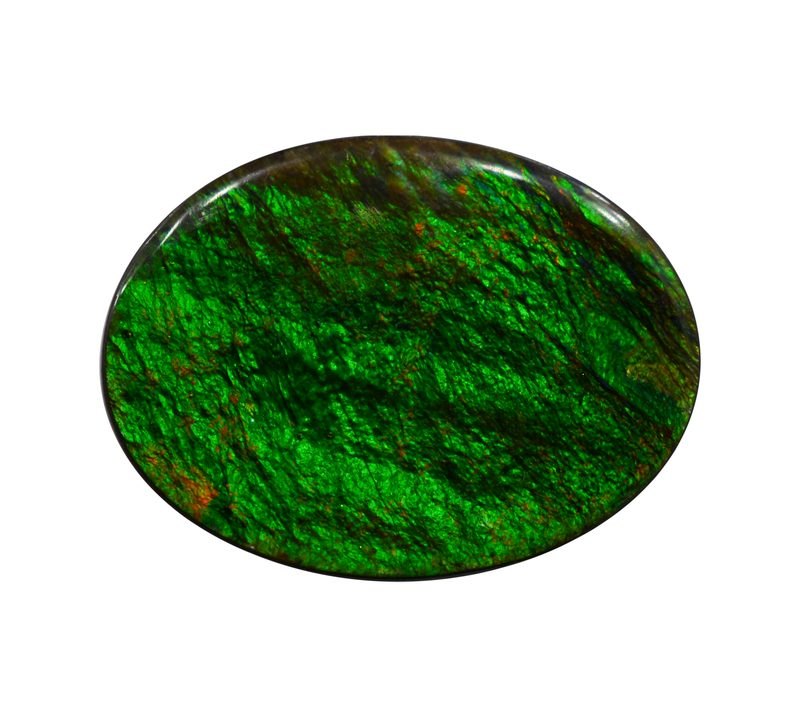
Ammolite
Pressed from 70-million-year-old ammonite shells in Alberta, ammolite flashes the rainbow palette feng shui practitioners call dragon skin.
- Ammolite is one of only three biogenic gemstones recognized by CIBJO, along with pearl and amber.
- Top stones can show all seven spectral colors and rotate through them as the viewing angle shifts.
- Korite International, the largest producer, mines ammolite from open pits along the St. Mary River.
- The same aragonite platelet structure is found in abalone shell, but only Alberta's burial conditions preserved the iridescence at gem grade.
- Some Alberta ammonite fossils reach over 80 cm across, large enough that a single shell yields dozens of cabochons.
- Collectors who want a true organic fossil gem rather than a mineral specimen
- Feng shui practitioners drawn to the seven-color dragon-skin tradition
- Pendant or earring shoppers willing to trade hardness for one-of-a-kind color play
- Spiritual readers working with grounding, sacral creativity, or ancestral memory
- Gift givers looking for a Canadian-sourced, conflict-free organic gem
- Daily-wear ring buyers who need 7+ Mohs durability (consider opal doublets or labradorite)
- Shoppers under $80 who want fine color play (try labradorite or rainbow moonstone)
- Anyone planning to swim, cleanse, or shower in their jewelry (try harder iridescent stones)
What Is Ammolite?
Ammolite is an organic gemstone made from the fossilized shells of ammonites, an extinct group of marine cephalopods that vanished 66 million years ago. The gem material is the iridescent aragonite layer of the original shell, preserved almost exclusively in the Bearpaw Formation of southern Alberta, Canada.
Mineralogically the gem is calcium carbonate in the aragonite polymorph, the same material that builds modern abalone and pearl. Stacked submicron platelets in the shell diffract light to produce the broad-spectrum color play, an optical effect technically called iridescence rather than play-of-color.
Ammolite was recognized as an official gemstone by the World Jewelry Confederation in 1981, one of the youngest entries on the list. Most commercial mining is concentrated along the St. Mary River south of Lethbridge, where a single producer holds the bulk of the lease.
Color depends on the thickness of the aragonite platelets. Thicker layers reflect red and green, thinner layers reflect blue and violet, and the rarest stones show all seven spectral colors at once.
Ammolite is fragile and is almost always sold as a triplet: a thin sliver of natural shell bonded between a dark backing and a clear quartz, spinel, or synthetic cap. The triplet construction protects the soft aragonite and makes the stone wearable.
Korite, the dominant Alberta producer, grades ammolite by color count, brightness, and rotational range, which is why retail prices can vary by a factor of fifty for stones of similar size.
How Ammolite Compares
| Property | Ammolite | Opal | Labradorite |
|---|---|---|---|
| Hardness | 3.5 - 4.5 | 5.5 - 6.5 | 6 - 6.5 |
| Price / carat | $ Budget | $ Budget | $ Budget |
| Rarity | Very rare | Common to rare | Common |
| Best For | Pendants, collectors | Fine jewelry | Daily wear |
Meaning and Symbolism
Ammolite carries the longest pedigree of any modern gem, since the shells it forms from swam in warm Cretaceous seas before the dinosaurs vanished. Indigenous Blackfoot peoples of southern Alberta have known the stone for centuries and call it iniskim, meaning buffalo stone.
Tradition holds that finding an iniskim was a sign of coming buffalo, and the stones were carried in medicine bundles for prosperity and survival.
Modern feng shui practitioners adopted ammolite in the 1990s after Chinese masters declared it the most influential stone of the millennium. They named it the seven-color prosperity stone, mapping each color to a different domain.
Red is said to support energy and growth, orange to encourage creativity, green to bring wisdom, blue to invite peace, and yellow to attract wealth. Practitioners believe a stone that shows all seven colors at once carries the full spectrum of life-force, which is why fully iridescent stones command premium prices.
In Western crystal practice, ammolite is traditionally associated with deep ancestral memory because of its fossil origin. Many find it useful in meditations on lineage, the long arc of personal history, or the question of what one inherits and what one passes forward.
It has long been used as a grounding stone for readers who feel disconnected from the body or from their own past, with a reputation for warmth rather than intensity.
Historical Timeline
Healing Tradition
Emotional
Practitioners believe ammolite is a stone of stability, optimism, and creative flow. In crystal healing tradition, it is said to lift mood, ease stagnation, and help readers reconnect with simple pleasures after long periods of stress or grief.
Many find ammolite particularly supportive during major life transitions, with the seven colors traditionally associated with seven aspects of well-being that the stone is said to balance in turn.
Because ammolite carries the energy of an extinct creature that lived for nearly 350 million years, practitioners often pair it with rose quartz when the work involves grief, lineage, or making peace with what has passed.
The stone has long been used to encourage childlike curiosity, and many find it useful for reigniting interest in old hobbies. Ammolite is generally considered a gentle stone rather than a powerful one, and is often recommended to readers who find more intense crystals overwhelming during the early days of practice.
Spiritual
In feng shui tradition, ammolite is said to harmonize energy across seven life areas at once, which is why practitioners often place a fully iridescent specimen in the wealth corner of a home or office. Each color is mapped to a domain.
Many find ammolite useful in meditations on ancestry, deep time, and the continuity of consciousness across generations. The stone's fossil origin makes it a natural anchor for practices that work with the long view of personal history.
Practitioners believe ammolite activates the lower three chakras together, drawing earth energy up through the root, sacral, and solar plexus to support grounded creative action. It pairs well with clear quartz in grids built around prosperity intentions.
Because ammolite is fragile, most practitioners keep their working stone on an altar or in a pendant rather than in a pocket, treating it as a focal point rather than a daily-carry charm.
Physical
Practitioners believe ammolite supports what they describe as the body's regenerative energy, and it has long been used in folklore for general vitality and stamina. Many find it grounding during times of low energy or convalescence.
In feng shui health applications the green flash of ammolite is traditionally associated with cellular renewal, while the red flash is said to support circulation and warmth. These associations come from color symbolism rather than mineral chemistry, and ammolite is not a substitute for medical care.
The stone is sometimes worn as a pendant near the solar plexus to support digestion and metabolism in folk practice.
Because the gem is soft and easily damaged, practitioners are careful to remove ammolite jewelry before bathing, swimming, or any activity involving sweat or impact, which limits how it is used in body-contact healing work.
Zodiac, Birthstone and Gifts
Ammolite is not a traditional birthstone, but modern crystal practice associates it most closely with the water signs Cancer and Pisces because of its oceanic origin. Practitioners believe the stone's seven-color play mirrors the emotional range water signs are known for.
It has long been used by readers seeking grounding without losing intuitive depth, which is why some astrologers also recommend it for sensitive earth signs.
In Vedic tradition ammolite is too young to have an established prescription, but contemporary practitioners often suggest it as a complementary stone for those whose primary chart gem feels too intense for daily wear.
Care and Cleansing
Ammolite is one of the most delicate gems on the market and tolerates only the gentlest cleansing. A soft dry cloth wipe after each wearing is the safest routine, since skin oils and lotions can dull the iridescent surface over time.
Avoid water, ultrasonic cleaners, steam, and any soaking, since the triplet construction relies on adhesives that soften with moisture.
For energetic cleansing, smoke from palo santo, sage, or cedar is considered safe and is the most commonly recommended method. Sound cleansing with a singing bowl or tuning fork works well, and brief moonlight exposure is gentle enough for routine use.
Avoid direct sunlight, which can fade the colors over months of repeated exposure, and avoid salt of any kind. Many practitioners recharge ammolite by resting it on a clear quartz cluster overnight rather than using any direct cleansing element.
- DO NOT submerge ammolite in water, even briefly, because the triplet adhesive is water-sensitive.
- DO NOT use ultrasonic or steam cleaners on any ammolite jewelry.
- DO remove ammolite rings or bracelets before washing hands, applying lotion, or wearing perfume.
- DO store ammolite in a soft pouch separated from harder gems to prevent scratching.
- DO NOT expose ammolite to direct sunlight for long periods, since the colors can fade over time.
- DO ask the seller whether the stone is a triplet, doublet, or solid natural slice and whether it carries a stabilizing coating.
- Note: high-grade solid ammolite without a protective cap is collectible but should be reserved for occasional wear.
Real vs Fake
Genuine ammolite shows broad, sweeping color flashes that shift smoothly as the stone is rotated, with sharp boundaries between color zones that follow the original shell's growth lines. Under magnification you can often see the natural septa, the thin walls that separated chambers in the living ammonite.
Imitations rarely reproduce these organic features and tend to show uniform, evenly distributed sparkle.
Most authentic ammolite is sold as a triplet, which is not a fake but a construction. A natural shell sliver is bonded between a dark backing and a clear protective cap. Reputable sellers always disclose the triplet structure.
Watch for suspiciously bright stones with perfectly flat color zones, which can indicate dyed shell or printed foil imitations sold online at ammolite prices.
Lab-grade authentication is straightforward, since natural ammolite shows a characteristic refractive index range of about 1.52 to 1.68 and a specific gravity near 2.75. A reputable lab can confirm the aragonite composition and origin, which matters most for high-value stones above $500.
At home, a careful look under daylight and lamplight will usually reveal the difference between true broad-spectrum iridescence and printed or dyed substitutes.
Be wary of online listings that show a single stock photo for many stones, since each genuine ammolite is unique and reputable dealers photograph each piece individually. The presence of natural fissures or slight irregularities is normal and does not lower value.
Ammolite Jewelry & Gifts
Ammolite pricing is driven by color count, brightness, and the percentage of the cabochon that shows iridescence. Entry-level single-color stones with limited play start around $30 to $80 per piece, while two-color stones in standard pendant sizes run roughly $100 to $300.
Three-color stones with strong rotational range typically reach $300 to $800, and rare seven-color cabochons with full coverage can exceed $1,000 per piece at retail.
Triplet construction is industry standard and accepted by reputable lab grading, since the natural shell layer is too fragile for solid use in most jewelry. Solid natural slices exist for collectors but are reserved for occasional wear.
Shoppers should ask about the protective cap material (synthetic spinel and quartz are most durable), the country of origin (Alberta is the benchmark), and whether the stone has been stabilized with epoxy or resin.
ethical Canadian sourcing has made ammolite a popular alternative to imported organic gems for buyers who prioritize provenance.
Where to Buy Ammolite
Affiliate disclosure: Some links below earn us a small commission at no extra cost to you. See our affiliate disclosure page.
Handmade, raw, and tumbled pieces from independent sellers worldwide.
Shop Ammolite on Etsy →Accessories, tools, and specimen sets with fast Prime delivery.
Shop Ammolite on Amazon →Certified loose gemstones graded and photographed for online buyers.
Shop Ammolite on GemSelect →Pairs Well With


Where Ammolite Is Found


