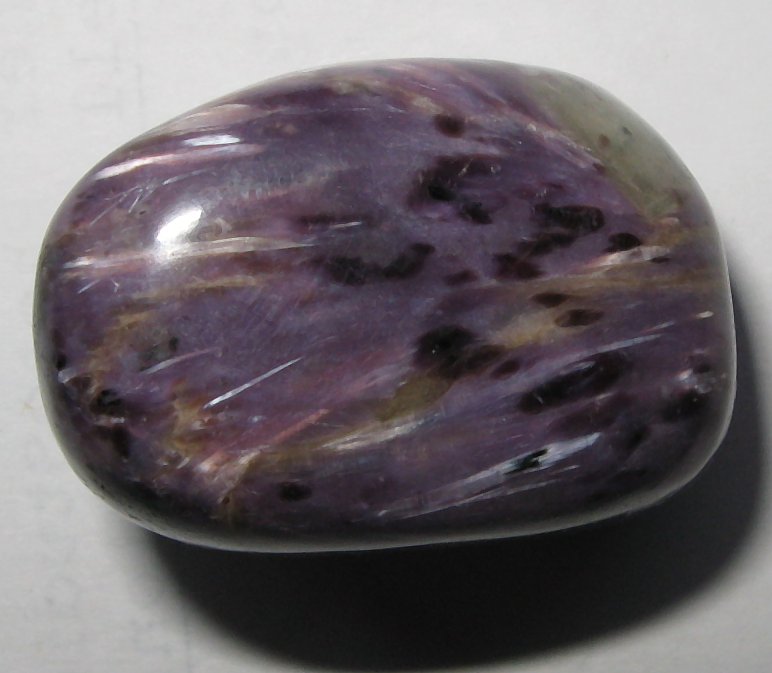
Charoite Purple
Charoite is the rare Siberian purple silicate with breathtaking swirling violet and lavender patterns - discovered only in 1978.
- Charoite was only discovered in 1978 - it is one of the most recently identified gemstone minerals and has no ancient metaphysical history.
- Charoite exists in only one place on Earth: the Murun Massif near the Chara River in Yakutia, Siberia - a single geological occurrence unique in world mineralogy.
- The word 'chara' means 'joy' in Russian - a meaningful coincidence that practitioners frequently incorporate into charoite's metaphysical narrative.
- Charoite's purple-violet swirling pattern results from thousands of intergrown fibrous crystals creating a naturally chatoyant silky appearance.
- Charoite formed from an extremely unusual geological process: a carbonatite intrusion contacting metamorphosed limestone at extreme temperatures - a combination that occurs nowhere else on Earth producing charoite.
- Those drawn to one of the world's most visually breathtaking stones - charoite's swirling purple patterns are immediately recognizable
- Practitioners working with transformation, spiritual evolution, and Crown chakra work who want a high-vibration purple stone
- Collectors seeking rare, geographically restricted stones with unique geological origin stories
- Those in spiritual transition who want a stone associated with soul purpose, higher calling, and transformative change
- Gift givers seeking a genuinely distinctive stone unlike amethyst or standard purple fluorite - something rare and memorable
- Those wanting a budget-friendly healing crystal - genuine charoite from Russia commands fair prices
- Those wanting a widely abundant stone with easy resupply - charoite comes from a single Siberian locality
- Those seeking a hard, durable stone for daily jewelry wear - Mohs 5-6 requires careful handling
What Is Charoite Purple?
Charoite is a complex potassium calcium silicate hydroxide with the formula K(Ca,Na)₂Si₄O₁₀(OH,F)·H₂O. It was first described in 1978 by Vera Rogova and colleagues from specimens found near the Chara River in Yakutia, Siberia - making it one of the most recently discovered gemstone minerals. It rates 5 - 6 on the Mohs hardness scale.
Charoite is found in only one location on Earth: the Murun Massif in the Sakha Republic (Yakutia) near the Chara River, explaining its rarity. The swirling, fibrous purple texture results from intergrown crystals creating a chatoyant, silky-appearing mass.
Charoite forms in a rare geological environment: a contact zone between carbonatite intrusions (alkalic igneous rocks rich in carbonate) and metamorphosed limestone sediments at extreme temperatures and pressures. This unusual geological combination - the meeting of carbonatite chemistry with altered sedimentary rocks - produced a mineral assemblage unique to the Murun region.
Associated minerals include tinaksite, canasite, aegirine, microcline, and other unusual potassium-calcium silicates found rarely or nowhere else.
The deep purple to violet color of charoite comes from a combination of trace manganese and the specific optical properties of the intergrown fibrous crystal structure. The lavender, violet, and purple tones swirl into patterns that resemble flowing silk fabric, watercolor brushstrokes, or aerial views of a violet landscape.
This distinctive appearance made charoite immediately popular when it entered the gemstone market, and it remains one of the most visually compelling stones in the healing crystal world.
How Charoite Compares
| Property | Charoite Purple | Sugilite | Blue John Fluorite |
|---|---|---|---|
| Origin | Siberia, Russia only | South Africa (Wessels Mine) | Derbyshire, England only |
| Pattern | Swirling violet-purple | Mottled purple-black | Banded purple-yellow |
| Hardness | 5 - 6 | 5.5 - 6.5 | 4 |
| Best For | Transformation, Crown chakra | Spiritual protection, rare | English heritage, rare |
Meaning and Symbolism
Charoite's history is remarkably short - having been unknown to the outside world until 1978, it has no ancient metaphysical tradition. However, it entered the crystal healing community with remarkable speed and established itself firmly in the spiritual vocabulary of working with transformation, soul purpose, and the Crown chakra.
Some practitioners find the absence of ancient history liberating - charoite is not weighted with centuries of cultural expectation but arrives as a fresh, present-tense mineral energy.
The Chara River connection has been incorporated into charoite's metaphysical identity: practitioners note that 'chara' in Russian means joy, and charoite is sometimes called a 'stone of joy' or 'stone of transformation' in healing traditions.
The Siberian origin - deep wilderness, vast cold landscapes, the edge of the known world for many Westerners - gives charoite an associations with the far inner reaches of the psyche and the journey to the soul's core.
Charoite is consistently associated in crystal healing with Crown and Third Eye chakra activation, spiritual transformation, and the alignment with one's soul purpose or higher calling.
Practitioners describe it as a 'wake-up call' stone - bringing clarity about what truly matters to the practitioner's path and stimulating the courage to live according to that clarity. It is sometimes described as the 'transformer' stone for those going through major life transitions.
Historical Timeline
Healing Tradition
Emotional
Charoite is described by practitioners as one of the most powerful stones for emotional and spiritual transformation. Many who work with it report accelerated processing of deep-seated fears, the dissolution of limiting beliefs about personal worth and capability, and the emergence of genuine clarity about life direction and purpose.
Unlike the gentle calming of lepidolite or the slow grounding of obsidian, charoite is energetically active and forward-moving - said to help people step into their larger purpose with courage. Those in major life transitions often find it invaluable.
Spiritual
In spiritual practice, charoite is consistently associated with Crown and Third Eye chakra activation, soul purpose recognition, and the courage to align with one's highest calling.
Many practitioners describe it as a stone that removes the spiritual excuses - the comfortable but limiting stories - that prevent people from fully living their path. It is also associated with lucid dreaming, past life exploration, and access to the akashic records in traditions that work with these concepts.
Charoite's violet frequency connects it to the violet flame tradition in some spiritual lineages.
Physical
Crystal healing practitioners associate charoite with the nervous system, sleep, and the body's responses to stress and transformation. Many use it to support people who are experiencing the physical symptoms of major life change - disrupted sleep, nervous tension, and the somatic experience of energetic reorganization.
Some traditions connect it to the regulation of blood pressure and neurological health. These are experiential practitioner associations; charoite is not a medical treatment.
Zodiac, Birthstone and Gifts
Charoite's associations with profound transformation, soul-level clarity, and the courage to face deep truth align it closely with Scorpio in crystal healing tradition - the sign most associated with transformation through depth.
Sagittarius resonates with charoite's connections to soul purpose, philosophical expansion, and the courage to pursue one's highest calling beyond comfortable limitations. Virgo connects through charoite's associations with service, the refinement of one's gifts, and the practical implementation of spiritual values in daily life.
All three signs find charoite useful for periods of major life direction work.
Care and Cleansing
Charoite should be cleansed gently. Moonlight is the ideal method - leave on a windowsill or outdoors overnight during any moon phase. Sound cleansing with a singing bowl, tuning forks, or Tibetan bells is excellent. Selenite charging plates are widely used and considered to enhance as well as cleanse charoite.
Avoid extended water exposure - brief rinsing is acceptable but soaking or regular water contact can affect the stone's polish and potentially the color intensity over time. Avoid salt entirely - it can etch the surface. Extended direct sunlight may gradually affect the deep purple coloration; brief sun exposure is acceptable.
Smudging is appropriate when done gently without concentrating smoke on the stone surface.
- DO NOT soak in water - brief rinsing is acceptable but extended water contact affects polish and color.
- DO NOT use salt cleansing - damages the surface of this relatively soft stone.
- DO handle with moderate care - Mohs 5-6 means charoite scratches from contact with quartz and harder stones.
- DO NOT expose to extended direct sunlight - ultraviolet exposure can gradually affect the violet coloration.
- DO store in padded cases away from harder stones that could scratch the polished surface.
- DO NOT use ultrasonic cleaners - vibration can damage the fine intergrown crystal structure.
Real vs Fake
Charoite counterfeiting exists primarily through dyed materials and misidentified stones. Genuine charoite has a distinctive swirling violet-lavender pattern with a chatoyant silky quality that results from thousands of intergrown fibrous crystals - this visual quality is difficult to replicate convincingly in dyed stone or glass.
The specific purple-violet-lavender tonal range, the flow and swirl pattern, and the silky luster are characteristic. Dyed howlite or other white stones are sometimes sold as charoite; these lack the fibrous silky quality and show a different surface character.
Specific gravity (2.54-2.68) and Mohs hardness (5-6) are consistent identifiers. Under magnification, genuine charoite shows the fine fibrous intergrown crystal structure responsible for its chatoyancy. Purchase from established gemstone dealers who can document Siberian provenance. Price is a useful indicator - genuine quality charoite is never very cheap.
Request provenance documentation for any significant purchase.
Charoite Purple Jewelry & Gifts
Genuine charoite is priced as a semi-precious collector stone. Small tumbled pieces begin at $8-$20 for modest specimens. Quality tumbled charoite with good swirling pattern and rich color runs $20-$50. Polished slabs or freeforms with excellent pattern and color depth run $50-$150.
Jewelry-grade charoite cabochons for ring or pendant settings begin at $20-$60 per stone; set charoite jewelry from established jewelers runs $80-$300+. Large display pieces with exceptional pattern reach $200-$500+.
Color richness, swirl pattern clarity, and the presence of multiple violet tones are the primary value drivers. Deep violet with lavender and cream swirls, high polish, and minimal black inclusion patches are most desirable. Russian Yakutian provenance is standard and expected; request documentation confirming Siberian origin.
Reputable established dealers are preferable to anonymous online sellers for this geopolitically sourced stone.
Where to Buy Charoite Purple
Affiliate disclosure: Some links below earn us a small commission at no extra cost to you. See our affiliate disclosure page.
Handmade, raw, and tumbled pieces from independent sellers worldwide.
Shop Charoite Purple on Etsy →Accessories, tools, and specimen sets with fast Prime delivery.
Shop Charoite Purple on Amazon →Certified loose gemstones graded and photographed for online buyers.
Shop Charoite Purple on GemSelect →Pairs Well With


Where Charoite Purple Is Found


