Heliotrope
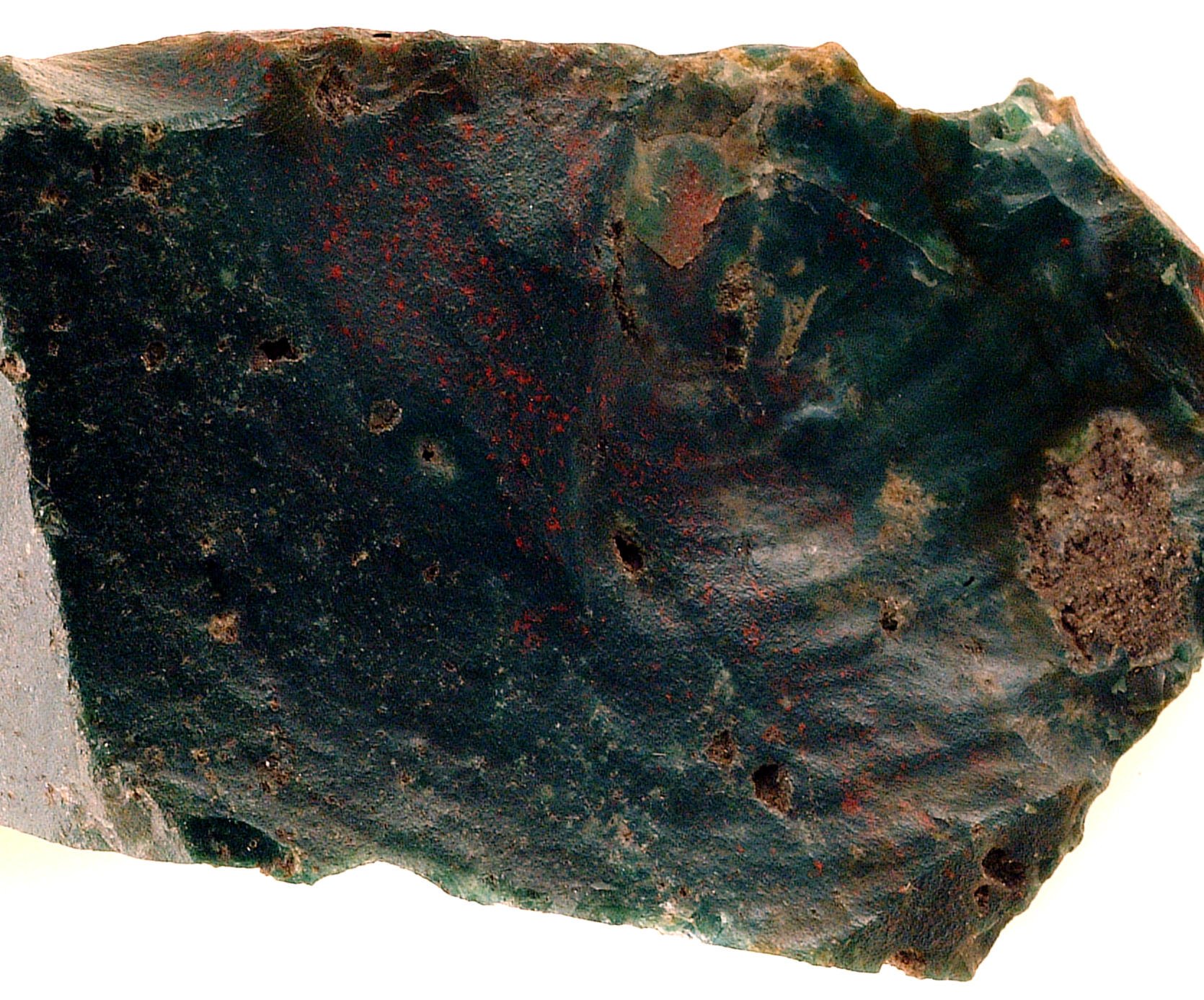
Dark green chalcedony spotted with iron-oxide red, heliotrope has been the warrior's stone for over two thousand years.
- The name heliotrope comes from the Greek words for sun and turning, referring to ancient beliefs about the stone's optical properties.
- Bloodstone is one of the traditional birthstones for March, alongside the modern aquamarine.
- Christian medieval tradition holds that the red spots represent drops of Christ's blood that fell on green jasper at the foot of the cross.
- Roman soldiers carried bloodstone into battle for courage and to stop bleeding from wounds.
- The Kathiawar Peninsula in Gujarat, India, is the world's primary source of commercial-grade heliotrope.
- March birthstone seekers wanting the traditional rather than aquamarine option
- Practitioners working with root chakra grounding and heart chakra courage
- Athletes, soldiers, and first responders drawn to the warrior's stone tradition
- Daily-wear jewelry buyers seeking affordable durable green-and-red stones
- Collectors interested in classical antiquity-era engraved gems
- Anyone wanting bright transparent gems (heliotrope is opaque)
- Buyers who dislike strong red-on-green color contrast (try jasper or moss agate)
- Practitioners wanting high-vibration crown chakra work (try amethyst or sugilite)
What Is Heliotrope?
Heliotrope, more commonly known as bloodstone in modern English-language markets, is a dark green variety of chalcedony spotted with red iron oxide inclusions that resemble drops of blood. It rates 6.5 - 7 on the Mohs hardness scale.
The species is mineralogically a chalcedony with diagnostic inclusions, and the IMA does not list bloodstone as a separate species; the parent quartz has IMA symbol Qz.
The name heliotrope comes from the Greek words for sun and turning, a reference to ancient beliefs that the stone reflected sunlight in a particular way when immersed in water.
The stone forms in volcanic environments where silica-rich groundwater precipitates microcrystalline quartz inside cavities containing iron-rich minerals. The red spots are inclusions of hematite or red jasper that crystallized within the green chalcedony matrix.
India is the among the largest known commercial source, particularly the Kathiawar Peninsula in Gujarat, with Brazilian, Australian, and American sources contributing to global supply. Indian bloodstone sets the global benchmark for color and pattern.
Bloodstone has a Mohs hardness of 6.5 to 7, which makes it durable enough for daily-wear jewelry. The stone cuts well into cabochons, beads, signet rings, and seal stones, and has been one of the most popular materials for engraved gems since classical antiquity.
Most commercial bloodstone is untreated, which is one of its appeals as a natural stone with thousands of years of continuous use. The variety with very few red spots is sometimes called plasma rather than bloodstone.
How Heliotrope Compares
| Property | Heliotrope | Moss Agate | Jasper |
|---|---|---|---|
| Hardness | 6.5 - 7 | 6.5 - 7 | 6.5 - 7 |
| Price / carat | $ Budget | $ Budget | $ Budget |
| Pattern | Green with red spots | Dendritic green | Various solid colors |
| Best For | Daily wear, courage work | Gardens, growth | Grounding, decor |
Meaning and Symbolism
Heliotrope carries one of the deepest mythological histories of any popular stone. Christian tradition associates the red spots with the blood of Christ during the Crucifixion, with legend holding that drops of blood fell on green jasper at the foot of the cross and stained it permanently.
The medieval name bloodstone derives from this association, and the stone became one of the most popular materials for religious carvings, reliquary mountings, and amulets throughout Christian Europe.
Earlier classical traditions used heliotrope as a warrior's stone. Babylonian and Roman soldiers carried bloodstone into battle, with practitioners traditionally believing the stone could stop bleeding from wounds and grant courage in combat.
Greek and Roman naturalists wrote about the stone's reputed power to reflect sunlight and predict weather, and Pliny the Elder described it as one of the most respected gems for both ornamental and protective use. The name heliotrope (sun-turning) comes from this classical period.
In modern crystal practice, bloodstone is traditionally associated with grounding, courage, and physical vitality. Practitioners believe the stone activates the root and heart chakras together, linking survival energy to brave-hearted action.
Many find heliotrope useful as a daily talisman during periods of major effort, athletic training, or any work that requires sustained physical and emotional courage. The stone has long been the preferred March birthstone in traditional birthstone lists.
Historical Timeline
Healing Tradition
Emotional
Practitioners believe heliotrope is a stone of courage, vitality, and the kind of grounded confidence that supports sustained physical and emotional effort. In crystal healing tradition, it is said to support readers facing major challenges that require both stamina and bravery, with the stone often recommended for athletes, performers, and first responders.
Many find bloodstone useful during periods of recovery from physical or emotional setbacks, when steady rebuilding matters more than dramatic breakthroughs.
The stone has long been used in modern crystal practice to support readers cultivating the courage to face difficult truths or take risks that have been postponed. Practitioners often pair bloodstone with rose quartz when courage needs to be balanced with self-compassion, or with clear quartz for amplified intention setting.
Heliotrope is sometimes recommended for readers managing anxiety related to physical health concerns, with the stone treated as a settling daily-wear companion.
Spiritual
Heliotrope is traditionally associated with the root and heart chakras together in modern crystal practice. Practitioners believe the green body of the stone resonates with heart-centered courage while the red spots ground that courage in physical vitality.
It has long been considered a stone of warriors, protectors, and anyone whose work requires both physical bravery and ethical grounding.
Many find bloodstone useful in meditation focused on personal mission, especially work that involves taking on responsibilities that demand both heart and stamina. The stone pairs well with clear quartz in grids built around courage and protection, and with black tourmaline for grounded protective work.
Practitioners sometimes use bloodstone in ceremonies marking initiation into challenging roles, treating the stone as a literal reminder of the courage and steady vitality the role will require.
Physical
Practitioners believe heliotrope supports what they describe as the body's circulatory system and overall physical vitality. In folklore, the stone has long been used for general physical recovery, immune support, and the kind of vigor that lets readers sustain demanding physical activity over time.
It is traditionally associated with the blood, the heart as a physical organ, and the cleansing functions of the kidneys and liver.
Many find bloodstone useful as a daily-wear pendant during athletic training, recovery from illness, or any period of high physical demand. The stone is durable enough for continuous wear, which is one of its advantages for ongoing physical-association work.
Heliotrope is not a substitute for medical care, and practitioners are careful to frame its role as supportive rather than curative. The stone is sometimes worn as a pendant near the sternum during convalescence or carried in a pocket during seasonal immune challenges.
Zodiac, Birthstone and Gifts
Heliotrope is most often associated with Aries, the cardinal fire sign ruled by Mars and tied to courage, action, and pioneering effort. Practitioners believe the stone supports Aries readers in channeling their natural assertive energy into sustained achievement rather than scattered short bursts.
It has long been recommended for Aries professionals in athletics, leadership, or first-responder roles.
Pisces is the secondary association because heliotrope is the traditional birthstone for March, which the sign occupies. Astrologers sometimes suggest the stone for Pisces readers seeking to ground their natural intuitive sensitivity in physical vitality and brave-hearted action.
Care and Cleansing
Heliotrope tolerates most common cleansing methods, which makes it relatively easy to maintain. Running tap water for under a minute is safe for both loose and set stones, as is a brief rinse in lukewarm soapy water with a soft cloth to remove skin oils.
Avoid prolonged hot water exposure, since rapid temperature change can stress fissures in larger pieces.
Sunlight cleansing is traditionally recommended for heliotrope and aligns with the stone's classical sun-turning name. Thirty minutes to an hour of morning sun is considered sufficient. Moonlight, smoke from sage or palo santo, and sound cleansing with a singing bowl are all considered safe and effective.
Salt cleansing should be brief and dry only, since prolonged saltwater contact can dull polish and corrode metal settings. Many practitioners recharge bloodstone by burying it in garden soil overnight, especially for stones used in vitality work.
- DO rinse heliotrope jewelry in lukewarm soapy water and dry with a soft cloth.
- DO NOT expose to rapid temperature changes, since thermal shock can crack the stone.
- DO store bloodstone separately from softer gems like opal and pearl to avoid scratching them.
- DO NOT soak in saltwater for long periods, since this can corrode metal settings.
- DO remove rings before heavy housework, gardening, or contact sports.
- DO ask whether the stone has been dyed, since some commercial bloodstone is color-enhanced.
- Note: untreated heliotrope is the standard and should not require a price premium for being natural.
Real vs Fake
Genuine heliotrope shows dark green chalcedony with distinct red iron oxide inclusions that look like drops or flecks suspended in the stone.
Under magnification you can see that the red inclusions extend through the body of the stone in three dimensions rather than appearing only on the surface, and the green base shows the slightly waxy luster characteristic of chalcedony.
Each stone is unique in its pattern of red spots, and two cabochons cut from the same rough will differ in spot distribution.
Common imitations include green dyed chalcedony with painted-on red spots, green glass with embedded red glass beads, and resin imitations with embedded color particles. Painted dye sits on the surface and will scratch off with light cleaning, while real bloodstone inclusions extend through the stone.
Resin imitations feel warm to the touch and are noticeably lighter than genuine quartz. A reputable independent gemological lab can confirm the silica composition with standard tests. At home, look for the diagnostic three-dimensional red inclusions, the cool feel of true silica, and the slightly waxy luster characteristic of chalcedony.
Hold the stone up to strong light: real bloodstone is opaque to slightly translucent at the edges, while glass and resin imitations either lack depth or show suspiciously even color distribution.
Watch for stones priced well below market that show unusually vivid uniform colors; these are often dyed. Reputable sellers disclose origin (India for premium grade, Brazil and Australia for commercial supply) and any color enhancement.
Heliotrope Jewelry & Gifts
Heliotrope is one of the most affordable durable gemstones on the market, particularly considering its long history as a treasured material.
Tumbled stones run $1 to $5 each, standard cabochons in pendant or ring sizes typically cost $5 to $25, and premium Indian stones with strong red spots and dark green base reach $30 to $80 per cabochon.
Antique engraved bloodstone signet rings and cameos can command much higher prices in the antiquities market, particularly Renaissance and earlier pieces.
Heliotrope is generally untreated, which is one of its main selling points. Reputable sellers disclose origin (India for premium grade, Brazil and Australia for commercial supply) and any color enhancement. Watch for dyed green chalcedony with surface-only red spots at suspiciously low prices.
For jewelry, signet rings and pendants in protective settings are the most traditional applications, with the bezel mounting common in heritage designs. fine Indian Kathiawar bloodstone remains a strong value for buyers seeking historical, ethically sourced traditional March birthstone material.
Where to Buy Heliotrope
Affiliate disclosure: Some links below earn us a small commission at no extra cost to you. See our affiliate disclosure page.
Handmade, raw, and tumbled pieces from independent sellers worldwide.
Shop Heliotrope on Etsy →Accessories, tools, and specimen sets with fast Prime delivery.
Shop Heliotrope on Amazon →Certified loose gemstones graded and photographed for online buyers.
Shop Heliotrope on GemSelect →Pairs Well With


Where Heliotrope Is Found


