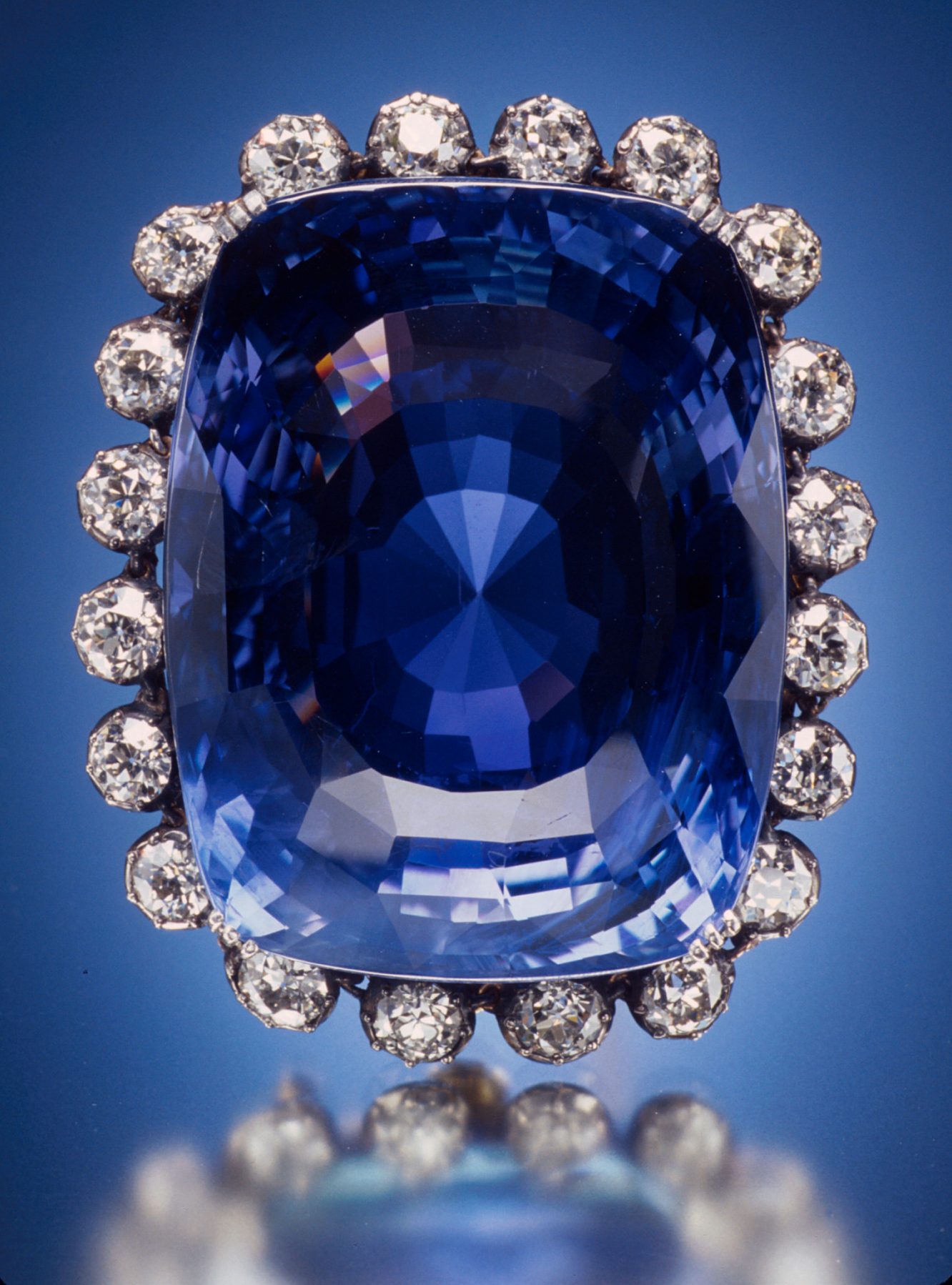
Kashmir Sapphire
Kashmir sapphire's velvety cornflower blue is the most coveted color in the gem world - a hue so precise it has been the standard against.
- The Rockefeller Sapphire - a 54.48 carat rectangular step-cut sapphire from Burma - sold for over $3 million, but comparable-quality Kashmir stones command even higher per-carat values.
- No significant new Kashmir sapphire production has occurred since the early 20th century - every Kashmir stone in commerce today is a legacy gem from a mine that is essentially exhausted.
- The specific 'velvet' quality of Kashmir blue is caused by submicroscopic rutile silk inclusions in a concentration and distribution not found in any other sapphire origin.
- At auction, a fine 10-carat Kashmir sapphire with gemological laboratories Kashmir origin certificate has sold for over $6 million per carat - more per gram than many fine diamonds.
- The Paddar mine sits at over 4,500 meters altitude in the Himalayas, making access difficult even today and adding to the romantic narrative surrounding these stones.
- Serious gem investors seeking the most prestigious colored stone with documented historical performance
- Fine jewelry collectors who want the ultimate blue stone for a once-in-a-lifetime piece
- Those seeking a September birthstone with maximum prestige and rarity
- Institutions and high-net-worth buyers building a gemstone investment portfolio
- Anyone who wants to understand what 'the world's finest sapphire' actually looks like and why
- Budget or mid-range buyers - a certified Kashmir sapphire above 2 carats can cost more than most homes
- Those who want to wear their investment daily without significant security concerns
- Buyers without access to gemological laboratories or Gübelin certification - purchasing without third-party origin documentation is extremely high risk
What Is Kashmir Sapphire?
Kashmir sapphire is corundum (Al2O3) from the Paddar area of the Zanskar range in Jammu and Kashmir, India, found at altitudes above 4,500 meters. It rates 9 on the Mohs hardness scale.
Its defining characteristic is a color unlike any other blue sapphire: a deep, velvety cornflower blue with exceptional saturation and a particular 'sleepy' quality of light diffusion caused by microscopic silk-like rutile inclusions that scatter light through the stone and give it a soft, almost glowing internal luminescence.
The Paddar mine was discovered around 1881 following a landslide that exposed gem-quality corundum on a remote Himalayan slope. Active mining lasted only a few decades before production became commercially unviable.
The mine is now essentially depleted, and virtually no new Kashmir sapphires have entered commerce in meaningful quantities since the early 20th century. Every Kashmir sapphire in the market today is a legacy stone.
**The velvety quality** of Kashmir sapphire color is technically attributed to submicroscopic rutile silk inclusions that are present in higher concentrations than in other sapphire origins.
These inclusions scatter and diffuse blue light, reducing transparency slightly while creating the characteristic soft, luminous quality that distinguishes Kashmir material from the brighter, slightly cooler blues of Sri Lankan or the more violet tones of some Burmese sapphires.
This quality is now the reference standard against which all other blue sapphires are assessed.
How Kashmir Sapphire Compares
| Property | Kashmir Sapphire | Ceylon Sapphire | Montana Sapphire |
|---|---|---|---|
| Price / carat | $$$$ Luxury | $$ Mid-range | $$ Mid-range |
| Color Quality | Cornflower velvet (benchmark) | Bright medium blue | Varied, steel to blue-green |
| Availability | Extremely rare, legacy only | Widely available | Limited but available |
| Best For | Investment, heirloom, prestige | Fine jewelry, daily wear | Ethical, American origin |
Meaning and Symbolism
Sapphire has been associated with divine wisdom, truth, and royal authority across ancient Persian, Greek, Roman, and medieval European cultures. The name derives from the Sanskrit *shanipriya* (dear to Saturn) and the Greek *sappheiros*. Medieval clergy wore sapphires to represent heaven's blue and divine favor; Solomon's seal was said to be sapphire.
Kashmir sapphire, with its origins in the highest mountains on Earth, carries these associations amplified by its extraordinary rarity and the romantic narrative of discovery in a remote Himalayan valley.
In the gem trade, Kashmir origin became synonymous with perfection - not just the best available but a standard against which quality is measured absolutely.
This cultural elevation of a specific origin is unusual even among precious gems; Kashmir sapphire's prestige is not merely commercial but has genuine aesthetic and historical grounding in the distinctiveness of its color quality.
**In crystal healing tradition**, sapphire is associated with wisdom, mental clarity, and truth-telling - the ability to perceive reality without distortion. Kashmir sapphire, as the most intensely blue and most pure expression of sapphire, is considered by some practitioners to carry these qualities at maximum intensity.
Its association with Saturn aligns it with depth, discipline, and the patient accumulation of genuine insight over time.
Historical Timeline
Healing Tradition
Emotional
Practitioners associate sapphire with mental clarity, emotional truth, and the courage to see situations without wishful distortion. Kashmir sapphire, as the most intensely blue and spiritually elevated expression of the sapphire family, is said to carry these qualities at exceptional depth.
Many practitioners describe it as a stone that supports the discipline of honest self-examination - seeing one's own patterns and motivations with the same clear sight one wishes to bring to the external world. In crystal healing tradition, its energy is dignified rather than emotional, supporting calm wisdom over reactive feeling.
Spiritual
In spiritual practice, sapphire is traditionally linked to divine wisdom, prophecy, and the expansion of perception beyond ordinary consciousness. Kashmir sapphire's extraordinary rarity and the Himalayan spiritual context of its origin amplify these associations for many practitioners, who regard it as a stone of accumulated, tested wisdom rather than quick insight.
Some traditions associate it with akashic access and the ability to perceive karmic patterns across lifetimes. Its Saturn connection links it to the kind of spiritual maturity that can only be earned through sustained practice and honest confrontation with what is.
Physical
Crystal healing texts associate sapphire with the nervous system, vision, and the physical health of the upper body including the throat, eyes, and brain. It is said to support focus, reduce mental clutter, and support the kind of clear thinking that distinguishes genuine insight from anxiety-driven mental loops.
Kashmir sapphire's additional resonance with the third eye chakra makes it popular for practices focused on developing discriminating wisdom and clear perception. These are traditional metaphysical associations and do not represent medical claims.
Zodiac, Birthstone and Gifts
Virgo is sapphire's primary zodiac association as the September birthstone, and Kashmir sapphire represents the most perfect expression of Virgo's aspirational qualities: precision, purity, depth of analysis, and devotion to what is genuinely true.
Saturn's rulership of Capricorn and its exaltation in Libra also connect sapphire to those signs, but the official September birthstone relationship with Virgo is most direct.
Taurus and Gemini connect to Kashmir sapphire through Venus and Mercury respectively - the stone's qualities of truth, clarity, and cultivated wisdom resonate with both signs' intellectual and aesthetic dimensions.
As the finest and rarest blue sapphire, Kashmir material particularly suits the Virgo desire for the very best expression of a quality rather than a compromise. All three signs benefit from the stone's associations with clear thinking, authentic communication, and the dignity of earned wisdom.
Care and Cleansing
Kashmir sapphire's corundum hardness of 9 makes it physically durable for water cleansing - a brief rinse or gentle cleaning with a soft brush and mild soap is safe for the stone itself.
Check with your jeweler before any wet cleaning if the stone is set, as metal settings may require specific care. Dry completely after any water contact.
For spiritual cleansing, moonlight is the most traditional method for sapphire in many crystal healing traditions - the stone's association with Saturn and wisdom is aligned with lunar energy in some esoteric frameworks. **Sound cleansing** with crystal singing bowls or bells is appropriate and avoids any physical contact that might risk the investment piece.
Selenite plates provide energy maintenance for displayed specimens.
- DO NOT use ultrasonic cleaners without first confirming with a gemologist that the stone has no significant fractures - vibration can extend natural fractures in corundum.
- DO clean with mild soap, warm water, and a soft brush; rinse thoroughly and dry completely.
- DO NOT store loose with other stones in rough bags - even though sapphire is very hard, abrasion against other sapphires or diamonds damages facets.
- DO store in an individual padded compartment or wrapped in soft cloth in a secure, appropriate location.
- NOTE: Any Kashmir sapphire sold without a Gübelin, gemological laboratories, or AGL origin certificate is impossible to authenticate - never purchase without documentation.
- DO insure Kashmir sapphires at current replacement value, which has historically increased over time.
- DO NOT expose to high heat (steam cleaning) - while corundum can withstand heat, gemological cements and fracture fillings may be damaged.
Real vs Fake
Kashmir sapphire authentication is the most sophisticated gemological exercise in the colored stone world. The first requirement is a laboratory report - specifically from Gübelin Gem Lab, gemological laboratories, or AGL - that confirms both the Kashmir origin and the absence of unacceptable treatments.
These labs analyze growth and inclusion characteristics specific to the Paddar geology and can distinguish Kashmir material from Sri Lankan, Burmese, or other origins with high confidence.
Visually, Kashmir sapphire's 'velvet' quality is distinctive but not reliably identifiable by eye alone - many non-Kashmir sapphires have been sold with Kashmir representations that only laboratory analysis could disprove.
The characteristic color - medium-deep cornflower blue with slight violet, neither too dark nor too pale, with that specific soft internal glow - is the consensus reference but requires experience to evaluate reliably. No visual inspection substitutes for laboratory documentation.
**Heat treatment** is the most critical authenticity question for Kashmir sapphires. Unheated Kashmir stones command dramatically higher prices than heated ones. Gemological laboratories and Gübelin reports specifically state whether evidence of heat treatment is present.
The words 'no indication of heating' on a Kashmir origin report are worth a significant premium; never accept verbal assurances about heat treatment status without laboratory confirmation.
Kashmir Sapphire Jewelry & Gifts
Kashmir sapphire buying is entirely a certified-stone exercise. The first requirement is a laboratory report from Gübelin, gemological laboratories, or AGL confirming both Kashmir origin and heat treatment status. Without this documentation, you are purchasing blind in a market where misrepresentation is common and the financial stakes are very high.
Budget for the certificate as a non-negotiable cost of acquisition.
Value factors in order of importance: origin confirmation (Kashmir), heat treatment status (unheated commands 3 to 5 times the price of heated equivalents), color quality (pure cornflower blue with the characteristic velvet quality, neither too dark nor too violet), clarity (eye-clean preferred, some minor inclusions accepted at this rarity level).
Size (exponential value increase per carat above 3 carats).
**Prices** for certified Kashmir sapphires range from approximately $10,000 per carat for heated commercial-quality material to over $100,000 per carat for exceptional unheated stones in the finest color. Individual auction records have exceeded $200,000 per carat.
Purchase exclusively from reputable auction houses (major auction houses, major auction houses, Bonhams) or certified dealers with verifiable track records in fine colored stones.
Where to Buy Kashmir Sapphire
Affiliate disclosure: Some links below earn us a small commission at no extra cost to you. See our affiliate disclosure page.
Handmade, raw, and tumbled pieces from independent sellers worldwide.
Shop Kashmir Sapphire on Etsy →Accessories, tools, and specimen sets with fast Prime delivery.
Shop Kashmir Sapphire on Amazon →Certified loose gemstones graded and photographed for online buyers.
Shop Kashmir Sapphire on GemSelect →Pairs Well With




Where Kashmir Sapphire Is Found
