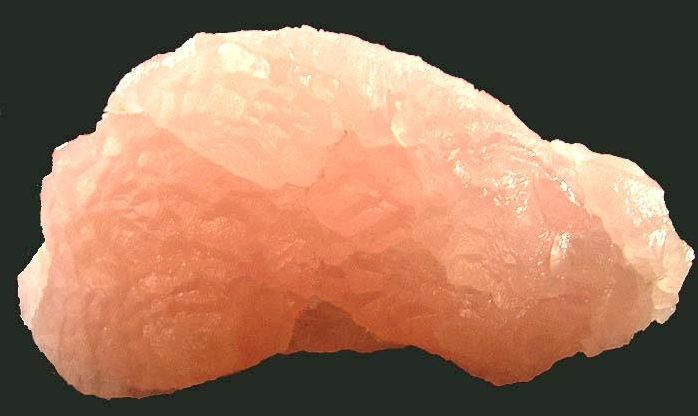
Manganese Calcite
Pale rose calcite tinted by manganese impurities - gentle in color and traditionally associated with the softest.
- Manganese gives pink color to several different minerals - Manganese Calcite, Rhodochrosite, Rhodonite, Pink Tourmaline, and Spessartine garnet all owe their pink or red tones to the same element.
- Calcite is one of the most common minerals on Earth, forming most limestone, chalk, and marble - but the manganese-pink variety is far less common than white calcite.
- Under UV light, many Manganese Calcite specimens fluoresce a vivid red or pink - a phenomenon caused by the manganese impurities activated by ultraviolet radiation.
- Manganese Calcite is soft enough (Mohs 3) that a copper coin can scratch it - always a useful field test for distinguishing it from Rose Quartz (Mohs 7).
- Peru is the among the largest known source of gem-quality Manganese Calcite, with material from the Andes being exported globally for the crystal healing and collector markets.
- Anyone working through grief, heartbreak, or emotional loss
- Practitioners building a heart-focused crystal collection
- Beginners seeking an affordable, gentle entry into crystal work
- People who find Rose Quartz too generic and want a softer alternative
- Those drawn to pastel palettes for meditation spaces or healing rooms
- Jewelry for daily wear - Mohs 3 scratches and chips easily
- Those needing a bold, saturated color statement piece
- Buyers wanting a rare or high-value collectible stone
What Is Manganese Calcite?
Manganese Calcite is calcium carbonate - the same mineral as regular calcite - colored pink by manganese impurities substituting for some calcium in the crystal lattice. The pink ranges from the palest blush to a warm dusty rose, often with white or cream banding. It rates 3 on the Mohs hardness scale.
It forms in sedimentary and hydrothermal environments worldwide, most notably in Peru, the Czech Republic, and the American Southwest, and is closely related to Rhodochrosite, which is also a manganese carbonate mineral.
Compared to other heart stones, Manganese Calcite occupies a distinctive emotional register - its pale, soft pink is less assertive than Rhodochrosite's bright red-pink and gentler than Rose Quartz's rosy clarity. Crystal workers describe its energy as quietly nurturing: the equivalent of a warm, unhurried embrace rather than an urgent healing rush.
This makes it popular in grief work, trauma recovery, and the cultivation of self-compassion.
As calcite, it has a Mohs hardness of only 3 and should be treated as a decorative and meditation stone rather than a jewelry material for everyday wear. Its trigonal cleavage means sharp edges can chip under impact.
Polished palm stones, towers, and tumbled pieces are the most practical forms for most users.
How Manganese Calcite Compares
| Property | Manganese Calcite | Rose Quartz | Rhodochrosite |
|---|---|---|---|
| Hardness | 3 | 7 | 3.5-4 |
| Price/piece | $ Budget | $ Budget | $ Budget |
| Rarity | Common | Common | Uncommon-rare |
| Best For | Meditation, gentle healing | Everyday jewelry | Collection, display |
Meaning and Symbolism
Manganese Calcite is traditionally associated with unconditional love in its quietest, most forgiving form - the love that asks nothing in return and soothes without demanding acknowledgment. Practitioners describe it as the stone you reach for when you have been hurt and need kindness more than insight.
It is said to open the heart not with force but with warmth, the way a gentle hand on the shoulder communicates more than any word.
In crystal-working traditions, Manganese Calcite is associated with releasing grief, softening anger, and dissolving the emotional calcification that unprocessed pain creates. It is said to help those who have numbed themselves to protect against hurt to gradually feel safe enough to open again.
The pale color is interpreted as purity and innocence - the return to emotional states that fear has not yet armored.
The stone is also traditionally associated with nurturing one's own needs - a form of self-parenting that many who struggle with self-worth find difficult to access.
Practitioners believe it supports the integration of the inner child, making it particularly useful in trauma-healing frameworks where reconnection with early emotional states is part of the work.
Historical Timeline
Healing Tradition
Emotional
Practitioners describe Manganese Calcite as one of the gentlest heart-healing stones available - less intense than Rhodochrosite and less activating than Emerald, it works quietly and persistently at the level of emotional tenderness.
It is said to be especially supportive in grief, particularly the kind that has not been allowed to be expressed fully - loss, disappointment, or heartbreak that got buried under the need to appear fine.
Crystal workers believe it creates a safe internal space for feelings to surface and be witnessed without drama, which they describe as essential to genuine healing.
It is traditionally associated with the healing of the mother wound and the father wound - the childhood emotional needs that were not fully met and continue to influence adult relationships and self-worth.
Spiritual
In spiritual practice, Manganese Calcite is traditionally associated with the Heart chakra's softest, most receptive mode - the capacity to receive love as freely as giving it. Practitioners believe many people are more comfortable giving love than receiving it, and that this stone specifically addresses the receiving side.
It is said to dissolve the subtle shame or unworthiness that blocks the intake of affection, appreciation, or care. Some practitioners use it in forgiveness meditations - both self-forgiveness and extending forgiveness to others - describing it as making the heart pliable enough to release what has calcified into grudge or self-condemnation.
It is said to work especially well alongside journaling practices that focus on compassionate self-inquiry.
Physical
Crystal-working traditions associate Manganese Calcite with the heart and circulatory system, though no scientific evidence supports these claims. Practitioners sometimes place it over the heart during rest or sleep, believing it supports the relaxation response and slows the nervous system's stress activation.
It is also traditionally associated with soothing tension held in the chest and upper back - the physical sites where emotional withholding is said to manifest in the body. These are complementary wellness practices and are not substitutes for professional medical care.
Zodiac, Birthstone and Gifts
Cancer is the nurturing, emotionally attuned sign most associated with care, vulnerability, and the deep need for safe emotional expression - Manganese Calcite's gentleness aligns perfectly with Cancer's sensitive nature. Practitioners believe it amplifies Cancer's capacity for empathy while helping with the boundary challenges that profound emotional openness can create.
Libra, the sign of harmony and relational balance, benefits from Manganese Calcite's support in releasing the emotional weight of past relational hurts - the imbalances that Libra finds particularly disturbing to carry.
Both signs are said to find in this stone a companion that honors their emotional depth without amplifying it to overwhelm.
Care and Cleansing
Never cleanse Manganese Calcite with water or salt - both dissolve calcite over time. Even brief water exposure will dull polished surfaces; prolonged contact causes pitting and erosion of the stone's structure. This is one of the most important care rules for all calcite varieties.
Gentle dry methods work perfectly: selenite charging plate, moonlight, sound from a singing bowl or bells, or light sage smoke. Moonlight is particularly fitting given the stone's Water element association and its feminine, receptive energy tradition.
Avoid prolonged direct sunlight - manganese-tinted stones can fade with sustained UV exposure. Brief exposure is fine, but don't leave Manganese Calcite on a sunny windowsill for days at a time.
- DO handle gently - Mohs 3 means it scratches easily against most surfaces including other crystals.
- DO NOT expose to water, salt, or acidic substances - all dissolve calcite.
- DO NOT leave in direct sunlight for extended periods - manganese coloring can fade.
- NOTE: Store separately from harder stones to prevent surface scratching.
- DO NOT use ultrasonic cleaners - vibration can fracture calcite along cleavage planes.
Real vs Fake
Genuine Manganese Calcite is distinctly soft - a fingernail (Mohs 2.5) won't scratch it, but a copper coin (Mohs 3) will. Rose Quartz (Mohs 7) is far harder and will scratch glass, while Manganese Calcite will not. This hardness test reliably distinguishes the two most common pink stones.
Authentic Manganese Calcite is typically translucent to opaque with gentle pink coloring and often white or cream banding or mottling. The color is never neon or sharply saturated - deep or electric pink indicates possible dye treatment or a different mineral altogether.
Look for the characteristic pale, milky quality in polished pieces. When held to light, genuine Manganese Calcite transmits a soft warm glow rather than the clear transparency of quartz. Under UV light, genuine pieces often fluoresce red or pink.
Dyed white calcite or howlite are sometimes sold as Manganese Calcite. Dye can be detected by rubbing a rough edge against white paper - genuine coloring does not transfer; dye may leave color traces.
Purchase from reputable crystal dealers who source from known localities (Peru, Czech Republic, USA). Very cheap pink palm stones without provenance information warrant closer inspection for dye treatment or material substitution.
Manganese Calcite Jewelry & Gifts
Manganese Calcite is one of the most affordable heart stones available. Tumbled pieces typically cost $3-$8; polished palm stones run $8-$25; towers or spheres depending on size range from $15-$60. Large raw chunks from Peru can be found at gem shows for $10-$40 per pound.
The most desirable pieces have a warm, even pink coloring without excessive gray or brown muddiness, and good translucency when held to light. Banding with cream or white is natural and attractive - uniformly solid pink stones may have been dyed.
Peru is the primary source for gem-quality Manganese Calcite on the US market. Czech Republic pieces often have slightly different coloring - sometimes more lavender-pink. Both are genuine and beautiful; personal preference in shade guides the choice.
For display, larger raw clusters or druzy Manganese Calcite pieces are available from specialty mineral dealers at gem shows. These show the crystal faces and internal structure that polished pieces conceal, and they make striking shelf displays.
When buying online, ask for photos in natural daylight without color-correction filters. Manganese Calcite's pale pink can look very different under warm artificial light versus accurate daylight photography, and the difference matters for aesthetic preference.
Where to Buy Manganese Calcite
Affiliate disclosure: Some links below earn us a small commission at no extra cost to you. See our affiliate disclosure page.
Handmade, raw, and tumbled pieces from independent sellers worldwide.
Shop Manganese Calcite on Etsy →Accessories, tools, and specimen sets with fast Prime delivery.
Shop Manganese Calcite on Amazon →Certified loose gemstones graded and photographed for online buyers.
Shop Manganese Calcite on GemSelect →Pairs Well With


Where Manganese Calcite Is Found


