Persian Turquoise
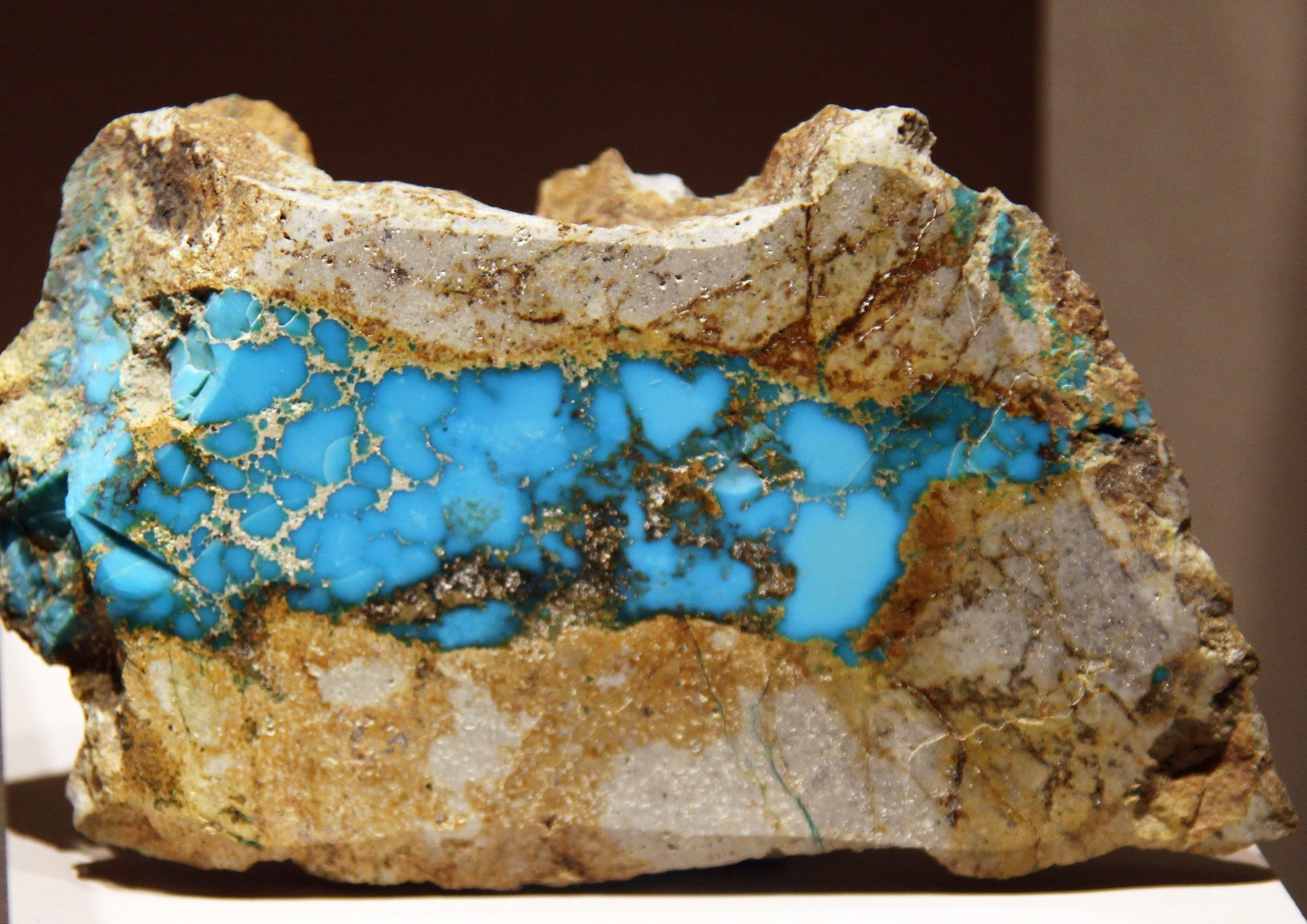
From Iran's Nishapur mines - the world's oldest continuously worked turquoise deposits - Persian turquoise sets the global standard for.
- The word turquoise comes from French pierre turquoise - Turkish stone - because Persian turquoise entered Europe via Turkish trading markets.
- Nishapur turquoise mines in Iran have been in continuous production for at least 5,000 years - the longest turquoise mining history on Earth.
- The blue domes of Persian mosques, including the Sheikh Lotfollah Mosque in Isfahan, are tiled with turquoise and its characteristic color.
- Ancient Egyptians believed turquoise brought joy and protected the dead in the afterlife - Tutankhamun's burial mask contains turquoise inlays.
- The finest Persian turquoise is classified as robin's egg blue - pure sky blue with no matrix, no green modifier, and even color distribution.
- Collectors who want the world's most historically important turquoise origin and purest blue color
- Jewelry buyers who value no-matrix robin's egg blue in authentic, documented Persian material
- Spiritual practitioners seeking turquoise's powerful Throat and Third Eye chakra associations in premium form
- December birthday gift shoppers wanting the most prestigious version of the birthstone
- Anyone who appreciates 5,000 years of cultural and trade history in a single gemstone
- Budget shoppers - authentic Persian turquoise from Nishapur is expensive and requires certification
- Buyers wanting a tough, impact-resistant stone for daily wear - turquoise at Mohs 5-6 chips and scratches easily
- Anyone who wants a vivid matrix pattern - Persian turquoise is prized specifically for its matrix-free appearance
What Is Persian Turquoise?
Persian turquoise is a copper aluminum phosphate mineral (CuAl6(PO4)4(OH)8·4H2O) mined in the Khorasan Province of northeastern Iran, particularly from the ancient Nishapur district. Iran's turquoise mines have been worked continuously for at least 5,000 years - the longest sustained turquoise production history in the world.
Persian turquoise is distinguished by its robin's egg blue to sky blue color, typically free of the dark matrix veining that characterizes most American and other origins.
The blue color of turquoise comes from copper ions within the phosphate lattice, with the specific shade influenced by the ratio of copper to iron: more copper produces vivid blue; higher iron shifts the stone toward green.
Nishapur deposits produce an unusual concentration of high-copper, low-iron turquoise resulting in the pure, unmixed blue that collectors and historians have prized for millennia. This color is called Persian blue or robins-egg blue in the trade - the reference standard against which all other turquoise is judged.
The word turquoise itself comes from the French pierre turquoise meaning Turkish stone, reflecting the ancient trade route through Turkish markets that brought Persian turquoise to medieval Europe.
The stone traveled west along the Silk Road, appearing in Egyptian pharaonic jewelry, Greek and Roman artifacts, and eventually the crowns and rings of European royalty. Persian turquoise is among the oldest traded luxury gemstones in human history.
Persian Turquoise vs Sleeping Beauty Turquoise vs Tibetan Turquoise
| Property | Persian Turquoise | Sleeping Beauty Turquoise | Tibetan Turquoise |
|---|---|---|---|
| Color | Robin's egg blue, no matrix | Sky blue, minimal matrix | Blue-green, often matrix-heavy |
| Hardness | 5 - 6 | 5 - 6 | 5 - 6 |
| Price / carat | $$ Mid-range | $ Budget | $ Budget |
| Historical prestige | Highest - 5,000 years | Modern mine, 20th century | Ancient trade route gem |
| Best For | Investment, collector, prestige | Modern jewelry, affordable blue | Spiritual use, ethnic jewelry |
Meaning and Symbolism
Persian turquoise carries perhaps the richest symbolic biography of any gemstone. In ancient Persia, turquoise was considered a stone of protection and fortune - worn by warriors on armor, horses, and weapons to guarantee safety in battle.
The legendary Persian poet and scholar Al-Biruni wrote in the 11th century that wearing turquoise prevented the eye of evil from touching the wearer. This belief in turquoise as a protective talisman spread from Persia across Central Asia, the Silk Road, and eventually to Native American traditions via ancient trade networks.
In Islamic culture, the blue of Persian turquoise became associated with paradise, heaven, and the divine. Turquoise tiles cover the domes of Persian mosques, with the most famous example being the Sheikh Lotfollah Mosque in Isfahan.
The stone is still commonly given as a gift for protection and good fortune in Iranian culture, and wearing Persian turquoise is a widespread practice across the Middle East and Central Asia. Many consider it the most culturally embedded gemstone in human civilization.
In modern crystal healing tradition, turquoise is associated with the Throat and Third Eye chakras - stones of authentic communication, intuitive wisdom, and spiritual protection. Practitioners believe Persian turquoise carries an especially concentrated version of these properties due to the stone's extraordinarily long history of intentional use and cultural reverence.
Is said to be a master healer in many Native American and ancient Persian traditions, though all such claims should be understood as spiritual and cultural rather than medical.
Historical Timeline
Healing Tradition
Emotional
Practitioners believe Persian turquoise supports emotional authenticity - the courage to express true feelings, set boundaries, and communicate from a place of genuine self-knowledge rather than social performance. Many who work with turquoise in crystal wellness describe it as particularly helpful for people who habitually silence themselves or minimize their needs.
Is said to gently dissolve the habit of emotional self-protection and create a felt sense of safety in honest expression. In multiple traditions, turquoise is linked to the restoration of depleted emotional reserves - a stone for those who give deeply and need to receive as well.
Spiritual
In crystal healing tradition, turquoise is one of the most universally revered healing and protective stones across unconnected world cultures - a convergence that many practitioners find spiritually significant. Persian turquoise is associated with the Throat and Third Eye chakras, traditionally linked to truthful communication and clear inner vision.
Is said to support shamanic journeying, meditation, and prayer in Native American, Persian, and Tibetan traditions alike. Many practitioners believe it creates a protective energetic field around the aura, particularly beneficial during spiritual work that involves opening to expanded states of awareness.
Physical
While no gemstone replaces medical care, turquoise has been used in traditional medicine across many cultures for thousands of years.
Persian medical texts from the medieval period describe turquoise as beneficial for eye health, headaches, and respiratory ailments - associations that appear in Egyptian, Native American, and Tibetan healing traditions as well.
Practitioners today often place turquoise near the throat or wear it as a necklace during practices intended to support voice, communication, and thyroid-area wellness. All such traditional associations should be understood as cultural and spiritual practice rather than clinical treatment.
Zodiac, Birthstone and Gifts
Turquoise is the traditional December birthstone, connecting it most strongly to Sagittarius (November 22 - December 21). Sagittarius, the archer of the zodiac - philosophical, adventurous, and truth-seeking - resonates with turquoise's long history as a stone of wisdom, protection in travel, and authentic communication.
Persian turquoise is an especially meaningful December birthday gift for Sagittarius personalities who appreciate history, spirituality, and the world's cultures.
Pisces and Scorpio are also linked to turquoise through its associations with deep intuition, protective energy, and connection to spiritual realms. Persian turquoise in particular resonates with water sign sensitivity through its deep cultural history across the Persian Gulf and Silk Road trade routes.
Many astrology practitioners choose Persian turquoise specifically for its provenance depth - a stone with this much human history carries a weight of intention that enriches zodiac-based spiritual work.
Care and Cleansing
Persian turquoise is one of the most care-intensive gemstones to cleanse. Avoid all water-based cleansing - turquoise is porous and absorbs liquids, which can discolor the stone permanently. Avoid salt, both dry and dissolved, which has the same penetration problem.
Sound cleansing with a singing bowl or moonlight are the safest traditional methods.
Selenite plate overnight cleansing is ideal for turquoise as it requires no liquid, heat, or contact that could damage the surface. Many practitioners pass turquoise through sage or incense smoke as a gentle, effective cleansing method with deep cultural resonance given the stone's long use in ceremonial contexts.
Intention cleansing - holding the stone while firmly visualizing clearing light - is another popular choice for porous gems that require extra care.
- DO NOT expose Persian turquoise to water, soaps, lotions, perfumes, or any liquid - it is porous and will absorb and discolor.
- DO NOT use salt cleansing methods - salt penetrates pores and disrupts the stone's color over time.
- DO store away from harder gemstones; turquoise at Mohs 5-6 is scratched by almost any other gem.
- DO NOT expose to extended sunlight or UV - turquoise color fades with prolonged light exposure.
- DO avoid wearing Persian turquoise during activities involving chemicals, sweat, or potential impact.
- DO have fine Persian turquoise pieces examined professionally to confirm treatment status - stabilization is common and affects value.
- DO keep in a cool, dark location when not worn; leather jewelry boxes are preferred by traditional collectors.
Real vs Fake
Persian turquoise authentication is among the most challenging in gemology because the global market is flooded with imitations, stabilized turquoise, simulants, and synthetic material.
Howlite dyed blue is the most common fake turquoise globally - it looks identical to untrained eyes but shows a plastic-like luster under magnification and reads differently on a specific gravity test. Magnesite is similarly dyed to simulate turquoise at very low price points.
Stabilization is a nearly universal treatment where low-grade porous turquoise is impregnated with resin or plastic to harden it and intensify the color. Stabilized turquoise is genuine mineral but significantly lower value than untreated natural Persian material.
Natural (untreated) Nishapur turquoise commands substantial premiums and requires certification from a recognized lab (gemological laboratories, Gemworld International, or equivalent) to validate the claim.
True Persian turquoise from Nishapur is expensive and requires documentation. If a price seems too good to be true, it almost certainly is. Request a laboratory certificate that specifies natural turquoise, untreated or minimal treatment, and confirms Persian/Iranian origin.
Under UV light, natural turquoise is typically inert; plastic or dyed howlite may show fluorescence. Specific gravity of genuine turquoise ranges from 2.6 to 2.9; howlite and plastic imitations differ measurably.
Persian Turquoise Jewelry & Gifts
Authentic natural Persian turquoise from Nishapur typically sells for $50 to $500 per carat or more depending on color purity, treatment status, and documentation. The most valuable stones show pure robin's egg blue with no matrix, no green modifier, and no stabilization treatment.
Stabilized Nishapur turquoise is significantly less expensive but still legitimate; non-stabilized material commands significant premiums.
For any Persian turquoise purchase over $200, insist on a laboratory certificate specifying origin and treatment status. Reputable dealers of genuine Persian material will have documentation readily available. Be suspicious of any vendor who cannot provide treatment disclosure or who claims untreated status without lab certification.
The best Persian turquoise is sold through established gem dealers, auction houses, and dealers who specialize in Middle Eastern or Southwest Asian gems.
Where to Buy Persian Turquoise
Affiliate disclosure: Some links below earn us a small commission at no extra cost to you. See our affiliate disclosure page.
Handmade, raw, and tumbled pieces from independent sellers worldwide.
Shop Persian Turquoise on Etsy →Accessories, tools, and specimen sets with fast Prime delivery.
Shop Persian Turquoise on Amazon →Certified loose gemstones graded and photographed for online buyers.
Shop Persian Turquoise on GemSelect →Pairs Well With



Where Persian Turquoise Is Found
