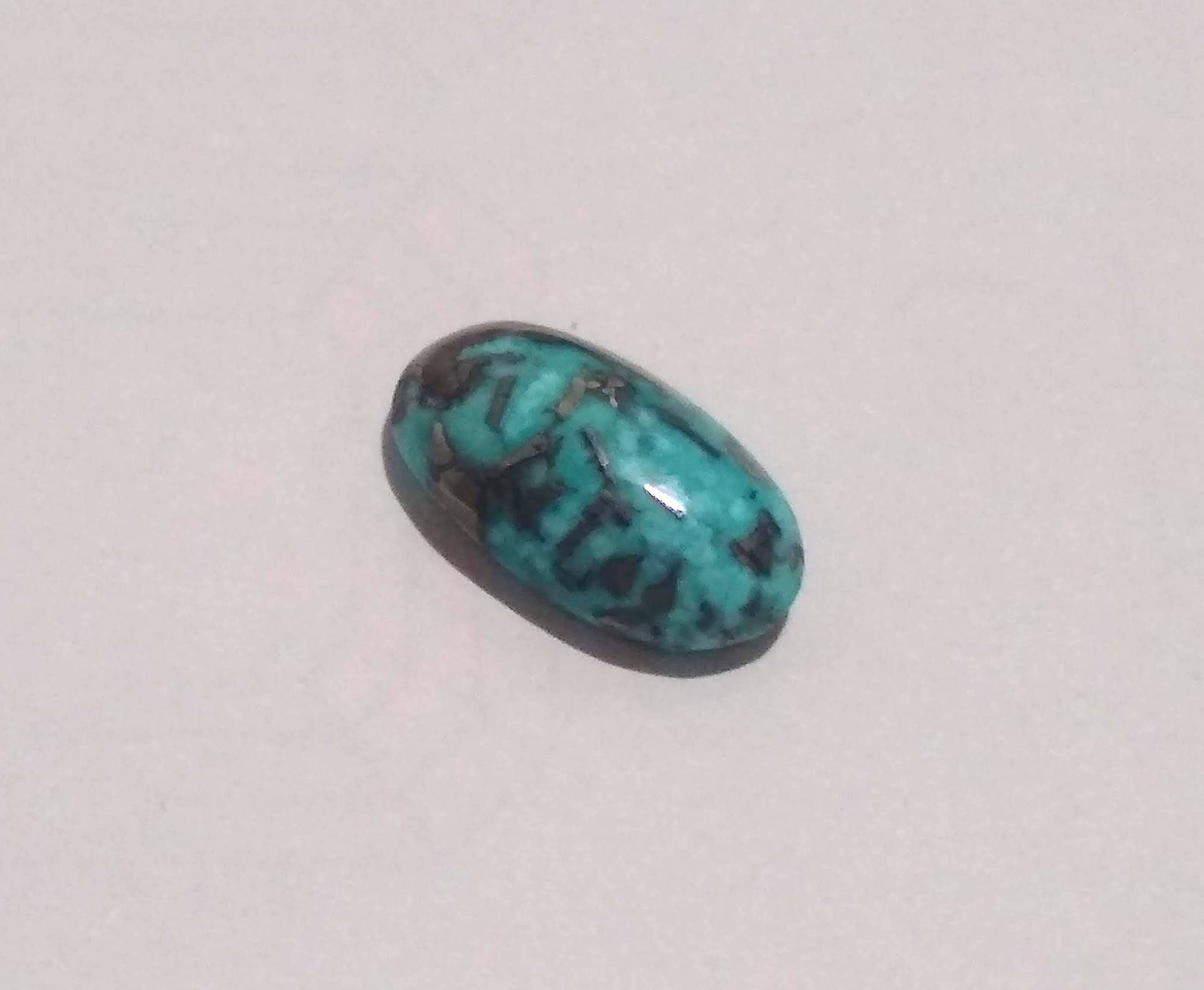
Turquoise Matrix
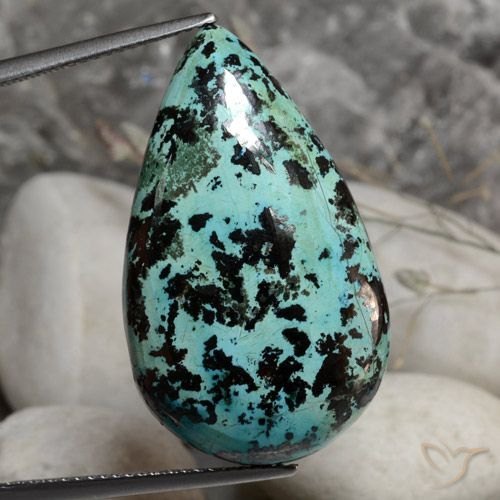
Turquoise Matrix preserves the stone's geological story - vivid blue-green copper phosphate laced with host rock veining that maps the.
- The most coveted matrix pattern - 'spider-web' - requires extremely fine, evenly spaced matrix veining that occurs only in specific mine deposits and is nearly impossible to replicate artificially.
- Turquoise changes color over time as it absorbs body oils and skin chemistry - a process traditional wearers valued as the stone 'bonding' with its owner.
- Persian turquoise from the Nishapur mines has been mined for over 2,000 years and remains the global benchmark for robin's-egg blue solid-color turquoise.
- The Bisbee Mine in Arizona produced the world's finest dark-matrix copper-stained spider-web turquoise before closing to mining in 1975.
- Turquoise's blue color comes from copper; the green tones come from iron - the ratio of copper to iron in any given deposit determines whether the material leans blue or green.
- Southwest and Native American jewelry tradition enthusiasts who prize natural matrix patterns
- Collectors who value the geological story visible in matrix turquoise over clean solid-color stones
- Throat chakra practitioners seeking an authentic, traditionally significant blue communication stone
- Those wanting natural unenhanced turquoise for its genuine earth-connection energy
- Gift givers seeking a recognizable, culturally rich stone with strong visual identity
- Buyers wanting clean, solid-color turquoise without host rock veining - choose natural solid turquoise or stabilized
- Daily ring wearers - turquoise at Mohs 5-6 scratches easily and requires protection
- Budget buyers expecting gem-quality matrix patterns - fine natural matrix turquoise is not cheap
What Is Turquoise Matrix?
Turquoise Matrix is turquoise - copper aluminum phosphate with the formula CuAl6(PO4)4(OH)8·4H2O - that retains visible portions of its host rock (matrix) as part of the finished cabochon. The matrix consists of the parent rock in which the turquoise formed, typically iron oxide (limonite), manganese oxide, quartz, or pyrite parent rock.
The resulting pattern of dark veins running through vivid blue-green turquoise is called 'spider-web matrix' when the veining is fine and interconnected, and valued as a distinctive feature rather than a flaw.
Turquoise forms in arid regions where copper-bearing surface waters percolate through aluminum-rich host rock, depositing copper phosphate in fractures and cavities over millions of years.
The fracture network that guided the water flow is preserved in the matrix pattern visible in each stone - making every Turquoise Matrix cabochon a literal map of ancient groundwater movement through specific geology.
Hardness of the turquoise itself is 5 to 6 on the Mohs scale, but matrix zones may be harder or softer depending on composition.
The most prized Turquoise Matrix comes from named American Southwest mines (Sleeping Beauty, Bisbee, Royston, Carico Lake), Persian Iran (Nishapur), Tibet, and Mexico. The mine of origin significantly affects both color character and matrix pattern.
American Southwest turquoise is among the most culturally significant in the world, having been used by Pueblo, Navajo, and Zuni artisans for centuries in ceremonial and adornment contexts.
How Turquoise Matrix Compares
| Property | Turquoise Matrix | Stabilized Turquoise | Persian Turquoise |
|---|---|---|---|
| Matrix | Natural host rock veining visible | Matrix typically filled/treated | Often matrix-free blue |
| Hardness | 5 - 6 | 5 - 6 (hardened) | 5 - 6 |
| Price / carat | $ Budget | $ Budget | $$ Mid-range |
| Best For | Collectors, authentic tradition | Affordable jewelry | Collector, investment |
Meaning and Symbolism
Turquoise is among the oldest gemstones used by humanity - Egyptian artifacts with turquoise settings date to 3000 BCE, and the mines at Sinai were among the first organized mining operations in history.
Native American cultures of the Southwest have used turquoise for over 1,000 years in ceremonial contexts, as trade currency, and as personal adornment. The Navajo, Zuni. Pueblo peoples consider turquoise sacred - a gift of the sky fallen to earth, connected to rain, the sky god, and the well-being of the people.
Matrix turquoise carries an additional layer of meaning in these traditions. Rather than representing an impurity or flaw, the matrix is understood as the stone's connection to its earthly origin - the rock mother that held and grew the turquoise.
Natural matrix turquoise is therefore considered more complete, more grounded, and more energetically whole than matrix-free material by practitioners working in these traditions.
Practitioners believe in contemporary crystal healing, turquoise is one of the most universally recognized throat and communication stones. The Throat chakra association connects turquoise to authentic self-expression, honest communication, and the courage to speak one's truth.
The matrix variety adds an earthy, grounded quality to this communication energy - not just speaking, but speaking from a place of genuine, rooted knowing.
Historical Timeline
Healing Tradition
Emotional
In crystal healing tradition, Turquoise Matrix is said to support authentic emotional expression - the courage to speak from the heart rather than from the mind's careful editing.
Practitioners believe the stone's long history as a sacred communication and ceremonial object gives it a particular resonance for those seeking to break through habitual patterns of self-censorship or emotional concealment. The matrix pattern is interpreted as grounding this open expression in genuine experience rather than performance.
Many find it calming during confrontational conversations or public speaking situations.
Spiritual
Turquoise Matrix is described in crystal healing practice as a bridge stone - connecting earth and sky, the personal and the collective, the individual voice and the larger truth. In Native American traditions, turquoise is said to carry the blessing of the sky father and the protection of the earth mother simultaneously.
Contemporary practitioners believe this dual connection creates an unusually stable spiritual anchor: one that is both receptive to higher guidance (sky) and grounded in practical wisdom (earth). The matrix is said to embody the earth aspect of this balance.
Physical
From a crystal healing perspective, turquoise is traditionally associated with the respiratory system, the throat, the immune system, and overall physical vitality. Many ancient traditions used turquoise as a healing amulet for infections and fevers - associations that modern crystal healers interpret energetically rather than literally.
As with all crystal practices, turquoise is a complementary energetic support, not a substitute for medical care.
Zodiac, Birthstone and Gifts
Turquoise is the traditional December birthstone, serving Sagittarius as its primary sign. Sagittarius resonates strongly with turquoise's communication, truth-seeking, and far-ranging spirit - both the stone and the sign are associated with philosophical exploration and the courage to speak uncomfortable truths.
Pisces benefits from turquoise's Throat chakra support for articulating the deep intuitive impressions Pisces so frequently receives. Scorpio resonates with turquoise's ancient protective and ceremonial power and its association with genuine depth over surface performance. All three signs value authenticity - which turquoise, especially in matrix form, represents in literal geological terms.
Care and Cleansing
Turquoise Matrix should be cleansed exclusively with non-contact methods to protect both the turquoise and any stabilization or wax treatments the stone may have. Sound cleansing with a singing bowl or smudging with sage are the safest options.
The smoke of sage has been used ceremonially with turquoise in Southwestern Native American traditions for centuries.
Moonlight overnight cleansing is gentle, non-contact, and symbolically appropriate. Bury loosely in dry earth or cornmeal (traditional Pueblo cleansing medium) overnight for a grounding energetic reset. Never use water, salt water, or chemical cleaners. Extended sunlight should also be avoided as turquoise can slowly change color with UV exposure.
- DO NOT expose to water - turquoise is porous and absorbs moisture; repeated water exposure changes color and damages the stone.
- DO NOT use salt water or any chemical cleaner.
- DO NOT expose to perfume, lotion, makeup, or household cleaning products.
- DO NOT use ultrasonic or steam cleaners.
- DO NOT store in direct sunlight for extended periods - color can shift with UV exposure.
- NOTE: Natural untreated turquoise will slowly change color with body oils and skin chemistry - many traditional wearers consider this a sign of the stone's living quality.
- DO store in a soft individual pouch away from harder minerals that can scratch it.
Real vs Fake
The turquoise market is extensively adulterated with dyed howlite, dyed magnesite, stabilized low-grade turquoise, and plastic imitations. The most reliable field test for genuine turquoise versus dyed stone is the acetone test: a cotton swab dampened with acetone rubbed on a hidden area of dyed howlite or magnesite will transfer color.
Genuine turquoise does not transfer color with acetone.
Natural matrix turquoise with spider-web or host-rock veining is harder to fake convincingly at scale. Genuine matrix patterns are three-dimensional - the matrix extends through the body of the stone, not just appearing as lines drawn on the surface.
Under magnification, genuine matrix shows natural mineral texture variation between the turquoise zones and the host rock.
For significant purchases, a laboratory analysis from a gemological lab or a named-mine certificate from a reputable Native American or Southwest jewelry dealer is the reliable standard. Ask dealers to specify whether material is natural, stabilized, or treated.
The distinction matters both for value and for the metaphysical traditions that associate energy with the stone's natural condition.
Turquoise Matrix Jewelry & Gifts
Commercial stabilized turquoise matrix begins around $10-$30 per carat. Natural untreated turquoise matrix from unnamed US sources runs $30-$100/ct. Named-mine natural US turquoise from desirable sources (Bisbee, Royston, Carico Lake, Sleeping Beauty) with fine spider-web matrix can reach $200-$500+/ct. Persian Nishapur natural material comparable to robin's-egg quality commands $100-$1,000+/ct.
Spider-web pattern quality and color saturation are the primary value drivers for matrix turquoise. Fine spider-web requires extremely regular, tight veining - rare even in good material. Color should be vivid medium-to-dark blue to blue-green without chalky or washed-out zones. Always confirm natural vs. stabilized vs. treated status.
Named-mine provenance with documentation is the strongest value signal.
Where to Buy Turquoise Matrix
Affiliate disclosure: Some links below earn us a small commission at no extra cost to you. See our affiliate disclosure page.
Handmade, raw, and tumbled pieces from independent sellers worldwide.
Shop Turquoise Matrix on Etsy →Accessories, tools, and specimen sets with fast Prime delivery.
Shop Turquoise Matrix on Amazon →Certified loose gemstones graded and photographed for online buyers.
Shop Turquoise Matrix on GemSelect →Pairs Well With


Where Turquoise Matrix Is Found


