Unakite
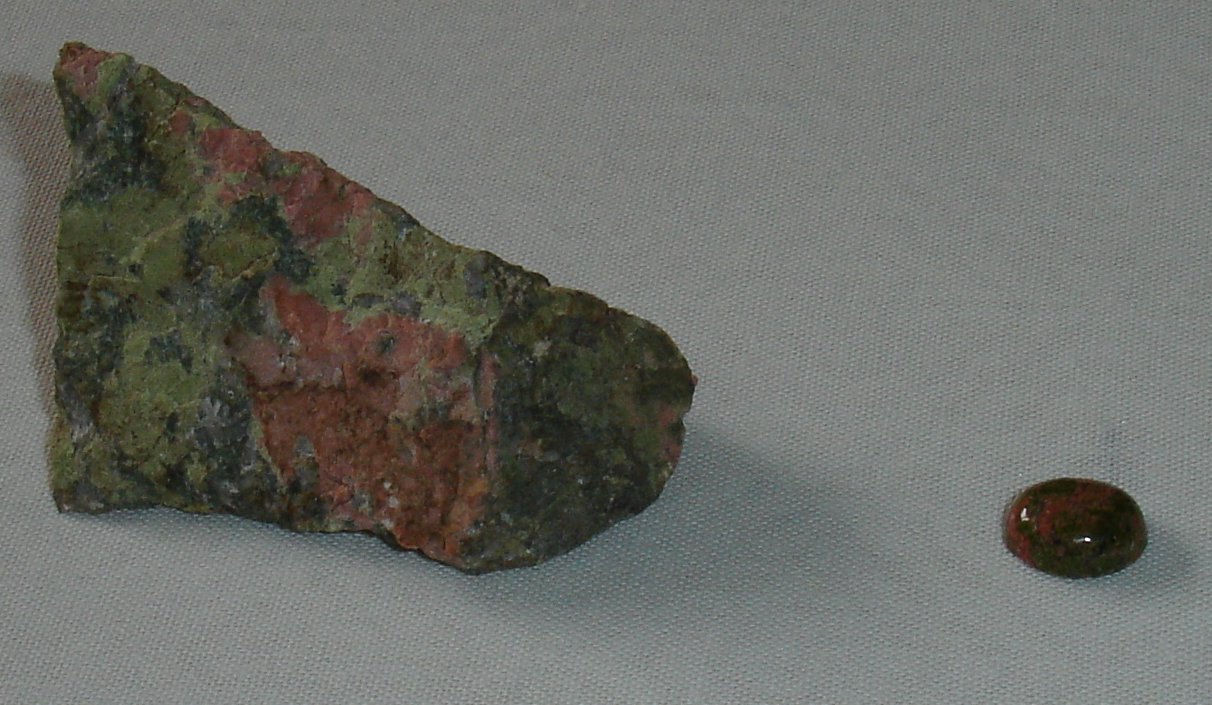
A blend of pink orthoclase and green epidote, unakite is the forest-floor stone of patient heart work.
- Unakite is named after the Unaka Range on the border of Tennessee and North Carolina where it was first identified.
- Unakite is a rock, not a single mineral, composed mainly of pink orthoclase feldspar and green epidote.
- The Blue Ridge Parkway passes through several known unakite outcrops, and rock hounds collect float material from roadcuts.
- Polished unakite cabochons were popular Victorian brooch stones during the late nineteenth century.
- Some unakite shows a third brown or black component from weathered hornblende, adding a three-color appearance.
- Practitioners working with heart chakra softening and root chakra grounding
- Beginner crystal collectors seeking affordable tumbled stones with strong character
- Lapidary hobbyists cutting cabochons from a forgiving, easy-to-polish material
- Gift-givers looking for a friendship stone with gentle pink-green symbolism
- Travelers and hikers drawn to Appalachian geology and local American origin
- Buyers seeking faceted transparent gems (consider green amethyst or rose quartz)
- Those wanting a single-color stone (try chrysoprase or pink opal)
- Shoppers looking for investment-grade stones (unakite is budget friendly)
What Is Unakite?
Unakite is not a single mineral but a granitic rock composed mostly of pink orthoclase feldspar, green epidote, and clear quartz, with trace magnetite sometimes speckling the surface. The rock is named after the Unaka Range of the southern Appalachian Mountains, where it was first described in 1874.
Because unakite is a rock rather than a mineral, it does not carry a single International Mineralogical Association symbol; each component mineral has its own.
With a Mohs hardness of 6 to 7 depending on the dominant mineral in a given section, unakite is durable enough for rings and bracelets with reasonable care. Specific gravity of 2.85 to 3.20 varies with the proportion of epidote, which is the denser component.
Unakite forms through the partial alteration of granitic rocks, where hot mineral-rich fluids replace some of the plagioclase with epidote while leaving pink orthoclase intact. The resulting mottled pink-and-green appearance is instantly recognizable and has earned the stone the trade name epidotized granite.
The finest deposits lie along the border of Tennessee and North Carolina in the Blue Ridge mountains, with secondary sources in Virginia, Zimbabwe, South Africa, Brazil, and China. Each locality produces slightly different ratios of pink to green and different levels of coarseness.
Most unakite on the market is sold as tumbled stones, cabochons, beads, or spheres. The stone is rarely treated, since its appeal lies in the natural blending of feldspar and epidote rather than in saturated single colors.
How Unakite Compares
| Property | Unakite | Bloodstone | Ocean Jasper |
|---|---|---|---|
| Hardness | 6 - 7 | 6.5 - 7 | 6.5 - 7 |
| Price / lb | $ Budget | $ Budget | $ Budget |
| Rarity | Common | Common | Uncommon |
| Best For | Tumbled, beads | Engraving, heirloom | Cabochon, display |
Meaning and Symbolism
Unakite entered the mineral literature in 1874, when geologist Frank Bradley named it after the Unaka Range on the border of North Carolina and Tennessee. The Cherokee people who lived in the region long before European mineralogists recognized the rock's association with old mountain granite and forest soil.
The modern crystal tradition grew largely from Appalachian lapidary shops in the twentieth century.
Because unakite combines pink and green in one rock, it is often described as a stone of reconciliation, linking the colors of rose quartz-style love and jade-style steady heart work.
Practitioners frequently highlight the way the colors remain separate within the rock rather than blending, interpreting this as a reminder that difficult emotions can coexist with gentleness.
The stone's rocky, rough-textured appearance contributes to its reputation for grounded practicality. It looks like something you could find on a forest trail, which is part of its appeal.
In modern crystal practice, unakite is traditionally associated with emotional patience, rebirth after loss, and the slow work of knitting the heart back to the root. Practitioners believe the pink feldspar carries tenderness and the green epidote carries earthly endurance.
Many find it a useful companion during convalescence, pregnancy loss, or long periods of emotional rebuilding, when the work is less about transformation and more about steady repair.
Historical Timeline
Healing Tradition
Emotional
Practitioners believe unakite is a stone of patient emotional repair. In crystal healing tradition, it is said to support the wearer through grief, recovery, and the long stretches after difficult endings, acting more like a warm blanket than a motivational push.
Many find unakite supportive during pregnancy, postpartum recovery, and the years after a significant loss, with the stone traditionally associated with rebuilding trust rather than forcing renewal.
Practitioners often pair it with rose quartz when the heart work is especially tender, or with black tourmaline when the root needs protective anchoring during vulnerable seasons.
Unakite is also said to support people reintegrating after burnout or long illness, giving them a steady, earthy sense of ground. It is not considered a high-energy stone; readers seeking motivation usually turn to carnelian or citrine, keeping unakite for the slow, gentle seasons that follow big shifts.
Spiritual
In crystal healing tradition, unakite is said to link the heart and root chakras through the pairing of pink feldspar and green epidote. Practitioners believe this combination is what gives unakite its reputation as a stone of embodied love, where feeling meets ground.
Many find unakite useful in meditations focused on ancestral work, forest walking, or seasonal rituals that mark a return to rest. The stone has strong associations with mountain landscapes and the steady patience of old rock, which practitioners often draw on during Samhain, winter solstice, or any quiet turning of the year.
Unakite is traditionally associated with Venus in modern crystal astrology, which practitioners interpret as loving kindness paired with earthly steadiness rather than romantic intensity. Placing unakite in a memory box, on a bedside altar, or beside a window overlooking a garden has become a common practice for gentle spiritual work.
Physical
Practitioners believe unakite supports what they describe as gentle physical healing and regenerative rest, and it has long been connected in folk tradition to pregnancy and skin recovery. Folklore associates unakite with nurturing body awareness during pregnancy, slow weight-bearing movement after injury, and the restorative side of chronic illness management.
Many find carrying a tumbled unakite in a pocket or placing a small sphere at the bedside comforting during physical therapy or convalescence, with practitioners framing its effect as slow, steady warmth.
Unakite is not a substitute for medical care, and practitioners are clear that its role is supportive rather than curative. For readers using unakite energetically during pregnancy or recovery, crystal healing tradition sometimes recommends pairing it with moonstone for lunar rhythm or aquamarine for calm communication with caregivers.
Zodiac, Birthstone and Gifts
Unakite is not a traditional birthstone, but it is often associated with Scorpio and Taurus in modern crystal astrology. The two signs sit opposite each other on the zodiac wheel, mirroring the pink-and-green duality within the stone itself.
For Scorpio, unakite is said to support the sign's deep emotional work, softening intensity with earthly patience. For Taurus, the stone is believed to encourage heart openness without sacrificing the sign's love of slow, rooted comfort.
Practitioners suggest carrying unakite as a tumbled stone in a pocket or worn as a pendant over the heart, rather than in ring settings, since the beauty of the mottled pattern tends to read best across a larger surface area.
Care and Cleansing
Unakite is among the easier stones to cleanse because it tolerates most common methods. Running tap water for under a minute is safe for a tumbled stone or loose cabochon, as is a brief rinse in lukewarm soapy water with a soft cloth.
Avoid long soaking for drilled or strung bead strands, since stringing materials and glues can weaken with prolonged exposure to water.
Sunlight cleansing is traditionally fine for unakite, since the stone does not fade under ordinary UV exposure. A short morning sun bath is considered sufficient. Moonlight, smoke cleansing with palo santo or cedar, and sound cleansing with a singing bowl are all considered safe.
Salt cleansing should be brief and dry, with the stone resting on a bed of salt rather than buried, since prolonged saltwater contact can slowly alter polish on softer feldspar patches. Many practitioners recharge unakite by resting it on a clear quartz cluster between uses.
- DO rinse unakite in lukewarm soapy water and dry with a soft cloth after long wear or pocket carry.
- DO NOT use ultrasonic or steam cleaners on unakite beads with glued stringing or fragile findings.
- DO store unakite separately from harder gems like sapphire or diamond that can scratch its softer feldspar zones.
- DO NOT expose unakite beads or bracelets to prolonged saltwater soaks; brief rinses are acceptable.
- DO remove unakite rings before rough manual work, since the mixed hardness can chip along mineral boundaries.
- DO ask sellers to confirm the stone is natural unakite rather than dyed serpentine or pink-green substitute.
- Note: polish quality varies by source; Chinese commercial tumbles are typically uniform, while Appalachian rough often shows more texture.
Real vs Fake
Genuine unakite shows a clear mottled pattern of pink feldspar and green epidote, with the two minerals remaining visually distinct under a 10x loupe. Natural specimens often include small clear quartz grains and occasional black magnetite flecks, giving the stone a coarse, granitic texture.
A stone sold as unakite that shows a smooth, uniform pink and green blend without visible grain boundaries deserves closer inspection, since resin imitations and dyed marble substitutes exist.
Common imitations include dyed pink-and-green marble, polymer composite tumbles, and dyed serpentine. Dyed marble is softer, fizzes when touched with dilute acid on an inconspicuous corner, and often shows color pooling along cracks. Composite tumbles are noticeably lighter than natural unakite.
Serpentine substitutes typically lack the granular crystalline texture of unakite and feel slightly slick rather than rocky.
Practical at-home checks include a hardness test (natural unakite scratches glass easily), weight and feel (denser than resin, about the density of other granitic rocks), and grain visibility under magnification. A drop of dilute vinegar on an inconspicuous edge will not fizz on natural unakite but will bubble on marble substitutes.
For mass-market tumbled stones, unakite is priced so modestly that deliberate imitation is uncommon, but for higher-end cabochons and beads, a report from a reputable lapidary or gemological lab can confirm identity when color uniformity raises doubts.
Unakite Jewelry & Gifts
Unakite is among the most affordable crystals on the market, and most pricing is done by the pound or piece rather than by carat.
Tumbled stones run roughly $1 to $5 each depending on size, while rough unakite sells for about $5 to $20 per pound through reputable online retailers and rock shops.
Polished spheres, palm stones, and towers range from $10 to $80 depending on quality and scale, with unusually large or attractive specimens reaching higher prices.
Unakite beads for jewelry stringing trade at $3 to $15 per strand, while finished bracelets and pendants usually fall between $10 and $60 at metaphysical shops. Appalachian-origin unakite sometimes carries a small premium among North American collectors who prize domestic provenance.
Because unakite is not treated in any significant way, most questions come down to color balance, polish quality, and origin. Look for clear distinction between pink and green zones without muddiness, a smooth polish without pits, and full disclosure if any stabilization has been applied.
A report from a reputable lab is rarely needed but can be helpful for cabochons where composite imitations are possible.
Where to Buy Unakite
Affiliate disclosure: Some links below earn us a small commission at no extra cost to you. See our affiliate disclosure page.
Handmade, raw, and tumbled pieces from independent sellers worldwide.
Shop Unakite on Etsy →Accessories, tools, and specimen sets with fast Prime delivery.
Shop Unakite on Amazon →Certified loose gemstones graded and photographed for online buyers.
Shop Unakite on GemSelect →Pairs Well With



Where Unakite Is Found


