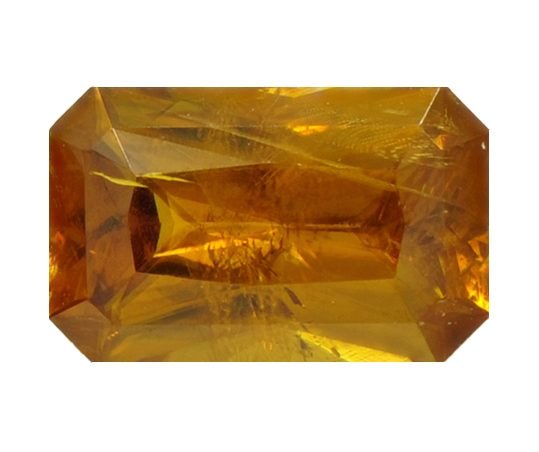
Titanite
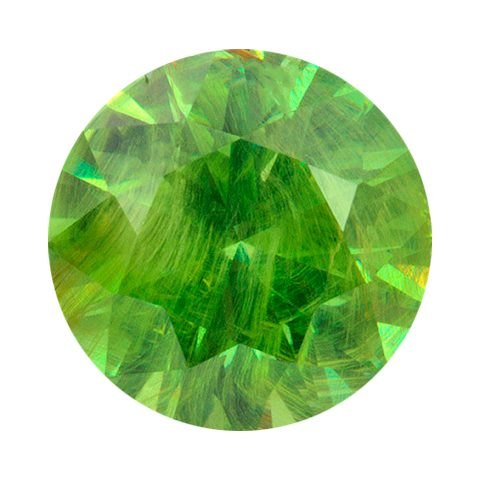
Also called sphene, titanite shows more fire than diamond in a warm.
- Titanite's dispersion of 0.051 is higher than diamond's 0.044.
- The names titanite and sphene refer to exactly the same mineral species.
- Titanite is used as a geochronology mineral, helping date ancient metamorphic events through uranium-lead analysis.
- Some titanite fluoresces weakly yellow under short-wave UV light.
- Chromium-rich titanite from Austria shows a rare emerald-green body color.
- Collectors chasing extreme dispersion
- Pendant and earring buyers (protected wear)
- Geologists wanting a telling thin-section mineral
- Spiritual readers working with mental clarity
- Fans of natural chartreuse and olive greens
- Daily-wear ring buyers (try demantoid garnet or peridot)
- Those on a strict budget under $50 (try peridot)
- Fine jewelry shoppers wanting mass-market availability (try tsavorite)
What Is Titanite?
Titanite is a calcium titanium nesosilicate with the formula CaTiSiO₅, widely known in the gem trade by its older name sphene, from the Greek sphenos meaning wedge, after its characteristic wedge-shaped crystals. Titanite is the official mineralogical name accepted by the International Mineralogical Association, while sphene persists as the popular gemological label.
Both terms refer to the same species, colored most often in chartreuse yellow-green, honey brown, or olive.
The mineral's gemological fame rests on two optical properties: an unusually high refractive index of approximately 1.843 to 2.110, and a dispersion of 0.051, meaningfully higher than diamond's 0.044. This combination produces intense prismatic fire, so a well-cut titanite sparkles with rainbow flashes that often exceed those seen in diamond.
Its strong birefringence of around 0.105 to 0.135 causes noticeable facet doubling, a tell that trained gemologists use for on-sight identification.
Titanite forms in metamorphic schists and gneisses and in some granitic plutons, typically in small crystals suitable for cutting under five carats. Major sources include the Kaghan Valley of Pakistan, Madagascar's high plateau, the Capelinha region of Brazil, and historic deposits in Ontario and Quebec.
Its Mohs hardness of 5 to 5.5 and perfect cleavage limit it to pendants, earrings, and protected settings, which is the main reason titanite remains a collector stone rather than a jewelry mainstay.
How Titanite Compares
| Property | Titanite | Demantoid Garnet | Peridot |
|---|---|---|---|
| Dispersion | 0.051 | 0.057 | 0.020 |
| Hardness | 5 - 5.5 | 6.5 - 7 | 6.5 - 7 |
| Price / carat | $$ Mid-range | $$$ Premium | $$ Mid-range |
| Best For | Pendants, earrings | Collector jewelry | Daily wear |
Meaning and Symbolism
In crystal healing tradition, titanite is associated with mental clarity and quick thinking, partly because of its strong fiery dispersion which practitioners read as a visual metaphor for lit-up thought.
Many readers use titanite to focus studies, research, or creative problem-solving, and some teachers keep a specimen on the desk as a visual anchor during long work sessions. Its name derives from titanium, and practitioners believe the stone carries titanium's mythic association with strength without rigidity.
Because titanite is a newer arrival to the spiritual market, folklore around it is thinner than that surrounding older gems. Modern crystal practitioners treat it primarily as a stone of the solar plexus and third eye, linking its yellow-green range to the junction between will and insight.
Collectors simply love it for the fire. Whichever angle a reader approaches from, titanite rewards attention: the more light you put on it, the more color it throws back.
Historical Timeline
Healing Tradition
Emotional
Practitioners believe titanite supports clear thinking during emotionally charged decisions, and many readers hold a tumbled piece during journaling sessions focused on untangling confused feelings.
In crystal healing tradition the stone is said to cut through mental fog without dulling sensitivity, a balance that makes it a favorite for readers juggling creative and analytical work.
Many find that keeping titanite on a desk reduces the urge to multitask, though this is a subjective, self-reported effect rather than a verified outcome. Some practitioners describe titanite as an emotional timekeeper, helping users notice when a feeling is fresh versus when it has become a loop.
Others pair it with rose quartz during difficult conversations, alternating hands between the two stones. Titanite is not a substitute for professional mental health care, and its effects remain traditional rather than clinical.
Spiritual
Titanite is traditionally associated with the third eye and solar plexus chakras, and practitioners believe it joins insight with willpower. Some crystal readers use titanite in grids intended to support intellectual manifestation, placing it at the top point with clear quartz at the anchor.
Many find the stone's strong fire visually activating, describing a brighter mental state during meditation with the stone in hand. In modern crystal practice, titanite is often recommended to writers, researchers, and teachers who want a desktop ally.
Its older name sphene, meaning wedge, is sometimes taken as a symbol of breakthrough: the wedge that opens a stuck insight. These associations are traditional and have not been demonstrated in scientific studies.
Physical
Practitioners believe titanite offers general support for eye strain and the recovery period after intellectual overexertion, though no gemstone has been shown in peer-reviewed research to affect the physical body. In folklore titanite was not widely used for physical complaints, so most claims trace to 20th-century crystal healing sources.
Many find the stone pleasant to hold during long screen sessions as a reminder to look away and rest the eyes. Titanite contains titanium compounds that are chemically stable when the stone is intact. Practitioners who make gem elixirs should always use indirect methods rather than soaking the stone in drinking water.
Readers with any physical health concern should consult a qualified clinician rather than rely on crystal traditions.
Zodiac, Birthstone and Gifts
Titanite has no traditional zodiac ruler, but modern crystal practitioners associate it with Gemini and Virgo because both signs govern thought and analysis. Gemini readers are drawn to titanite for its lively, quick-firing brilliance, which practitioners match to the sign's mental agility.
Virgo readers tend to appreciate titanite's precision and its association with fine detail. Some astrologers connect the stone to Mercury, the ruler of both signs, because of its role in clear communication and study.
Regardless of sign, anyone starting a research project or returning to formal study may find titanite a fitting desk companion.
Care and Cleansing
Clean titanite with a soft damp cloth or brief rinse in lukewarm water with a drop of mild soap. Dry immediately with a lint-free cloth. Avoid ultrasonic cleaners, steam cleaners, and household ammonia, which can damage the surface and harm filled specimens.
Salt soaks are not recommended because the stone's perfect cleavage and moderate hardness make it vulnerable to salt-crust stress.
For energetic cleansing, practitioners recommend moonlight overnight, a short smoke cleanse with sage or palo santo, or placement on a selenite plate for a few hours. Sound cleansing with a singing bowl is safe and popular.
Avoid prolonged direct sunlight not because titanite fades, but because thermal shock from a hot windowsill can stress the stone. Cleanse after long research sessions, intense exam preparation, or after lending the specimen.
- DO NOT wear titanite rings during manual work; the stone chips easily.
- DO NOT use ultrasonic or steam cleaners.
- DO store titanite separately in a soft pouch.
- DO NOT expose to household ammonia or acidic cleaners.
- DO NOT soak in salt water.
- Note: titanite has perfect cleavage; a hard knock can split the stone.
- DO clean with a soft cloth and mild soap only.
Real vs Fake
Natural titanite shows strong double refraction visible under a loupe as doubled facet edges when viewed from the crown. Its refractive index of approximately 1.843 to 2.110 exceeds nearly all common yellow-green gems; a refractometer reading above 1.84 essentially confirms titanite among typical yellow-green candidates.
Dispersion of 0.051 produces a rainbow fire unmistakable in direct lighting. Specific gravity of 3.48 to 3.60 separates titanite from yellow sapphire and peridot.
Common substitutes include synthetic yellow-green spinel, citrine, peridot, and glass. Synthetic spinel lacks titanite's strong birefringence; peridot shows weaker fire and a characteristic oily luster; glass shows bubbles and no double refraction. Yellow-green zircon can approximate titanite's fire but has different refractive index and often stronger birefringence.
Laboratory-grown titanite exists but is uncommon on the retail market because its cutting economics favor synthetic sapphire or CZ.
Provenance documentation matters less than species verification for titanite because the market is small and collectors mainly want genuine material. For stones over about $500, request a basic identification report from a reputable lab confirming species and treatments.
Most titanite is sold as natural and untreated, though rare heat treatment to lighten color has been reported and should be disclosed.
Titanite Jewelry & Gifts
Titanite pricing reflects both color and size. Commercial material under one carat starts around $40 to $100 per carat. Fine chartreuse stones of one to three carats run $200 to $500 per carat, and exceptional saturated greens or rare chromium-green titanite over three carats can reach $800 to $1,500 per carat.
Large clean titanite above five carats is genuinely rare and priced by the piece rather than per-carat rate.
Buyers should favor eye-clean stones with open chartreuse or warm yellow-green color and precise modern cutting that maximizes fire while controlling the strong double refraction. Avoid titanite with visible cleavage cracks, as these may worsen in wear. Most titanite reaches the market untreated; ask the seller to confirm.
Because titanite is fragile, pendants and earrings are better value than rings. For collector purchases above roughly $500, request a gem lab report.
Where to Buy Titanite
Affiliate disclosure: Some links below earn us a small commission at no extra cost to you. See our affiliate disclosure page.
Handmade, raw, and tumbled pieces from independent sellers worldwide.
Shop Titanite on Etsy →Accessories, tools, and specimen sets with fast Prime delivery.
Shop Titanite on Amazon →Certified loose gemstones graded and photographed for online buyers.
Shop Titanite on GemSelect →Pairs Well With



Where Titanite Is Found


