
Sphene
With dispersion higher than diamond, sphene flashes rainbow fire in every facet and rewards any collector.
- Sphene’s dispersion (0.051) is higher than diamond’s (0.044), producing more visible rainbow fire.
- Its birefringence of about 0.105 is strong enough that cutters see obvious facet doubling through the stone.
- Geologists use sphene for uranium-lead dating of ancient rocks.
- The name “sphene” comes from the Greek word for wedge, describing its crystal shape.
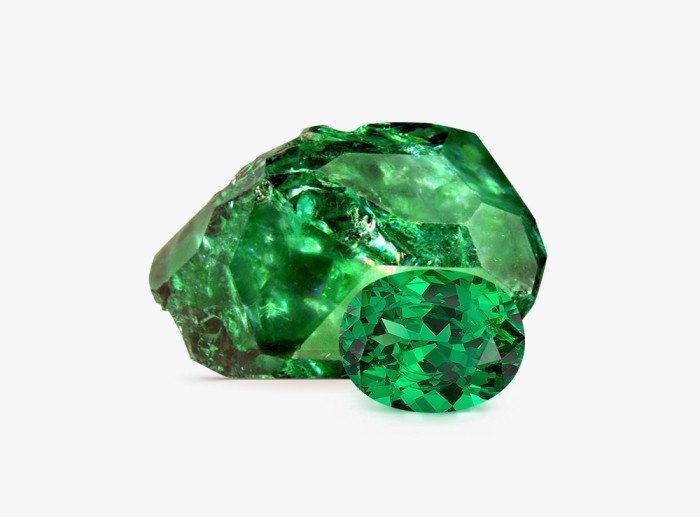
- Chrome-bearing sphene from Myanmar can show an emerald-like green that fluoresces a ghostly glow.
- Collectors who value optical fire and dispersion over hardness
- Pendant and earring shoppers where ring-wear durability is not needed
- Buyers seeking a rare green alternative to tsavorite or demantoid garnet
- Fine jewelry lovers who want a stone that looks unlike anything mainstream
- Readers drawn to heart and solar plexus stones with a kinetic, living glow
- Daily-wear ring buyers: at Mohs 5 to 5.5 sphene chips easily, try tsavorite garnet
- Active lifestyles and sport settings: sapphire or spinel are safer
- Budget shoppers wanting rainbow fire: consider faceted zircon or moissanite
What Is Sphene?
Sphene is the traditional gemological name for titanite, a calcium titanium silicate with the formula CaTiSiO5. Its gem-trade name refers to the Greek “sphenos” (wedge) because its crystals often grow as sharp wedge-shaped forms. The International Mineralogical Association prefers “titanite” as the species name, but “sphene” remains standard in the jewelry trade.
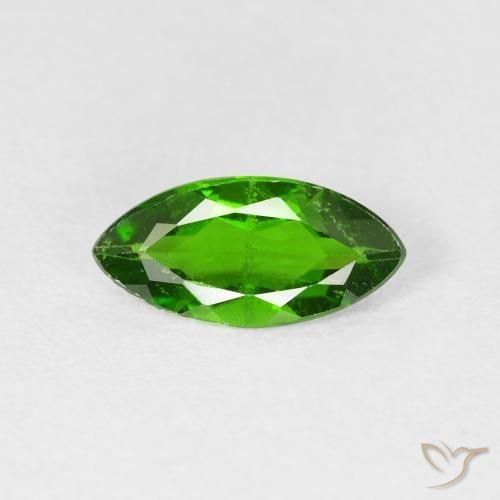
Color ranges from vivid grass green through golden yellow, honey brown, and occasionally orange or near-black.
What makes sphene remarkable is its optical physics. Its refractive index sits approximately between 1.843 and 2.110, with a birefringence near 0.105 (the highest of any well-known gem), and a dispersion of about 0.051 - higher than diamond’s 0.044.
That dispersion produces dramatic rainbow fire in well-cut stones, especially pear and brilliant cuts. The downside is Mohs hardness of 5 to 5.5, which makes sphene soft enough that it is typically reserved for protected settings or occasional-wear pieces.
Sphene forms in calcium-rich metamorphic rocks and in some alkaline igneous settings, usually as an accessory mineral alongside pyroxenes, amphiboles, and feldspars. Gem-quality material has historically come from Madagascar, Pakistan’s Skardu region, Myanmar’s Mogok Valley, Brazil, Mexico, and smaller deposits in Russia and Canada.
Cutters must work around the strong birefringence, which can produce visible facet doubling if the table is oriented incorrectly.
How Sphene Compares
| Property | Sphene | Tsavorite | Demantoid Garnet |
|---|---|---|---|
| Hardness | 5 - 5.5 | 7 - 7.5 | 6.5 - 7 |
| Price / carat | $$ Mid-range | $$$ Premium | $$$ Premium |
| Dispersion | 0.051 (high) | 0.028 | 0.057 |
| Best For | Pendants, earrings | Rings, daily wear | Collector jewelry |
Meaning and Symbolism
Because sphene was only isolated as a distinct gem species in the late eighteenth century, its meaning in crystal healing tradition is relatively young. It has been absorbed into the green-stone lineage of prosperity, growth, and heart-centered clarity, and into the yellow-stone lineage of willpower and mental brightness.
Practitioners tend to describe sphene as a stone of “living energy,” citing its rainbow fire as a visible symbol of dynamic vitality.
In mineralogical culture, sphene signals a connoisseur’s palate. Collectors seek it for the same reasons they seek demantoid or benitoite: technically interesting optics, a soft but rewarding color, and a pedigree that rewards people who have already worked through the mainstream gem list.
The stone appears repeatedly in museum collections, especially specimens from Madagascar’s Ihosy area and Pakistan’s Skardu region, and in scientific literature for its use as a uranium-lead dating mineral in geology.
Practitioners associate sphene with what they describe as mental and emotional agility. Many find the stone is said to support learning, problem-solving, and creative synthesis - anything that benefits from quick, multi-angle thinking.
Traditionally associated with Mercury in astrological symbolism, it has long been used as a study companion stone and is often recommended to readers in fast-moving careers.
Historical Timeline
Healing Tradition
Emotional
Practitioners believe sphene is said to encourage mental agility, curiosity, and creative synthesis. Many find the stone useful during study sessions, brainstorming, or any task that benefits from seeing many angles at once.
In crystal healing tradition, sphene has long been described as a stone of living energy that is said to shake off mental fog and restore the small, curious spark that gets buried under routine. Practitioners often recommend it for readers returning to school, switching careers, or starting a creative project.
Some describe it as supportive during transitions because its kinetic fire is said to mirror the feeling of being in motion. None of these associations are medical claims, and sphene is offered as a traditional supportive companion, not a therapy replacement.
Spiritual
Sphene is traditionally associated with the heart and solar plexus chakras, bridging the energy centers of love and willpower. Practitioners believe the stone is said to help align what you love with what you are willing to act on, resolving the gap between feeling inspired and taking the first step.
In folklore it has been linked to the planet Mercury, making it a natural companion for communication, writing, and teaching practices. Some crystal workers use sphene in grids aimed at new projects or seasonal transitions, pairing it with clear quartz amplifiers and moss agate for grounded growth.
Sun exposure is fine for sphene, and some practitioners briefly sun-charge the stone on a windowsill to refresh what they describe as its vitality.
Physical
In crystal healing tradition, sphene has long been used as a companion stone for mental focus, eye strain relief during long study sessions, and general vitality during recovery from burnout. Practitioners believe it is said to support clarity during moments of fatigue and is sometimes held during breaks from screen work.
Some traditions extend its associations to liver and metabolic health because of its yellow-green range. None of these associations constitute medical claims. Sphene is offered as a traditional ritual tool rather than a treatment, and any physical symptom should be evaluated by a licensed healthcare provider rather than managed with a stone.
Zodiac, Birthstone and Gifts
Sphene is often recommended for Gemini and Virgo, the two Mercury-ruled signs. Practitioners believe the stone is said to complement Gemini’s quick mind and Virgo’s analytical nature, adding a touch of warmth and kinetic fire to what can otherwise be a purely intellectual energy.
For Gemini, sphene is traditionally offered as a study and communication companion. For Virgo, it is associated with creative synthesis and is said to help balance precision with joy. It is also popular with artists, writers, and teachers born under any sign who want a stone that visibly mirrors mental motion.
Care and Cleansing
Safe cleansing methods for sphene include brief moonlight exposure on a windowsill, sound cleansing with a singing bowl or bell, and placing the stone on a selenite plate overnight. Sunlight is generally safe for short periods because sphene is not known to fade, although prolonged heat should be avoided.
A brief rinse under cool running water is fine, followed by a soft, dry cloth.
Avoid salt burial because sphene is soft enough for salt grains to abrade the polish, and ultrasonic cleaners because internal inclusions can fracture. Skip harsh chemical cleaners and never expose the stone to sudden temperature changes.
For spiritual cleansing, many practitioners prefer a smoke cleanse with rosemary, cedar, or mugwort, which requires no moisture or heat and is friendly to the stone’s delicate surface.
- DO store sphene separately from harder gems like sapphire, spinel, and diamond.
- DO NOT use ultrasonic or steam cleaners on sphene under any circumstances.
- DO remove sphene jewelry before manual work, sports, or heavy cleaning.
- DO NOT leave sphene in salt burial cleansing rituals.
- DO choose bezel or halo settings for sphene rings to protect edges.
- DO NOT expose sphene to sudden temperature changes, which can fracture included stones.
- Note: small children may find the dispersion mesmerizing; supervise young handling.
Real vs Fake
The strongest identifying feature of natural sphene is its extreme birefringence, which produces visible doubling of back facets when you look through the stone with a loupe.
No common imitation shows this effect; it is a near-unique gemological fingerprint for sphene and zircon, and sphene’s color range is more yellow-green than typical zircon. Refractive index (approximately 1.843 to 2.110) and specific gravity (approximately 3.48 to 3.60) are diagnostic when measured in a lab.
Sphene may be confused with chrome tourmaline, peridot, tsavorite garnet, and demantoid garnet in the green color range, or with chrysoberyl and heliodor in yellow tones. Dispersion is the giveaway: few other gems produce sphene’s level of rainbow fire.
Under a loupe, many natural sphenes show included needles, fingerprint inclusions, and occasional two-phase inclusions, all reassuring signs of natural origin.
Synthetic sphene has been grown in laboratories for research purposes but is not common in the jewelry market, so most sphene offered for sale is natural. Glass imitations fail the doubling test immediately.
For stones above roughly $500 total, ask the seller for origin information, any treatment disclosure, and ideally a short lab report from an independent gemological lab, or a reputable regional lab. Reputable sellers disclose treatments and origin in writing.
Sphene Jewelry & Gifts
Expect to pay approximately $100 to $300 per carat for pleasant yellow-green commercial sphene under two carats, $300 to $600 per carat for vivid green and saturated golden stones in the two to five carat range, and $600 to $1,500 per carat for top-tier chrome-green material or large clean specimens.
Stones above five carats with top color are rare and trade accordingly. Pricing is driven by color saturation first, then clarity and cut, and finally carat weight.
Treatments are uncommon: most sphene reaches the market in its natural state. Heat is occasionally used to lighten overly dark brown stones, and should be disclosed. Look for stones cut deeper than you might expect, because cutters must work around the strong birefringence. A well-oriented table minimizes visible doubling and maximizes brilliance.
Recutting poorly oriented stones is common for high-grade rough.
Where to Buy Sphene
Affiliate disclosure: Some links below earn us a small commission at no extra cost to you. See our affiliate disclosure page.
Handmade, raw, and tumbled pieces from independent sellers worldwide.
Shop Sphene on Etsy →Accessories, tools, and specimen sets with fast Prime delivery.
Shop Sphene on Amazon →Certified loose gemstones graded and photographed for online buyers.
Shop Sphene on GemSelect →Pairs Well With



Where Sphene Is Found


