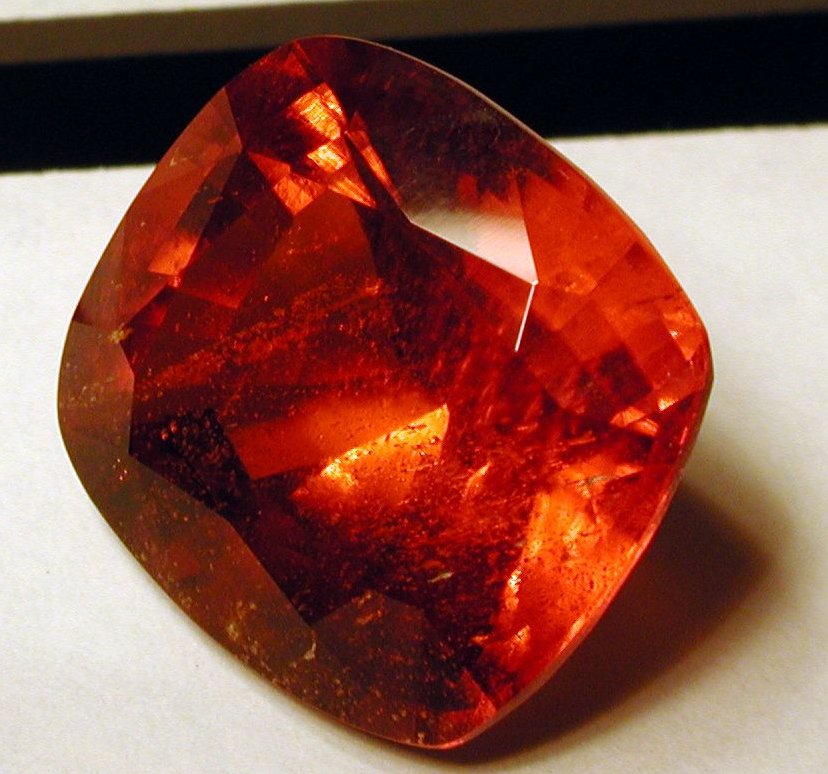
Clinohumite
Clinohumite is a warm orange gem so rare it appears at perhaps a handful of gem shows worldwide each year.
- Gem-quality faceted clinohumite is rarer by annual production than alexandrite - only a small number of clean, facetable pieces reach the market each year.
- The Pamir Mountains of Tajikistan, clinohumite's primary source, are the geological meeting point of three major tectonic plates - one of Earth's most extreme metamorphic environments.
- Clinohumite was first described from volcanic ejecta on Mount Vesuvius in Italy - gemological material from the Pamirs was unknown for decades afterward.
- The orange color in clinohumite comes from iron-titanium charge transfer - the same mechanism that gives some blue sapphires their color, operating in a different compositional context.
- Clinohumite belongs to the humite group of minerals, named collectively for Sir Abraham Hume - a group that includes chondrodite, humite, norbergite, and clinohumite itself.
- Advanced gem collectors seeking one of the rarest faceted stones in the world
- Orange gem enthusiasts who have exhausted common options like sapphire or spessartite
- Investment-oriented buyers willing to hold for long-term scarcity appreciation
- Practitioners drawn to fire-element energy and the warmth of orange sacral chakra stones
- Connoisseurs who appreciate geological provenance (Pamir Mountains origin)
- Everyday jewelry wearers - Mohs 6 is too soft for ring wear; use spessartite garnet (Mohs 7-7.5) instead
- Budget buyers or those new to collecting rare gems - entry price for quality faceted material is high
- Those wanting a recognized or named gem - clinohumite has no consumer brand recognition outside specialist collectors
What Is Clinohumite?
Clinohumite is a magnesium nesosilicate mineral of the humite group, with the formula Mg₉(SiO₄)₄(F,OH)₂. It was first described in 1876, named for British mineralogist Abraham Hume. It rates 6 on the Mohs hardness scale.
The mineral forms in the monoclinic crystal system and appears in colors ranging from colorless to pale yellow, orange, reddish-orange, and brown - the orange variety being the most commercially and aesthetically significant. The warm orange color results from iron and titanium impurities within the magnesium-silicate lattice.
Gem-quality transparent clinohumite is extraordinarily rare - rarer by most estimates than tanzanite and approaching the scarcity of fine alexandrite. The primary source for facetable material is the Pamir Mountains of Tajikistan, particularly in forsterite marble deposits formed during extreme metamorphic events at great depths.
Russian Ural specimens and Finnish material from skarn deposits also exist but in minimal commercial quantities. Myanmar (Burma) has produced small amounts of brownish material.
Clinohumite's Mohs hardness of 6 places it at the lower end of gem-quality stones - harder than apatite but softer than quartz. For faceted collectors who will not wear the stone daily, this is acceptable.
The refractive index of approximately 1.629 to 1.674 gives faceted stones moderate brilliance with a warm, honeyed orange luster. Specific gravity of 3.17 to 3.35 is in the normal range for silicate minerals. The mineral is naturally included in many specimens, making eye-clean examples especially valuable.
How Clinohumite Compares
| Property | Clinohumite | Spessartite Garnet | Imperial Topaz |
|---|---|---|---|
| Rarity | Extremely rare | Rare (fine quality) | Rare (fine quality) |
| Hardness | 6 | 7 - 7.5 | 8 |
| Price / carat | $$ Mid-range | $$ Mid-range | $$ Mid-range |
| Best For | Collector investment | Jewelry + collecting | Jewelry + collecting |
Meaning and Symbolism
Clinohumite is young to metaphysical tradition because it is so rarely encountered - most spiritual practitioners have never held one. Those who work with it draw on its elemental character: the warm, deeply saturated orange of the finest Pamir specimens carries an immediate visceral warmth that practitioners associate with the sacral chakra and the generative fire of creative life force.
The Pamir Mountain origin adds a layer of geological mythology - the Pamirs are one of the world's most remote and dramatic high-altitude landscapes, where tectonic forces have driven ancient seafloor carbonate rocks to extreme metamorphic depths and brought them back to the surface bearing extraordinary minerals.
In the emerging metaphysical literature for rare gems, clinohumite is associated with the joy of pure creative expression - the delight in making and doing that doesn't require external validation.
Its scarcity makes it a stone that few will ever hold, and practitioners who work with it often report the experience as one of deep privilege and presence - the awareness that something remarkable and irreplaceable is briefly in one's hands.
This quality of rare presence is itself said to be its primary teaching: the practice of recognizing and fully inhabiting exceptional moments.
Historical Timeline
Healing Tradition
Emotional
Practitioners believe clinohumite carries a quality of pure, uncomplicated joy - the orange warmth of creative life expressing itself without agenda. Many find it useful when creative blocks, self-doubt, or emotional depletion have dimmed the natural sense of enthusiasm and delight that children experience easily and adults often lose.
In crystal healing tradition, it is said to reconnect the practitioner to the feeling of genuine pleasure in the act of creating or doing, independent of results or recognition. Its fire-element character is associated with the generous, solar quality of warmth that radiates outward rather than the consuming fire that burns inward.
Spiritual
In spiritual practice, clinohumite is said to activate the sacral chakra's connection to life force and creative generativity - not sexuality specifically, but the broader principle of vitality that generates new forms.
Practitioners believe it supports those whose spiritual work has become dry or overly cognitive, restoring warmth and embodied presence to practices that have lost their felt sense.
The stone's geological origin in extreme metamorphic depths (deep marble crystallization under millions of atmospheres of pressure) is said to model the spiritual principle that the most luminous qualities emerge from the most intense pressure - that transformation is the source of radiance.
Physical
Crystal healing tradition connects clinohumite's orange fire energy to physical vitality, sexual and reproductive health in the energetic body, and the body's natural capacity for pleasure and warmth. Practitioners believe it supports those experiencing physical fatigue or disconnection from bodily sensation by restoring energetic warmth to the lower chakras.
Some energy workers use orange stones including clinohumite near the lower abdomen during sacral chakra work to encourage energetic flow and ease of physical expression. Crystal practice is complementary to, not a substitute for, qualified medical care.
Zodiac, Birthstone and Gifts
Clinohumite's solar warmth, fire-element character, and association with generous creative expression align naturally with Leo's solar rulership and the sign's characteristic radiance. Leo practitioners may find it amplifies their natural gift for joyful self-expression while encouraging the sign to enjoy the creative process itself rather than performing for recognition.
Sagittarius connects through the fire element and Jupiter's expansive warmth - both the planet and the sign share clinohumite's quality of abundant generosity and the desire to extend light outward.
For Sagittarius practitioners, clinohumite may support the philosophical adventurousness that defines the sign by keeping that exploration grounded in physical warmth and embodied joy.
Care and Cleansing
Clinohumite is relatively stable chemically and tolerates most cleansing methods. Brief water rinsing is safe for polished specimens. Avoid prolonged water soaking as a precaution, and avoid strong salt exposure which could potentially affect the fluorine content at the surface over extended periods.
Sound cleansing with a singing bowl or bells is ideal for faceted stones where any abrasion risk should be minimized.
Sunlight for brief periods (15-30 minutes) is generally safe, though extended exposure to intense UV is avoided as a precaution since iron-bearing orange stones can occasionally show slight color shifts over years of sustained strong UV exposure. Moonlight overnight is perfectly safe and symbolically appropriate for this warm, receptive sacral stone.
Smudging with sage or palo santo effectively clears energetic residue without any physical contact risk.
- DO NOT wear clinohumite in rings - Mohs 6 will show scratches quickly in daily abrasion.
- DO store in a soft pouch or padded compartment away from harder stones (quartz and above) that will abrade the surface.
- DO NOT use ultrasonic or steam cleaners - vibration and heat can affect inclusions in faceted material.
- DO clean with a soft damp cloth only - avoid abrasive cloths or polishing compounds.
- NOTE: Clinohumite is rare enough that replacement is difficult or impossible for unique specimens - treat accordingly.
- DO avoid prolonged direct sunlight for set stones as a precaution against potential gradual color shift.
- DO obtain laboratory certification for any significant purchase - its rarity makes misidentification common among non-specialist sellers.
Real vs Fake
Clinohumite is rarely directly faked but frequently misidentified or misrepresented. The most common misidentification is golden beryl (heliodor) or yellow-orange sapphire being sold without accurate species identification.
Laboratory testing with a refractometer confirms clinohumite by its refractive index range (1.629-1.674) and biaxial optical character, distinguishing it from beryl (1.57-1.58 biaxial), spinel (1.71-1.72 isotropic), or corundum (1.76-1.77 uniaxial).
Genuine Pamir clinohumite typically shows characteristic inclusions visible under magnification: fine needles, two-phase inclusions, and growth tubes aligned with the monoclinic crystal structure. The fluorine in the mineral formula sometimes produces characteristic cleavage traces in crystals.
Specific gravity of 3.17-3.35 is in the normal silicate range and not particularly diagnostic, but it eliminates glass imitations which are much lighter.
For any clinohumite purchase above $200 per carat, a laboratory report from gemological laboratories, Gübelin, or equivalent institution confirming the species and natural origin is strongly recommended. The stone's rarity makes it worth the authentication cost.
Tajikistan (Pamir) origin can sometimes be confirmed by characteristic inclusion patterns and geochemical signatures, adding locality premium value.
Clinohumite Jewelry & Gifts
Clinohumite is evaluated primarily on color saturation and clarity. The finest specimens show a pure, vivid orange similar to a fine spessartite garnet - deeply saturated without brownish modifiers. Eye-clean or nearly eye-clean material commands the highest premiums. Stones above 2 carats with good clarity are rare enough to be investment-caliber.
Commercial prices for faceted Tajik clinohumite typically run $200-$600 per carat for good quality, and $600-$2,000+ per carat for exceptional color and clarity in larger sizes (3 carats+). Rough material for collectors is sometimes available at $50-$150 per gram for well-crystallized material.
Most material on the market is below 2 carats due to limited clean rough.
Clinohumite is not known to receive any standard treatments. The color is entirely natural iron-titanium origin. As a stone with very limited production and inconsistent supply, prices are most reliably established through specialist dealers in collector gems rather than mass-market sources.
Where to Buy Clinohumite
Affiliate disclosure: Some links below earn us a small commission at no extra cost to you. See our affiliate disclosure page.
Handmade, raw, and tumbled pieces from independent sellers worldwide.
Shop Clinohumite on Etsy →Accessories, tools, and specimen sets with fast Prime delivery.
Shop Clinohumite on Amazon →Certified loose gemstones graded and photographed for online buyers.
Shop Clinohumite on GemSelect →Pairs Well With



Where Clinohumite Is Found


